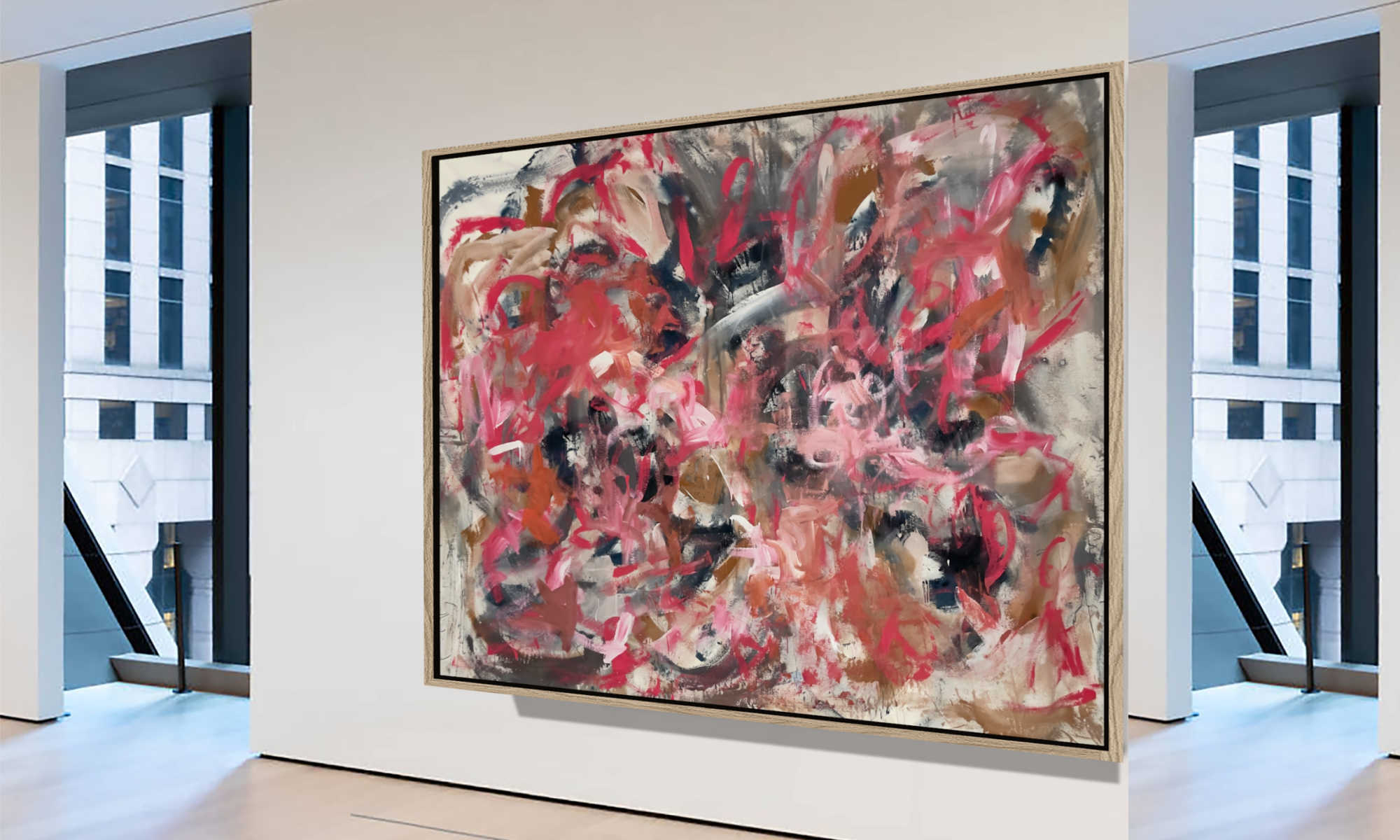
Asking a Painter About Price Has a Better Question Underneath It
In short
Asking is fine. Nobody is insulted. But in a studio that publishes its prices, the question usually has a better one hiding under it — what am I actually paying for? — and that one gets a much more useful answer. Here, price is set plainly by size and medium across the whole body of work, so the number is the same whether you ask warmly or not at all.
Why does the question feel awkward when almost nobody minds it?
Because the art market taught two generations of buyers that the sticker price is a starting position. That convention is real, it is documented, and it belongs to a specific room: the primary-market gallery, where an asking price is quoted privately and a ten percent courtesy is close to conventional wisdom.
A working studio is a different room. When a painter publishes a number on her own site next to her own painting, that number has already been through the only negotiation it is going to have — the one she had with herself about what the work is worth. There is nothing left to shave.
So the awkwardness is inherited from a transaction you are not actually in. It costs nothing to ask, and in this studio it changes nothing either.
What actually sets the number on a painting?
Size and medium, applied consistently across everything. A larger canvas costs more because it took more surface, more material, and more of the physical work that large scale requires — a horizontal working surface, the freedom to approach from all four sides, weeks of layering before the surface settles. A smaller one costs less for the same honest reasons.
What the number is not is a read on you. It does not move because a piece has been available a while, or because someone asked nicely, or because a room has two walls to fill instead of one. Consistency is the whole point: everyone who bought a painting at the published price would have to have overpaid for a discount to mean anything, and that is not a thing a studio can do to the people who trusted it first.
What do collectors and dealers actually say about the ask?
The people closest to the transaction talk about it far more generously than buyers expect. In Artsy's 2018 reporting on discount practice — dated here because the conventions it describes are older than the piece and have outlasted it — Nicelle Beauchene, of the Lower East Side gallery bearing her name, framed the whole mechanism as social rather than financial: "The art world is based on relationships, and the discounts help to keep relationships, and keep people happy."
Alex Mor, of Paris's Mor Charpentier, put the case for flexibility in terms that have nothing to do with haggling: "Some people, they work to buy a work of art, and we have to be honest about it, and use this facility to open up access to the works they want." That is a description of instalments and access, not of a markdown — and it is the most useful thing in the whole conversation for a first-time buyer, because it names the real obstacle.
And the Brussels collector Alain Servais made the argument from the buyer's side of the table: "I know the hard work they're doing defending artists who are not fashionable, and sometimes it's my responsibility not only to buy from them, but not to request discounts."
None of those three is saying the ask is rude. All three are saying it is a relationship question rather than a price question — which is exactly why a published number is a kindness. It takes the relationship out of the arithmetic and leaves it where it belongs.
Why are more buyers having this conversation than ever?
Because the studio is now a real sales channel rather than a romantic one. The Art Basel and UBS Global Art Market Report 2026, the tenth edition, authored by Dr. Clare McAndrew of Arts Economics and published this March, found that buying directly from artists — through a studio visit, an Instagram message, or a commission — more than trebled as a share of collector spending, to twenty percent. In the same survey, artist studio visits rose in attendance more than any other kind of art event, ahead of exhibitions, biennials, auctions and fairs.
That is a lot of new conversations happening without a script. The etiquette question is not a sign of inexperience. It is a sign of a channel growing faster than its manners.
Is buying an original from someone you have never met actually safe?
That is the same buyer's next question, and it is more worth answering than the first one.
The signals that matter are all things a real studio can produce on request and a scam cannot. A named artist with a findable body of work and a press record you can check. Video of the actual painting moving in real light before it ships — not a photograph, which flattens surface, but footage where the built-up passages catch and release the light as the camera moves. Direct correspondence with the person who made it, answering questions about materials that only the maker could answer. Documentation that comes from the studio rather than from a listing.
Michael Kimmelman, the New York Times critic, wrote that "the time spent looking and thinking about a work is often proportionate to the effort made to get to it." Buying online inverts that — the effort is nearly zero, so the looking has to be supplied deliberately, by the studio, before the crate is sealed. That is what a pre-ship video is for.
What is worth asking instead?
Ask what the surface is doing where the photograph cannot show you. Ask what the painting looked like three weeks before it was finished. Ask what happens if it arrives and the wall was wrong about it. Ask whether there is a companion canvas from the same colour story, because there often is, and the second one is frequently the one that belongs to you.
Those questions get answers a working painter can actually give. A discount request gets a polite no and a slightly smaller conversation.
FAQ
Is it rude to ask an artist for a discount? No. Most artists are not offended and will simply tell you their pricing structure. In studios that publish prices by size and medium, the answer is that the number is fixed and applies to everyone — which is the point of publishing it.
How do artists usually price original paintings? Most working painters price consistently by size and medium across their whole body of work, so a larger canvas costs more than a smaller one in a predictable way. Consistency protects everyone who has already bought.
Is it safe to buy an original painting online without seeing it in person? It is, when the studio supplies real trust signals: a named artist with a checkable record, video of the actual work moving in real light before shipping, direct communication with the maker, and documentation from the studio itself.
Do prices differ between a gallery and an artist's own studio? They can, because different channels carry different costs and presentation. The useful thing for a buyer is not comparing the two but knowing which one you are in — a published studio price has already settled the question a quoted gallery price leaves open.
See available original work — or start a conversation about a commission.