Should You Buy Art Directly From the Artist or Through a Gallery?
TL;DR: Should you buy art directly from the artist or through a gallery? Buying directly from the artist usually means a clearer price, a relationship with the person who made the work, documentation that comes straight from the studio, and the painting handled canvas-to-wall by one hand. A gallery adds curation, a second set of eyes, and a vetted secondary-market record. For a living artist's original, buying direct gives you the maker, the provenance, and the story without a layer in between. Here is the honest trade-off.
Angela Simeone is a Nashville-based contemporary abstract painter whose boutique luxury wallpaper line is created from her own paintings and composed — through her artistic and editorial eye — into layered, original, chic patterns, printed on a single luxurious 20 oz vinyl that looks like raw silk with a glimmering sheen, sold direct and to the trade.
Should you buy art directly from the artist or through a gallery?
If you are buying an original by a living artist to live with, buying directly from the studio is often the most straightforward path: you see current prices, you talk to the person who made the work, and the painting reaches your wall through a single chain of custody. A gallery earns its role differently — by curating, by representing an artist over time, and by standing behind a piece on the secondary market. Both are legitimate. The right answer depends on what you most want: the relationship and the clarity, or the curation and the resale infrastructure.
I sell my work directly — no gallery representation — so my studio handles everything from canvas to wall. You can see every available original, with prices, in the paintings available now collection, and a commissioned piece begins on the commission page.
What do you gain by buying directly from the artist?
Four things, mostly: price clarity, the maker, the paperwork, and the handling. Buying direct usually means a transparent number rather than "price on request." It means you can ask the artist why a surface was scraped back or what a color is doing — questions a working painter can actually answer. It means your documentation (a signed verso, a certificate of authenticity, an invoice) comes straight from the source. And it means one studio is responsible for framing, delivery, and install, instead of a piece changing hands several times. For many collectors, that direct line to the maker is the whole point.
"Meet artists, drink with them, dance with them, visit their studios, ask questions. If you love the work and connect with the artist, buy it." — Rodrigo Padilla and Elliott Trice, collectors (Cultured, April 2026)

What does a gallery give you that a studio doesn't?
A good gallery is a curator and an advocate. It filters — you are seeing work someone with a trained eye chose to show. It builds an artist's record over years, and it often participates in the secondary market, which can matter if resale is part of your thinking. Those are real services, and for blue-chip or estate work, the gallery (or auction house) is frequently the only responsible way to buy, because provenance and authentication are the whole transaction. The trade-off is the layer itself: another set of hands, a markup you may not see itemized, and sometimes the "inquire for price" friction that sits on the gallery, not on the studio.
"Don't be afraid to ask questions. People in the art world are far more generous with their knowledge than you might expect, especially if they can see you're genuinely curious." — Will Bennett, collector (Cultured, April 2026)
Is buying direct riskier?
It doesn't have to be, as long as the studio behaves like a professional one. The things that make a direct purchase safe are the same things that make any purchase safe: a verifiable artist with a real body of work and press, a signed and documented piece, clear images in real light, a written invoice, and transparent shipping. My studio sends multiple pre-ship videos of every finished work, signs and documents each piece, and ships rolled to a framer local to you, stretched on arrival and hand-delivered ready to hang. If you want an outside primer on buying with confidence, the editors at Artsy offer a level-headed, non-salesy guide.
"Don't try to impress anyone. Buy what moves you. And live with it — the relationship with an artwork evolves over time." — Suzanne Syz, collector (Cultured, April 2026)
Do interior designers buy direct or through a gallery?
Often direct, because the studio can offer what a project needs: trade pricing, sizes, transparent-background images, forwardable tear sheets, and an artist who handles framing, delivery, and install. Verified designers and firms receive 20% off retail through my trade program, and for large public spaces — lobbies, atriums, restaurants — the studio works canvas-to-wall on the commercial and hospitality side. Buying direct lets a designer keep the chain of custody short and the documentation clean for their client.
"Buy what you love and invest time in getting to know the work of emerging artists." — Sandy and Stephen Perlbinder, collectors (Cultured, April 2026)
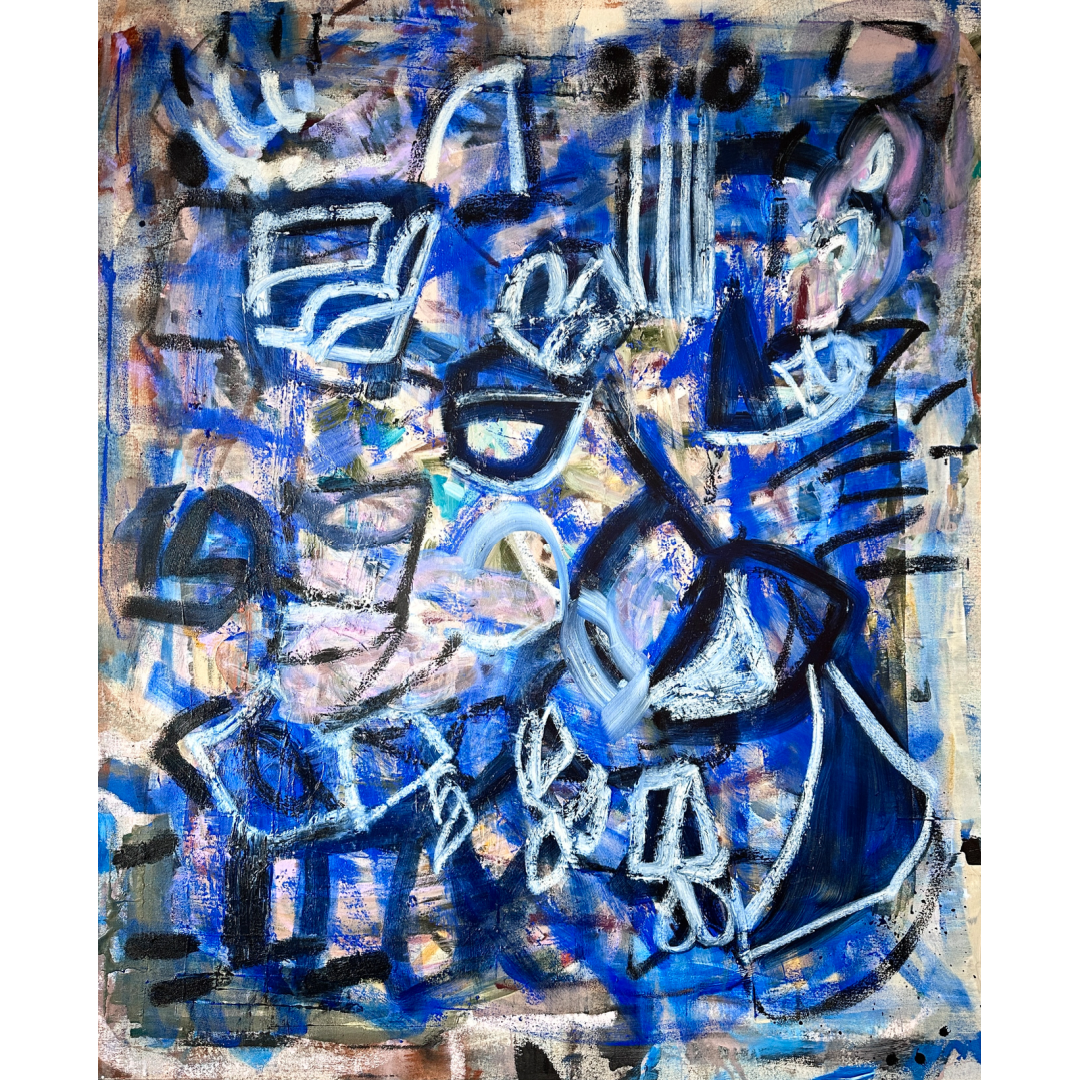
If you are torn, here is the plain version: for a living artist's original you intend to keep, buying direct gives you the maker, the paperwork, and the price in one conversation. A piece like Royal Blue White Lilac ($6,850) or Light Pink Light Green Charcoal White ($6,800) comes to your wall through a single hand — mine.
"Pull the trigger. Buy something you love and hang it on your wall. Even if that artist doesn't become super famous, you're going to love living with the work and you are going to discover more about yourself and your world." — Rob and Eric Thomas-Suwall, collectors (Cultured, April 2026)

FAQ
Is it cheaper to buy art directly from the artist? Not always, but it is usually clearer. A direct purchase typically shows you a transparent price instead of "price on request," and you deal with one party rather than a markup you can't see.
What should a direct purchase from an artist include? A signed work, a certificate of authenticity, a written invoice, real-light images or pre-ship video, and clear shipping terms. My studio provides all of these and ships hand-delivered, ready to hang.
When is a gallery the better choice? For secondary-market, estate, or blue-chip work where provenance and authentication are the transaction, a gallery or auction house is usually the responsible path.
Do designers get trade pricing buying direct? Yes — verified designers and firms receive 20% off retail, with sizes, tear sheets, and white-glove logistics handled by the studio.
Ready to buy from the source? Browse original paintings available now with current prices, or start a commission at angelasimeone.com.
Sources: Cultured, "15 Collectors Offer Their Best Advice For Getting Started" (April 3, 2026) — quotes from Rodrigo Padilla & Elliott Trice, Will Bennett, Suzanne Syz, Sandy & Stephen Perlbinder, and Rob & Eric Thomas-Suwall; Artsy, "How to Buy Your First Artwork." Studio policies per the Angela Simeone studio.