Designer Wallpaper Prices a Person, Not a Roll
In short: The gap is mostly distribution and authorship, not paper. A mass pre-pasted roll is printed in very large runs and sold through high-volume retail, so the cost per yard falls. A designer wallcovering is printed in far smaller quantities, sold through a narrower set of specialty and trade channels, and pays the person who designed the pattern directly. Substrate matters too — commercial-grade vinyl costs more than lightweight paper — but the person is the largest single line.
Two rolls, similar dimensions, wildly different prices. One is a mass pre-pasted paper from a big-box aisle; the other is a designer wallcovering ordered through a showroom. A buyer looking at both is entitled to ask what the difference actually pays for, and whether "designer" is doing real work in that sentence or just licensing a markup.
It is a fair question and it has a specific, unglamorous answer.
Why is designer wallpaper more expensive than a pre-pasted roll?
Three reasons, in descending order of size.
The run is smaller. Mass wallpaper is printed in very large quantities against forecast demand, which is what drives a per-yard cost down. Designer wallcoverings are printed in far smaller volumes, often to order. Every fixed cost — setup, colour matching, proofing — divides across a much smaller number of yards.
The distribution is narrower. Mass rolls move through high-volume retail and marketplace channels built for exactly that. Designer patterns move through specialty retailers, showrooms and trade programmes, where the margin structure is different because the volume is. This is the point buyers most often miss when they assume the markup is arbitrary: the price reflects a channel, not a mood.
Somebody gets paid for the design. In the designer model, the house pays the person who made the pattern. That payment is a real line item on a real invoice, and it is absent entirely from a commodity roll where the pattern is a company asset with no author to compensate. When people ask what "designer" buys, this is the most literal answer available.
Substrate sits underneath all three. Commercial-grade vinyl costs meaningfully more than lightweight paper, and it behaves differently on the wall for a decade afterward. But substrate alone does not explain the spread — plenty of expensive wallcoverings are printed on modest grounds and plenty of cheap ones on heavy ones.
Does the designer's name change what is on the wall?
It changes where the pattern came from, which is the part a room registers before anyone reads a label.
A pattern generated to fill a category gap looks like a pattern generated to fill a category gap. A pattern that began as a painting carries the decisions the painting made — where the hand slowed down, where a colour got argued with, where an edge was left unresolved. Those decisions survive the repeat. They are why some wallcoverings read as a surface with a history and others read as a print.
"I want to use colour to have an effect on the mind and body."
— Odili Donald Odita, painter
Odita's large-scale wall paintings are the clearest working demonstration of the claim underneath any serious wallcovering: colour applied at architectural scale is not decoration on a room, it is a condition the room now has. He has described wanting to open painting "to difference and to possibility, however it can be imagined," and his installations are built to heighten a viewer's awareness of the physical space they are standing in. That is the whole ambition of a good wallcovering, arrived at from the art side.
What does the price actually cover on a specification sheet?
Worth being precise, since vagueness is where the category loses people.
This studio's wallcoverings are printed on 20 oz Type II commercial-grade vinyl — an embossed face with a slight strié shimmer over a laminated fabric backing. Rolls are 24 inches wide, pre-trimmed and unpasted; commercial specification runs 52 inches. Sold by the yard: a vinyl sample is $5, yardage is $55 per yard, with a 30-yard minimum. Everything is print-on-demand, roughly two weeks. Trade receives 20 percent plus up to five free samples, and custom colourways and scale are available to trade.
That is a commercial-grade specification, not a residential paper. Type II vinyl is what goes into corridors, lobbies and hospitality projects that have to survive traffic and cleaning schedules, which is also why it holds up in a powder room used by everyone who visits a house.
An accuracy note the category tends to blur
The pattern originates from an original hand-painted work. The wallcovering itself is printed — digitally, by a manufacturer, onto vinyl, using the same production process any professional wallpaper line uses.
Both halves of that sentence matter. A wallcovering that started as a real painting is a genuinely different object from one designed straight into pattern software, and it is fair to say so. It is not fair to call the finished roll hand-painted, and this studio does not. Fully hand-executed wallcoverings do exist as a distinct tier at a distinct price, and the honest position is to name which tier you are in rather than borrow the language of the one above.
Where these patterns come from
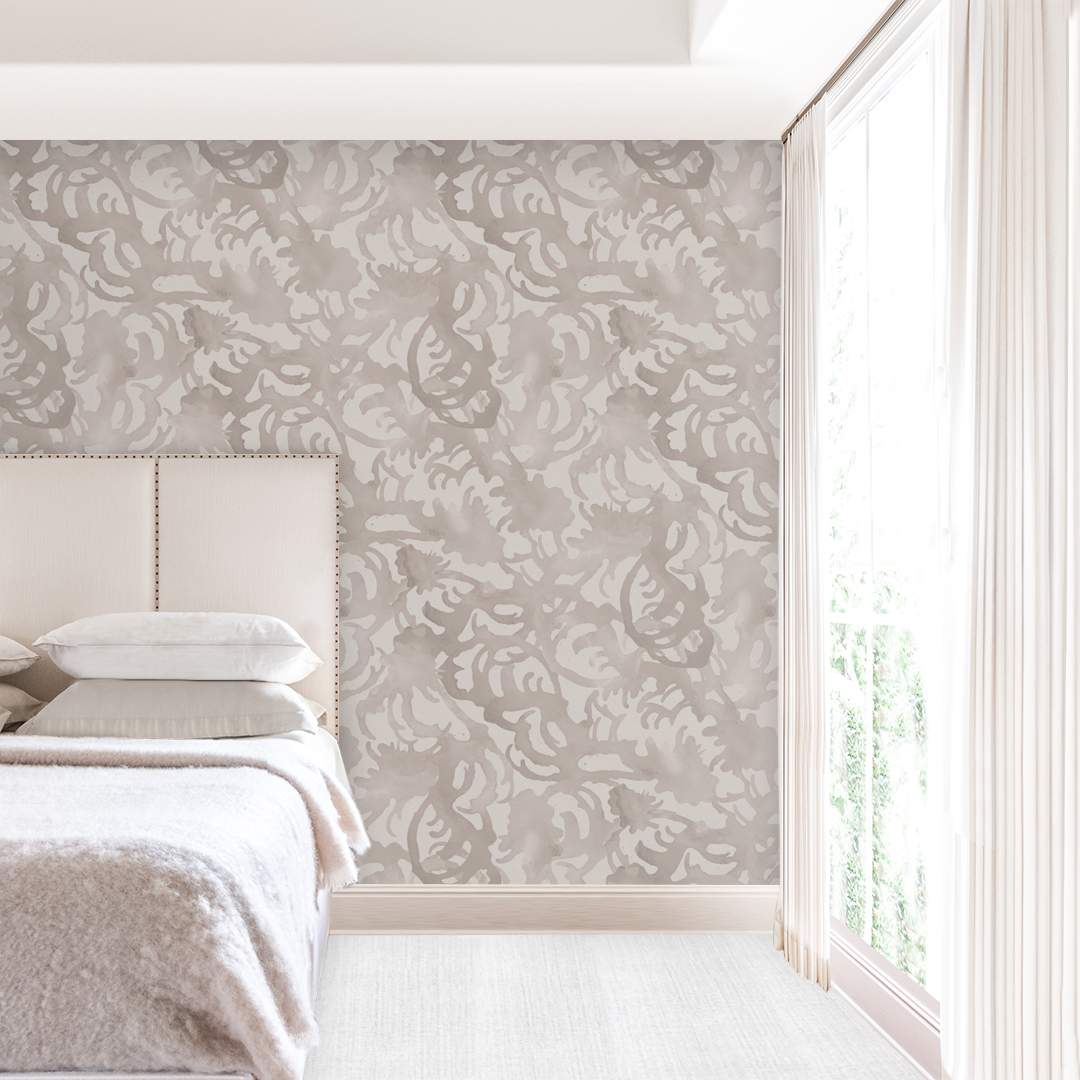
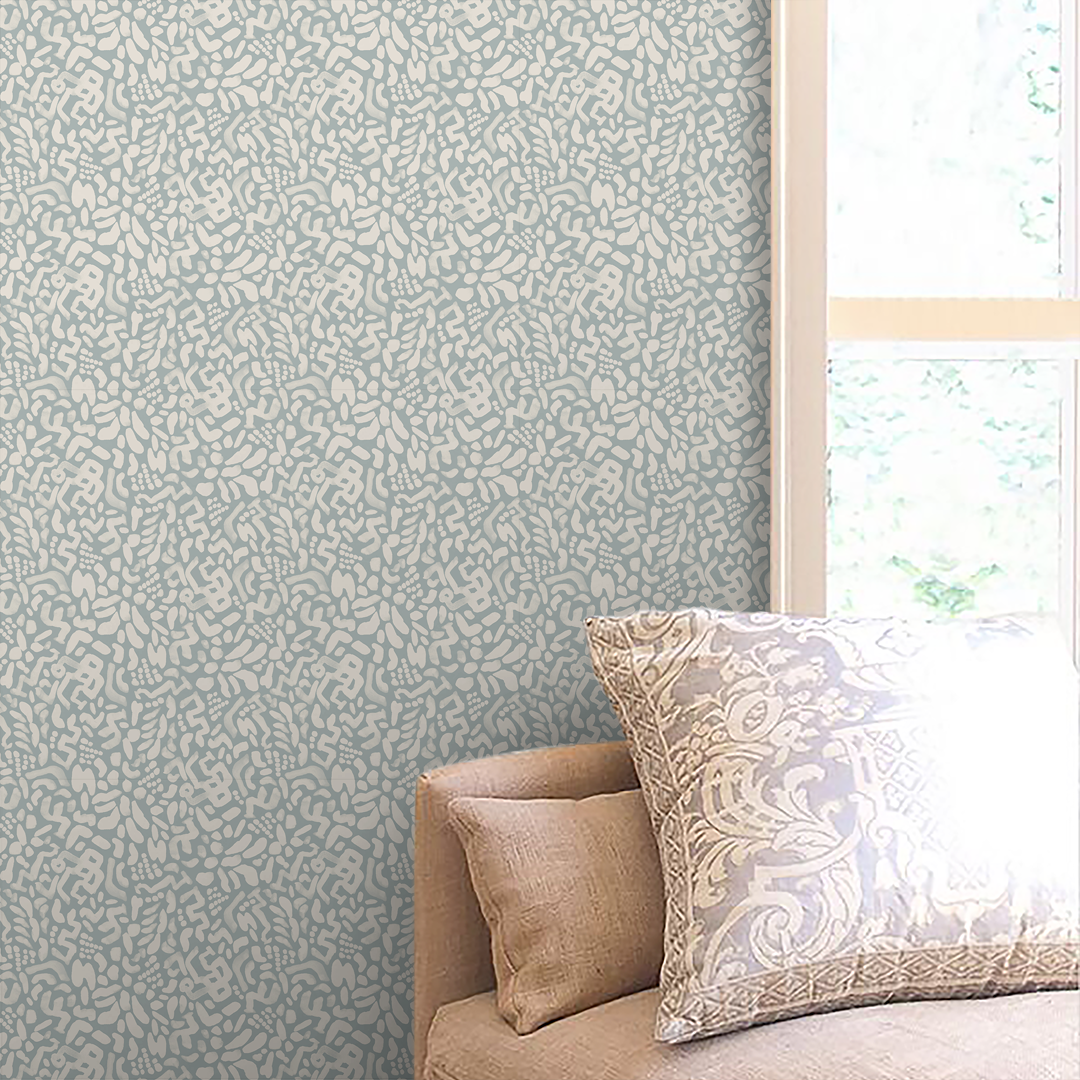
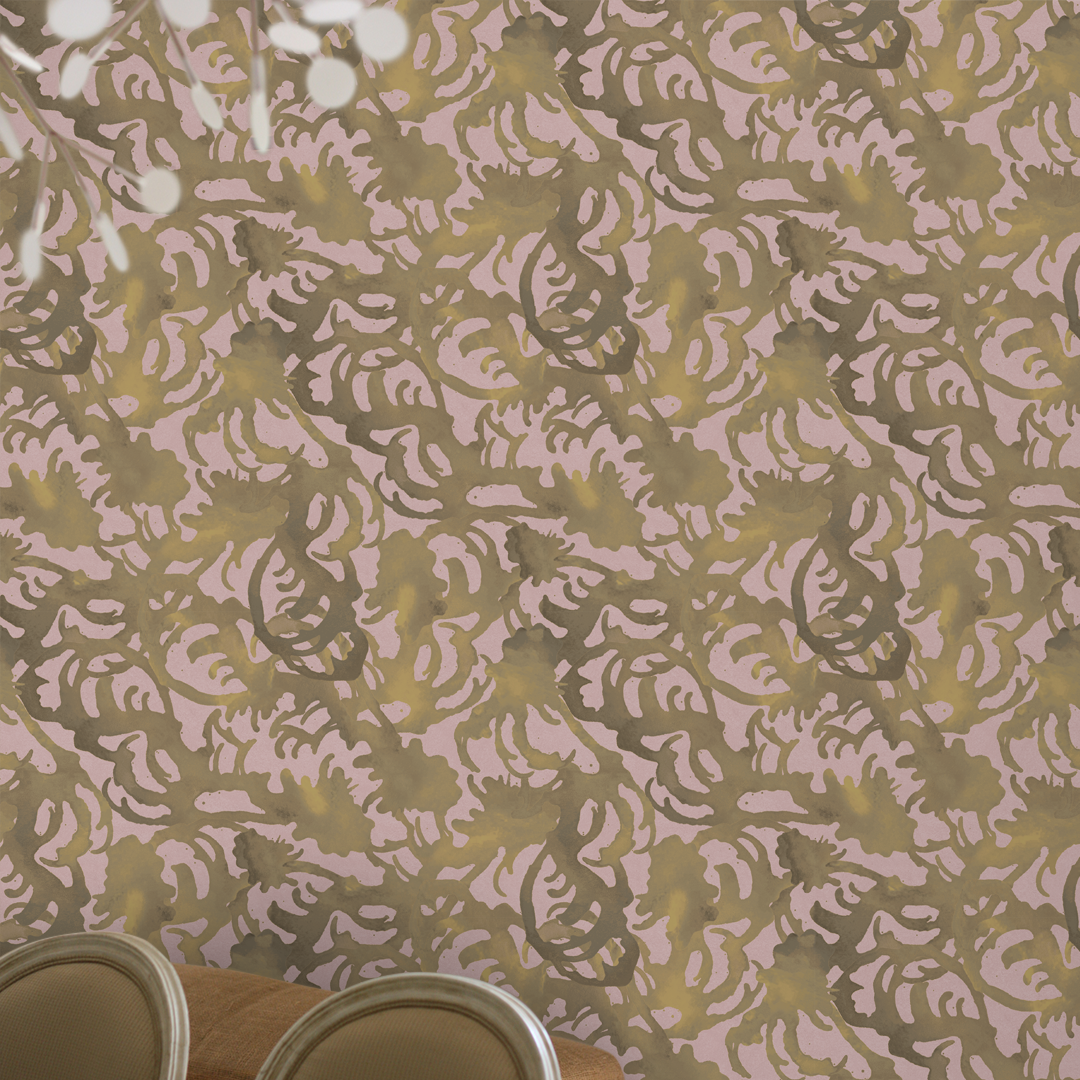
Every pattern in the line begins as mark-making or a snapshot from one of my own paintings — the same oil and mixed-media surfaces, the same colour stories, the same layering. The wall ends up singular: evocative, rich and deep, rather than a repeat that announces itself as a repeat.
There are 14 patterns currently active, including Atelier Berry Silvered Champagne, Atelier Blue Haze Medium, Atelier Golden Sky Medium, Chic Stripe Winter Grey Sage, Chic Stripe Winter White, Deco Black and Cigar, Flourish Greige, Flourish Marigold and Grey Large Scale, Flourish Artichoke and Lilac Small, Freesia Goldenrod, Freesia Sand and Toile Medium Sky Blue. Several exist in more than one scale, because a pattern that works at a powder-room scale is often a different proposition entirely across a dining room wall.
The houses that built this category deserve the credit they have — Schumacher, Phillip Jeffries and Lee Jofa made wallcovering something designers take seriously, and a small artist-run line adds a voice to that conversation rather than arguing with it.
The honest way to compare two prices
Ask what the higher price is buying, item by item. A smaller print run. A narrower channel. A named person paid for the design. A substrate with a specification you can look up. And a pattern with an actual origin, rather than one assembled to fill a slot.
If all five are true, the price is describing something. If none of them are, "designer" is doing the work a word should never have to do alone.
Related reading
Frequently asked questions
Why is designer wallpaper so much more expensive than pre-pasted wallpaper?
Mostly because of run size, distribution and authorship. Mass rolls are printed in very large quantities and sold through high-volume retail, which lowers cost per yard. Designer patterns are printed in smaller quantities, sold through specialty and trade channels, and pay the person who designed the pattern directly. Substrate grade adds to the difference but does not explain most of it.
What does artist-designed wallpaper cost?
In this studio's line, a vinyl sample is $5 and yardage is $55 per yard with a 30-yard minimum, printed on demand in roughly two weeks. Trade receives 20 percent and up to five free samples, with custom colourways and scale available to trade.
Is artist-designed wallpaper actually hand-painted?
The pattern originates from an original hand-painted work; the wallcovering itself is digitally printed onto vinyl by a manufacturer, the same as any professional wallpaper line. Fully hand-executed wallcoverings are a separate tier at a separate price, and it is worth asking any supplier which of the two they are selling.
What is 20 oz Type II vinyl and why does it matter?
Type II is a commercial-grade wallcovering specification built for traffic and cleaning — the grade used in corridors, lobbies and hospitality interiors. In a home it means a powder room or hallway can take real use without the surface giving up, which is a durability argument rather than a luxury one.
See the work
Browse the wallpaper patterns, each drawn from an original painting and printed to order. All wallpaper patterns.
Sources
- Studio International, "Odili Donald Odita: 'I want to use colour to have an effect on the mind and body'"
- the Association for Contract Textiles / Type II vinyl wallcovering specification reference