Ceilings and Niches Become the Season's Best Wallpaper Decision
In short: The single feature wall is giving way to the wrapped volume — ceilings, niches, powder rooms and alcoves papered continuously so the space reads as one decision. Small, contained rooms are the most forgiving place to do it. Scale matters more than colour here: a very small repeat reads busy across five surfaces, a very large one loses its structure, and a medium repeat usually flows best. Vinyl is the practical substrate for ceilings and high-use rooms.
Veranda's designer survey for 2026 landed on a prediction that has since shown up almost everywhere: wallpaper is being used in less traditional places — a papered ceiling, the inside of a cabinet, a niche — rather than a single accent wall behind a sofa. The trade shorthand for the fuller version is drenching: one pattern carried across walls and ceiling so a room reads as a designed volume rather than a wall with something on it.
It is the most interesting thing happening in wallcovering right now, and it changes which patterns work.
Why are designers papering ceilings instead of feature walls?
Because a feature wall announces itself and a wrapped volume does not.
A single papered wall reads as an applied decision — the eye finds the edge where the pattern stops and treats everything inside it as an object. Carry the same pattern up over the ceiling and the room stops having a front. Interior designer Kristina Phillips puts the appeal plainly: "Wallpapering a ceiling can be a fantastic way to add a bit of whimsy to a space." Whimsy is the friendly version; the structural version is that the room becomes enveloping instead of directional.
There is also a plain practical reason it is happening now. Ceilings and niches are small. A powder room, a coat closet, a bar alcove, a stair niche — these are surfaces measured in a handful of yards, which makes an ambitious pattern a contained decision rather than a whole-house commitment.
Which rooms actually reward it?
Small, enclosed, and briefly occupied. Powder rooms first, then entry vestibules, bar nooks, stair landings, the inside of a bookcase, a pantry, a ceiling over a bed.
The common factor is that nobody spends four hours in these spaces. A pattern that would be relentless in a living room is a genuine event in a room you are in for ninety seconds — and the rooms guests remember are almost always the small ones that were fully committed to.
Is "enveloping" a real difference, or a more expensive word for covered?
The trade has settled on envelop as the word for what a wrapped room does — Business of Home's recent profile of the Auckland wallcovering artist Emma Hayes describes patterns built to envelop a room rather than decorate it, and the language has spread fast enough to be worth testing rather than repeating.
It is real, and it is measurable in the plainest possible way: an enveloped room has no edge where the treatment stops.
That is the whole of it. Every decorative surface you can name has a boundary — a rug ends, a curtain ends, a feature wall ends at a corner. The eye finds the boundary and files what is inside it as an object placed in a room. Remove the boundary and there is nothing to file. The pattern is no longer in the room; it is what the room is made of.
The felt effects follow from that one fact. The space reads smaller in dimension and larger in presence. Sound seems softer, because there is no visual seam for the eye to keep returning to. And a small room stops apologising for being small, which is the actual reason powder rooms are where this trend lives.
So: a legitimate word, describing a real structural difference — not a synonym for covered. What it is not is automatic. A pattern with a strong centre or a hard directional repeat will keep announcing its own edges even when it runs continuously, which is the next section's problem.
How do you choose pattern scale for a wrapped volume?
This is where most of these projects succeed or fail, and the rule is different from feature-wall logic.
- A very small repeat across five surfaces reads as texture at best and as noise at worst. In a wrapped room the pattern is in your peripheral vision continuously, and a tight repeat starts to vibrate.
- A very large repeat loses its own structure when it is cut by a doorway, a mirror, a ceiling line and a vanity. The motif never completes anywhere.
- A medium repeat generally flows best — big enough that the drawing is legible, small enough that a whole motif survives on the shortest wall.
A useful trade move: use two scales of the same pattern — the larger on the ceiling where the plane is uninterrupted, the smaller on the walls where doors and cabinetry cut it up. That reads as one considered decision, not two patterns negotiating.
Why a painterly pattern behaves differently in a wrapped room
A pattern derived from a painting is not built around a centre.
Large-scale painting is composed in the round rather than in front of — the body circling, leaning, retreating, returning — and a surface made that way resists a single focal point on purpose. There is no beginning and no end; the eye keeps travelling. That property is a mild curiosity on a feature wall and a genuine advantage in a drenched room, because a wrapped volume has no obvious place to align a motif to. A pattern with no built-in centre simply continues around the corner and up the ceiling without ever looking like it has been interrupted.
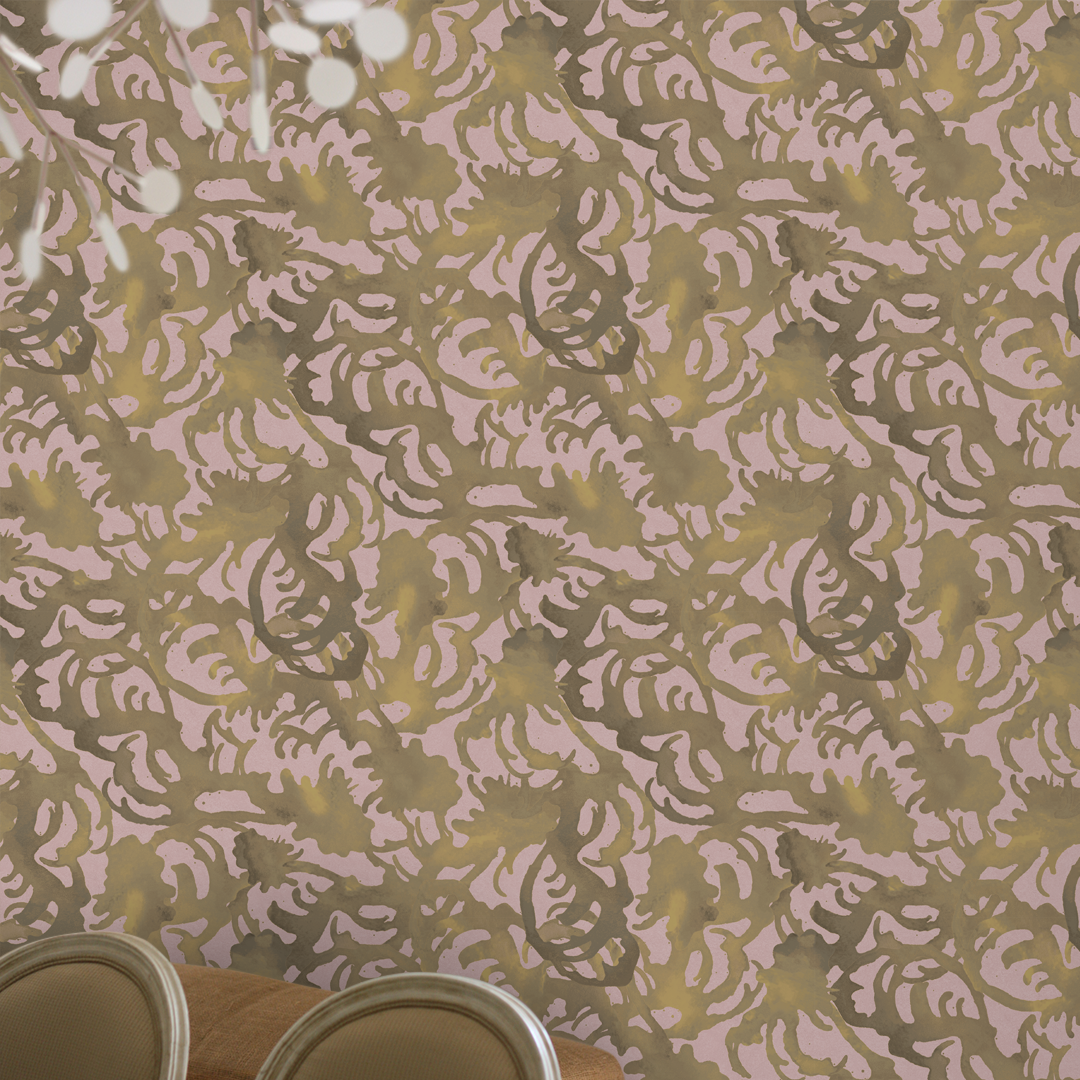
The patterns in this line begin as mark-making or a snapshot from an original painting — so the wall carries the same lack of a fixed focal point the painting had. To be exact about it: the source is a hand-made painting; the wallcovering itself is printed by a manufacturer onto vinyl. The hand is in the drawing, not in the roll.
What holds up on a ceiling, practically
Ceilings are unforgiving — the paper hangs against gravity through years of temperature swings, and in a powder room it also lives with steam.
The line here is 20 oz Type II commercial-grade vinyl: an embossed face with a slight strié shimmer over a laminated fabric backing. It reads as texture rather than as plastic, and it is durable and cleanable in a way flat paper is not, which is why it holds up in high-traffic and moisture-adjacent rooms as well as overhead. Rolls are 24 inches wide, pre-trimmed and unpasted, with a 52-inch commercial width available. Sold by the yard, with a 30-yard minimum, printed on demand in roughly two weeks.
For a typical powder room drenched floor-to-ceiling, that is a modest yardage and one lead time — which is the whole argument for starting with a small room.
Which patterns are actually available
Fourteen patterns are live right now, and they cover the scale range this kind of project needs:
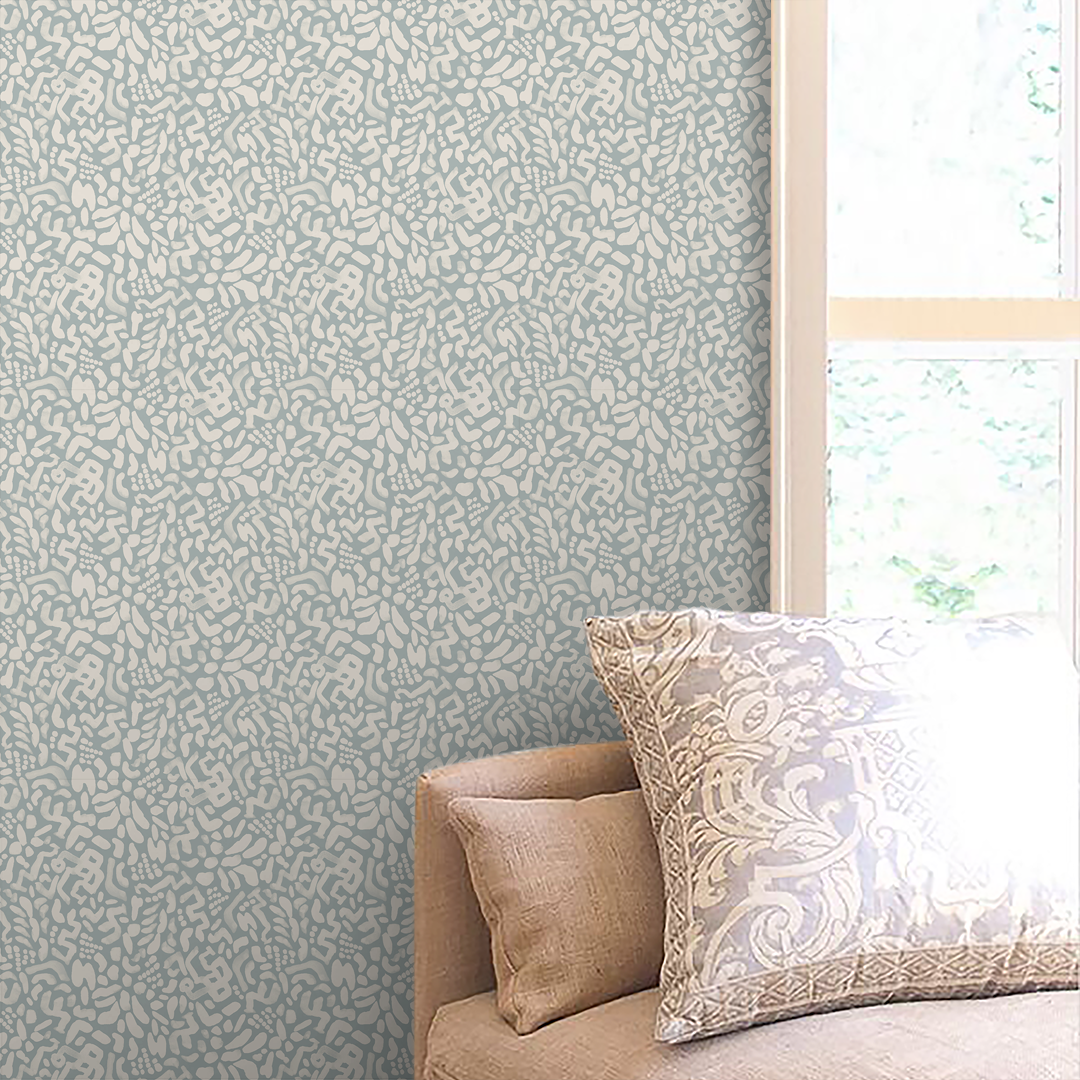
- Flourish — Marigold and Grey Large Scale, Small Scale Marigold Grey Ivory, Greige, Warm White with Tan Liquid Silk, Artichoke and Lilac Small. The one family with both a large and a small scale live, which makes it the natural choice for the two-scale ceiling-and-walls approach above.
- Freesia — Sand, Goldenrod. Softer and warmer; good for a vestibule or a ceiling over a bed.
- Atelier — Blue Haze Medium, Golden Sky Medium, Berry Silvered Champagne. The most painterly of the patterns, and the closest to the in-progress surface of the studio.
- Chic Stripe — Winter White, Winter Grey Sage. A stripe with a brushstroke rather than a ruled edge; stripes wrap a small volume with unusual grace because the vertical does the room's proportions a favour.
- Toile Medium Sky Blue — a toile loosened into gesture; dining rooms and stair niches.
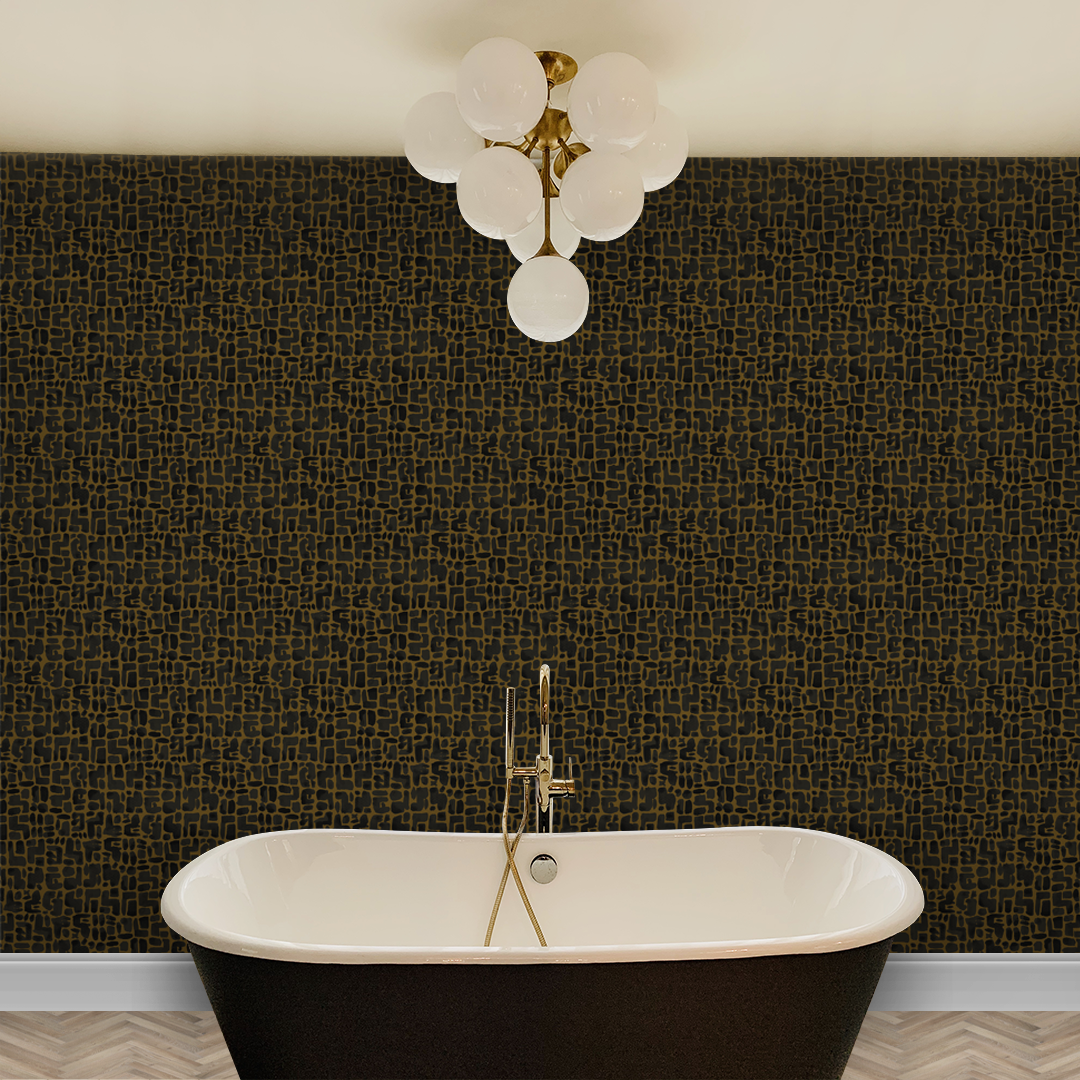
- Deco Black and Cigar — the darkest and most graphic; a bar alcove or a jewel-box powder room.
Samples are $5, up to five free to the trade alongside 20% trade pricing, with custom colourways and custom scale available to trade — which is the mechanism for getting a two-scale pairing exactly right on a specific room.
The honest way to start
Pick the smallest room in the house you are willing to fully commit. Measure the longest uninterrupted plane, usually the ceiling, and choose the scale that lets one whole motif live there. Order samples and tape them up — on the ceiling as well as the wall, since the light hits those two planes completely differently.
Browse the full pattern collection, or, for a project, the trade programme. The patterns come from the paintings and from the practice behind them.
Gracious note where it is owed: the heritage wallcovering houses — Schumacher, Phillip Jeffries, Lee Jofa — built the standards this category still runs on. This is a newer voice added to that conversation, not a correction of it.
Related reading
Frequently asked questions
Can you wallpaper a ceiling?
Yes, and it is one of the strongest uses of pattern available. Ceilings are uninterrupted planes, which lets a pattern read whole. A durable substrate matters more overhead than on a wall, since the material hangs against gravity through years of temperature change.
What is wallpaper drenching?
Carrying one pattern continuously across the walls and ceiling of a room so the space reads as a single designed volume rather than a wall with a treatment on it. It works best in small, enclosed rooms — powder rooms, vestibules, alcoves.
What pattern scale works best for a small papered room?
A medium repeat usually flows best. A very small repeat reads as visual noise across five surfaces; a very large one loses its structure once doors, mirrors and cabinetry cut it up. Using a larger scale on the ceiling and a smaller scale of the same pattern on the walls is a reliable trade approach.
Is this wallpaper hand-painted?
No. The pattern originates in an original hand-painted work by the artist; the wallcovering itself is printed by a manufacturer onto 20 oz Type II commercial-grade vinyl. The hand is in the drawing, not in the roll.
Does an "enveloping" wallpaper actually feel different, or is it just a word?
It is a real structural difference: an enveloped room has no edge where the treatment stops, so the eye has no boundary to file the pattern inside. The room reads smaller in dimension and larger in presence. It is not automatic, though — a pattern with a strong centre or a hard directional repeat keeps announcing its own edges even when it runs continuously.
See the work
Browse the wallpaper patterns, each drawn from an original painting and printed to order. All wallpaper patterns.
Sources
- Veranda, "10 Wallpaper Trends That Will Be Everywhere in 2026, According to Designers" (Kelsey Mulvey, 25 June 2026)
- "The Underrated 2026 Trend Interior Designers Swear By for Luxe Rooms" (Kristina Phillips quote)
- Business of Home, Meet the Makers — Emma Hayes, on wallcovering that envelops a room