Legacy Wallpaper Houses Borrow an Eye. A Painter's Line Keeps One.
In short: Heritage wallcovering houses keep their archives current by commissioning a rotating cast of outside designers — Schumacher, at 127 years old, has worked with Miles Redd, David Kaihoi and others under creative director Dara Caponigro. That is one legitimate model. A second is a fully hand-executed studio like Callidus Guild. A third is a pattern drawn from a working painter's own canvas and printed to order. Knowing which tier you are specifying is the whole job.
A specifier looking at three wallcoverings in a folder is looking at three different kinds of object, and the folder rarely says so.
The differences are not about quality. They are about who made the pattern, and what physically exists before the roll ships.
How does a 127-year-old wallpaper house stay current?
By bringing in new eyes on purpose. F. Schumacher & Co., founded in 1889, has stayed relevant across four generations of taste under creative director Dara Caponigro, who has built the house's contemporary reputation on exclusive collections with outside designers — Miles Redd, David Kaihoi and others, alongside cross-pollinations with fashion names.
1. Since Frederic Schumacher started the company in 1889, the house's continuity has come from its willingness to adapt — a point Caponigro herself makes about why it has lasted.
— Dara Caponigro, creative director, Schumacher, in 1stDibs Introspective, "After 127 Years, Schumacher Is Still Keeping It Fresh"
That is a genuinely impressive model, and the archives it has produced are part of why the American decorative tradition looks the way it does. It is also worth being precise about what it means: the eye behind any given pattern belongs to whoever was commissioned that season. The house supplies the archive, the standards and the distribution. The authorship rotates.
What does a fully hand-executed wallcovering look like?
A different category again, and a rare one. Yolande Milan Batteau founded the Brooklyn studio Callidus Guild in the late 1990s, and her team of more than a dozen artisans hand-paints bespoke wallcoverings for Chanel, Louis Vuitton and Tiffany & Co., using water-gilding, shell inlay, marble-dust plaster and mother-of-pearl. Speaking to Business of Home, she described what that level of execution actually costs in time:
2. "It can often take a year or two until an artist can truly reproduce our work."
— Yolande Milan Batteau, founder, Callidus Guild
And on what the finished surface is:
3. "Each piece feels more like a painting than a wallpaper."
— Yolande Milan Batteau
That is the top tier of the category: an object hand-executed at full scale, wall by wall, mixed to the room's stone and hardware. Anyone specifying it knows exactly what they are buying, and prices it accordingly.
So what is the third tier, and why does the language blur?
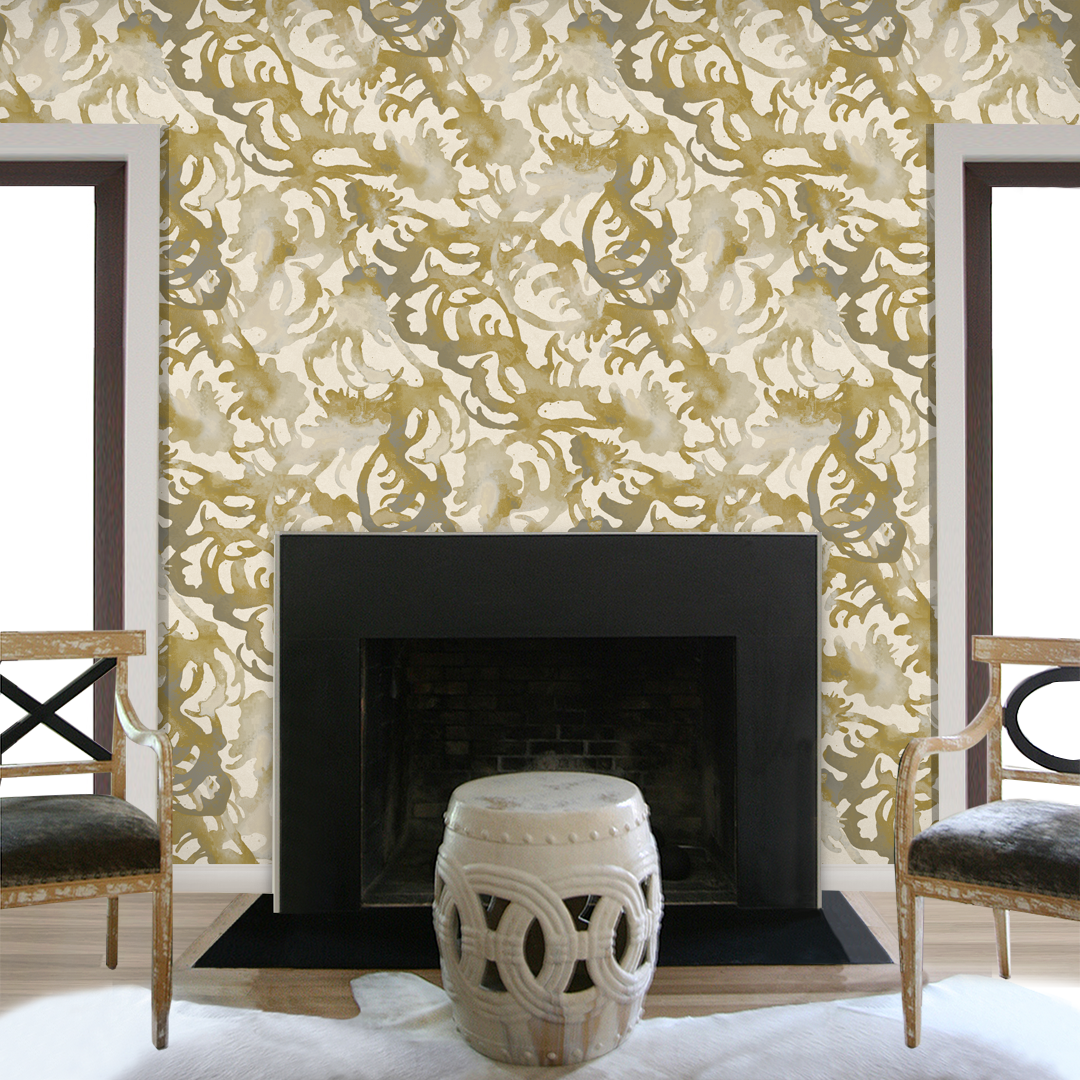
The largest tier by far is art-derived, digitally printed wallcovering: a pattern that originates in a real physical artwork, then is printed by a manufacturer onto a substrate. This is the standard production process for a professional wallpaper line, and it is a good one — durable, repeatable, specifiable at scale.
The blur happens when this tier borrows the vocabulary of the second. "Hand-painted" said of a printed vinyl roll is doing work it has not earned, and it makes the honest version harder to hear.
The honest version is easy to state. The source painting is hand-made. The wallcovering is printed. Both facts are true at once, and neither diminishes the other.
How does a designer tell the difference in one email?
Ask three questions.
Who made the pattern, by name? Not the house — the person. A rotating designer collaboration, a staff studio and a single working artist are three different answers, all legitimate, all worth knowing.
What physically existed first? A painting on canvas, a hand-executed plaster panel, or a file. Ask to see it.
Is the finished product hand-executed or printed? If printed, on what substrate, at what width, with what lead time.
Any studio that knows its own answers will send them back the same day.
Where these patterns come from
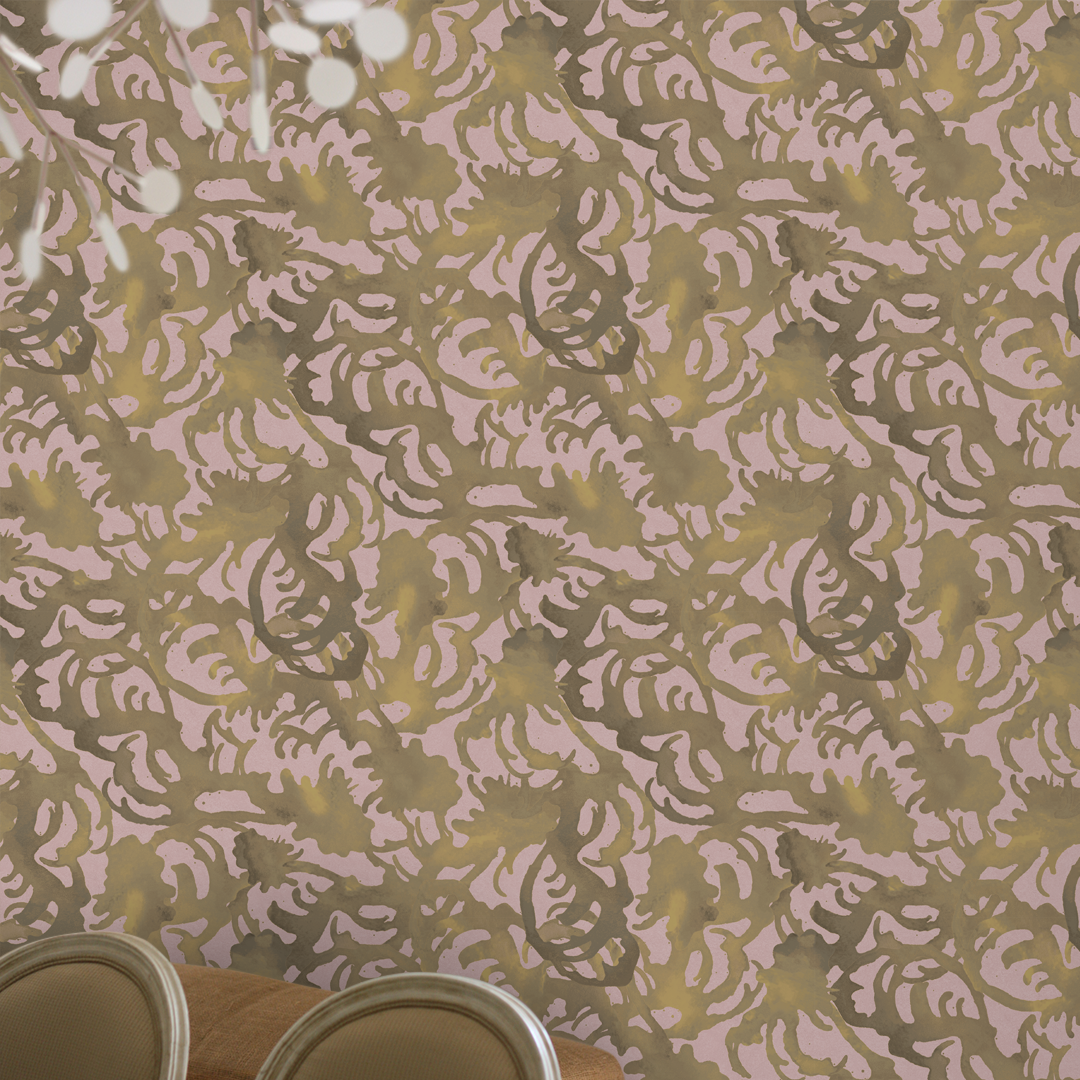
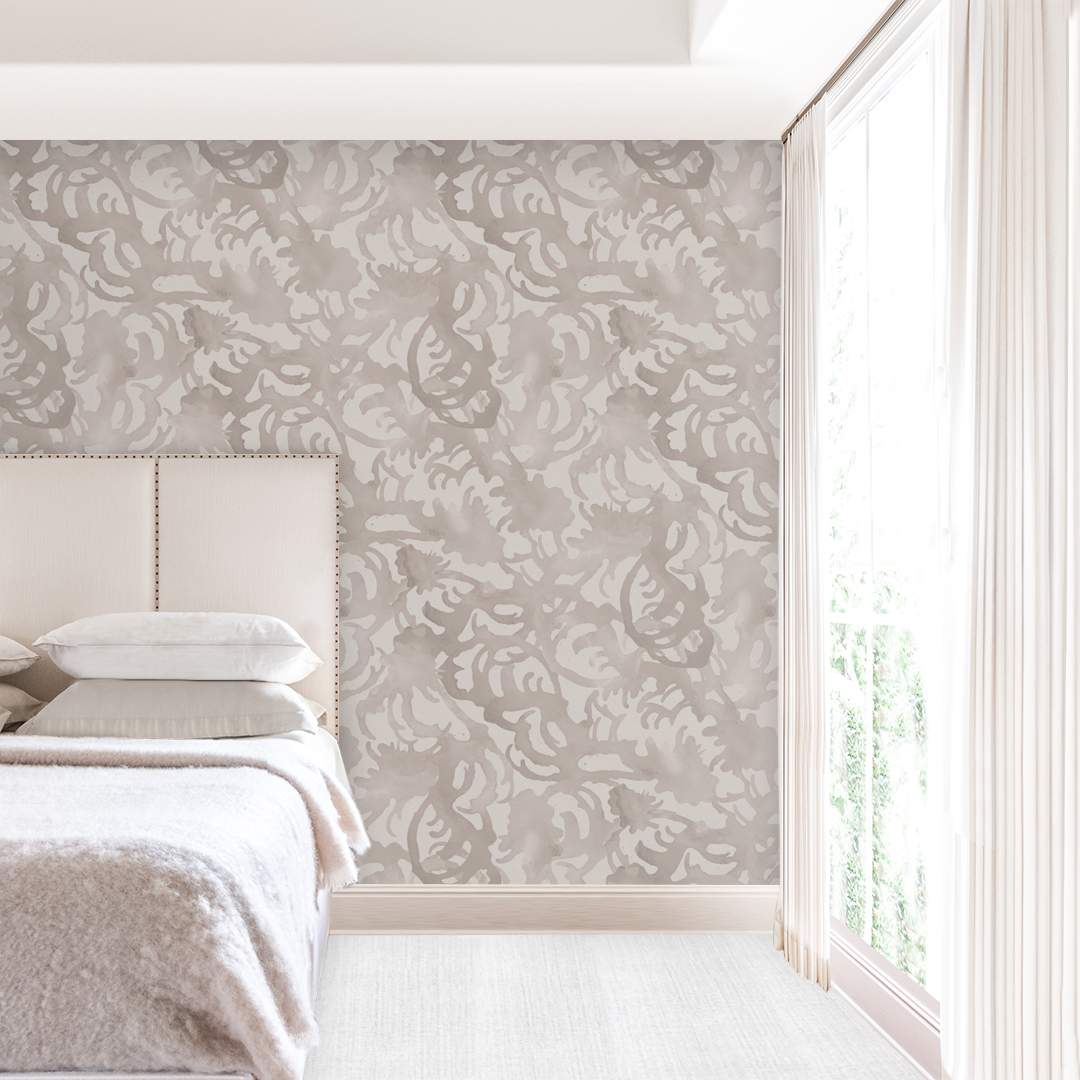
Each of my patterns begins as mark-making or a snapshot from one of my own paintings — the same eye, continuously, across the whole line, because there is only one person making them. That is not a claim about being better than a heritage house with a rotating roster. It is a different structure, with a different thing to verify: one working painter, twenty-plus years of documented practice, and a source canvas behind every repeat.
The product itself is stated plainly. Twenty-ounce Type II commercial-grade vinyl, embossed face with a slight strié-shimmer over a laminated fabric backing. Twenty-four inches wide, pre-trimmed and unpasted; fifty-two inches for commercial. Sold by the yard, thirty-yard minimum, print-on-demand in about two weeks. Twenty percent trade discount and up to five free samples, with custom colourways and scale available to trade.
Currently published patterns include Atelier Blue Haze Medium, Atelier Golden Sky Medium, Atelier Berry Silvered Champagne, Chic Stripe Winter White, Chic Stripe Winter Grey Sage, Flourish Greige, Flourish Warm White with Tan Liquid Silk, Flourish Marigold and Grey Large Scale, Freesia Sand, Freesia Goldenrod and Toile Medium Sky Blue — each drawn from an original painting, each printed to order.
Schumacher borrows a brilliant eye every few years and has done it beautifully for well over a century. A painter's line has one eye and keeps it. A specifier deserves to know which they are holding.
Related reading
Frequently asked questions
Who actually designs the patterns at a heritage wallpaper house?
Often an outside designer commissioned for that collection. Schumacher, under creative director Dara Caponigro, has produced exclusive collections with Miles Redd, David Kaihoi and others. The house supplies the archive and standards; the authorship of a given pattern rotates.
What does "hand-painted wallpaper" actually mean?
It should mean the wallcovering itself was executed by hand, as at Callidus Guild, where a team of artisans paints bespoke panels and where founder Yolande Milan Batteau says it can take an artist a year or two to reproduce the studio's work. It is often used loosely for printed products whose pattern came from a painting. Ask which you are being offered.
Is a printed wallcovering drawn from an original painting still artist-designed?
Yes, provided the source artwork is real, made by a named artist, and identifiable. The pattern originates in a hand-made painting; the finished product is printed by a manufacturer. Both are true, and a good studio states both.
What should a designer ask before specifying a wallcovering?
Who made the pattern by name, what physically existed first, and whether the finished product is hand-executed or printed — and on what substrate, at what width, with what lead time.
See the work
Browse the wallpaper patterns, each drawn from an original painting and printed to order. All wallpaper patterns.
Sources
- 1stDibs Introspective, "After 127 Years, Schumacher Is Still Keeping It Fresh"
- Business of Home, Caroline Biggs, "This artist handpaints bespoke wallcoverings for big-name fashion and design brands"