Pattern Scale Gets Decided Long Before Your Wall Sees It
In short: Designers who call wallpaper the fastest way to change a room also warn that an oversized pattern needs architecture to contain it. Both are true, and both are downstream of one earlier decision: whether the pattern's scale was set at the original artwork or applied afterwards at the printer. A pattern drawn at the proportions it will inhabit behaves differently on a wall from one resized to fit.
Two pieces of standard designer advice sit awkwardly together. The first: wallpaper is the fastest and most economical way to transform a room without touching the architecture. The second: a bold, oversized pattern needs a contained room — trim, a stopping point, a single wall — or it swallows the space.
Both are sound. Together they leave a buyer with a shopping problem and no method. What actually settles it is a question about the pattern, asked before the room comes into it at all.
Why is scale so often the thing that goes wrong?
Because for most patterns, scale is an option applied late. A design exists as a repeat, and the repeat is offered at small, medium and large — three renderings of one file, sized after the fact. Nothing about the drawing changes when the slider moves. The motifs get bigger and the negative space between them gets bigger with them, which is why an enlarged pattern so often reads as loud rather than generous.
A pattern composed at a specific size behaves differently, because the relationship between the marks is the design.
“Every Fromental design begins as an original artwork — not as a sketch or digital file, but as a full-scale painted original, worked at the exact proportions it will eventually inhabit.”
— Fromental, from the house's own account of hand-painted wallcovering
The heritage houses have always worked this way, and it explains the containment advice rather than contradicting it. A pattern painted at the proportions of a real room already knows where it stops.
What does a pattern with a real source do differently?
It carries an origin you can name, and origin turns out to be a scale decision too. Fromental's Soru began as a bespoke commission for interior designer Young Huh's own Hudson Valley home — one room, one set of proportions — before it entered the house's permanent collection.
“What I love about Korean art is how expressive and uninhibited it is, as well as its embrace of intense color. There is whimsy, humor, and fantasy — but above all, a love of the beautiful.”
— Young Huh, interior designer, on the Minhwa tradition behind Soru
“I first encountered Minhwa 25 years ago and have remained captivated by its immediacy — that remarkable fusion of naïveté and sophistication in the iconography.”
— Tim Butcher, co-founder, Fromental
Neither of them is describing a repeat. They are describing a picture, which is the point: a pattern with a picture behind it has an internal logic — where the eye rests, what the density does across a wall — that survives being applied to twelve feet of it.
Does this mean printed wallpaper is disqualified?
No. Printing is a manufacturing step, not a verdict on the design. The Studio's own patterns are printed to order on 20 oz Type II commercial-grade vinyl, embossed over a laminated fabric backing, 24 inches wide, pre-trimmed and unpasted, 52 inches for commercial specification — because that substrate outperforms flat paper in the rooms these go into.
What matters is what happened before the file reached the printer. Each pattern here begins as mark-making from one of the original paintings — a specific canvas, made by hand, in a Nashville studio, at a real size. The wall then reads as singular: evocative, rich and deep, rather than as a decorative texture.
How does a designer verify this in one email?
Four questions, and they take a supplier about a minute to answer honestly.
- What did this pattern originate as — a painting, a drawing, a photograph, or a file?
- At what size was the original made?
- When the scale changes, is the drawing redrawn, or is the same file resized?
- Can I see the source artwork?
A supplier with a real origin answers all four in specifics. The last question is the one that settles it.
Where the studio's own patterns come from, and how scale works here
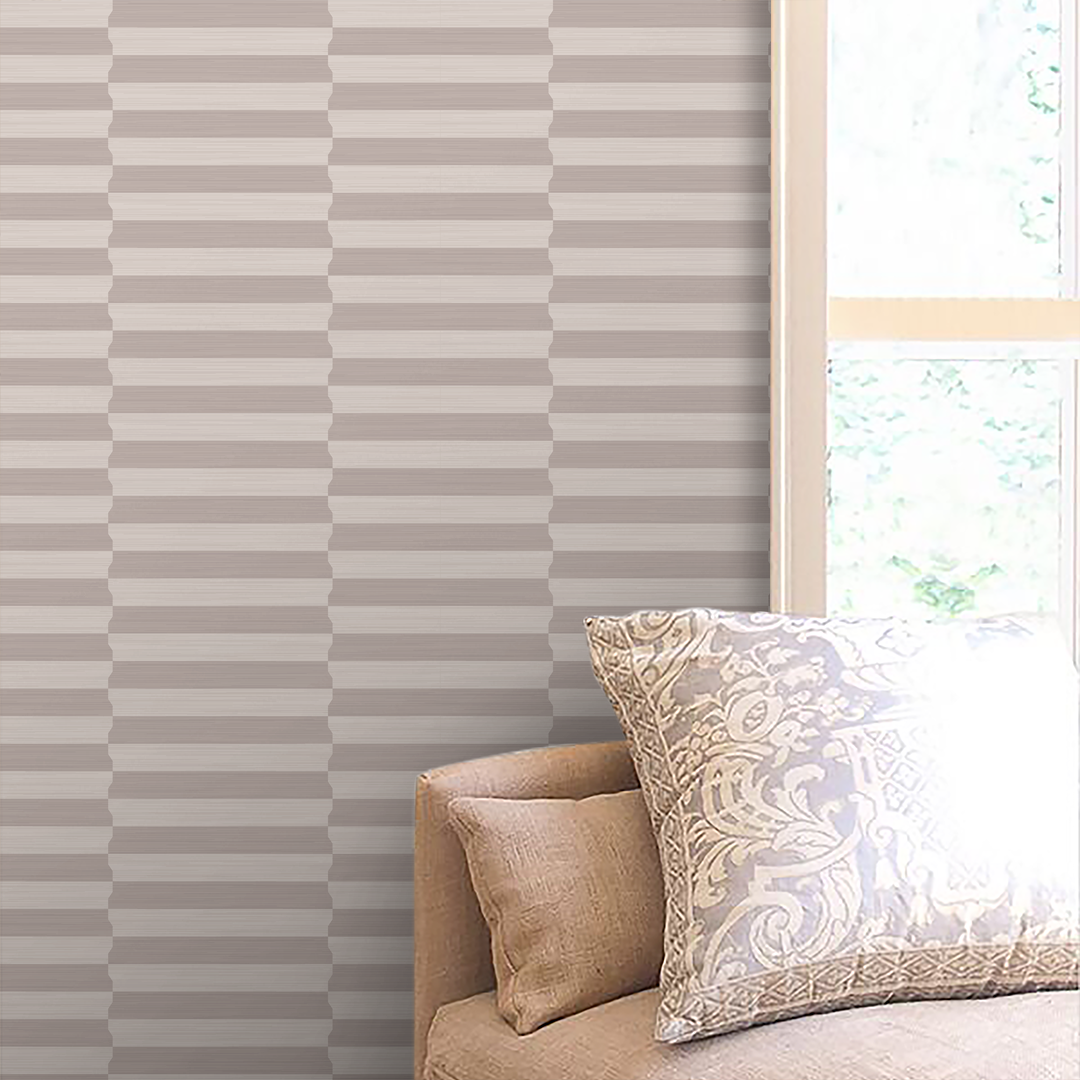
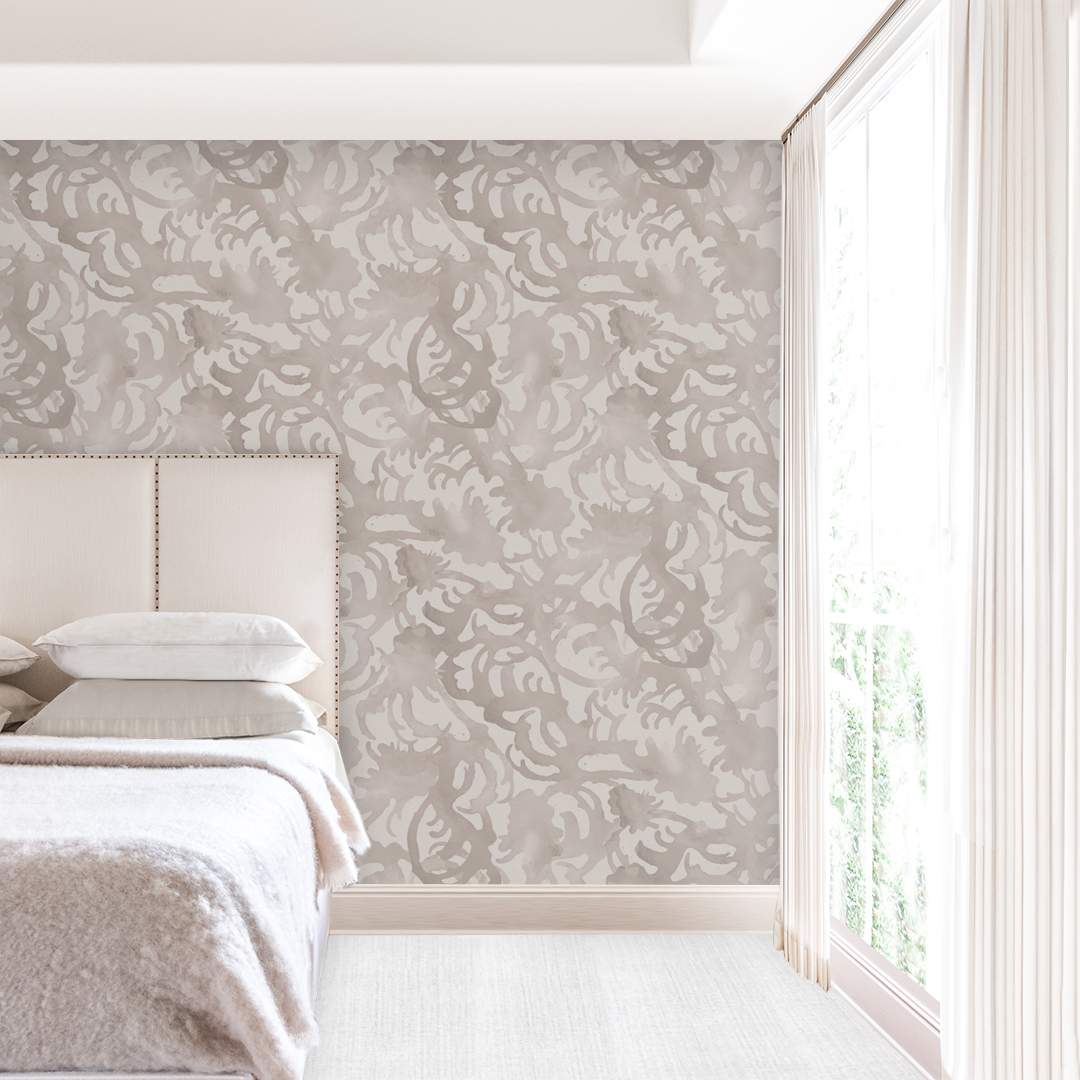
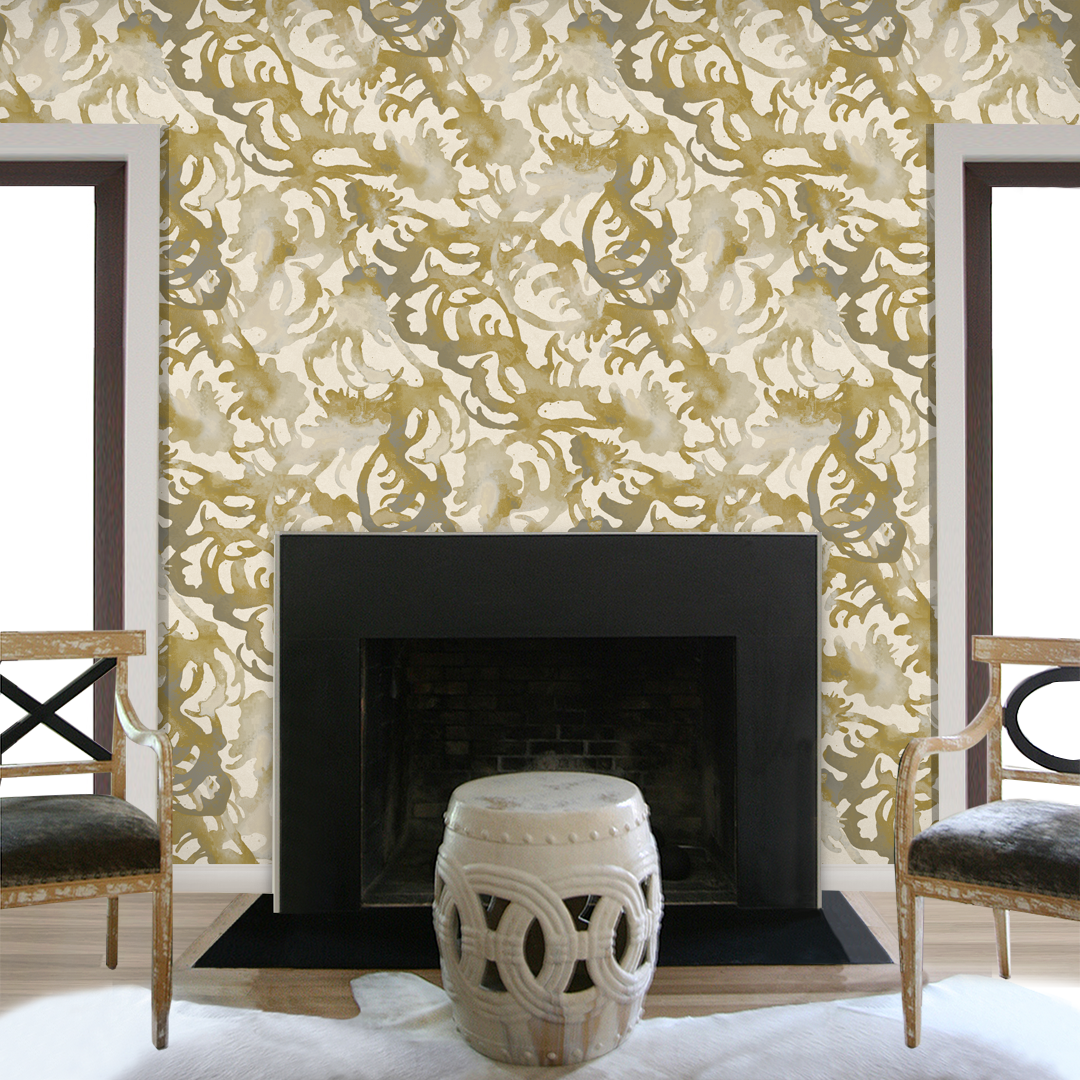
Each pattern is drawn from an original hand-painted work — the painting is hand-painted, the wallcovering is printed from it, and the studio does not blur that line. Where a pattern is offered at more than one scale, the two are treated as separate designs with separate names rather than one slider position: Flourish Marigold and Grey Large Scale gives a wall the generosity of a large painting, while Flourish Small Scale Marigold Grey Ivory draws the same marigold warmth fine and intimate, for powder rooms and tucked-away walls that reward a second look. Chic Stripe Winter White solves the containment problem structurally — a stripe carries its own stopping point, keeping the order of a stripe and the character of a brushstroke.
Custom colourways and custom scale are available to the trade, and that conversation is best had early rather than at the ordering stage. Samples are $5, yardage is sold by the yard with a 30-yard minimum, print-on-demand runs about two weeks, and the trade programme carries 20% off plus up to five free samples.
The full pattern library is here, and the Trade Program covers custom colourways, scale and sampling.
Frequently asked questions
Should a large-scale wallpaper pattern only go in a large room?
Not necessarily. Containment matters more than square footage — a stopping point, trim, a single defined wall. A small room with clear architectural edges often carries a bold pattern better than a large open-plan space with nowhere for the pattern to end.
Is a pattern offered at three scales the same design three times?
Usually yes — one file rendered at three sizes, with the negative space enlarging along with the motifs. A pattern composed at a particular scale is a different proposition, and worth asking about directly.
Does printed wallpaper count as artist-made?
The distinction is where the design came from, not how it was produced. A pattern drawn from an original hand-painted work is artist-made; the printed wallcovering itself is manufactured, and an honest supplier will say so plainly rather than calling the product hand-painted.
Can scale be customised for a specific room?
Custom colourways and custom scale are available to the trade here. Raise it at the specification stage rather than at ordering — the answer changes what gets drawn, not just what gets printed.
Sources
- Veranda, Designer Young Huh's New Wallpaper Collection with Fromental Is Full of Fascinating Symbolism (Madoline Markham Koonce)
- Fromental, The Art of Hand Painted Wallpaper