An Archive Stays Current by Handing Someone Else the Key
In short: Heritage wallpaper houses stay current by periodically handing their archive to an outside eye — a guest designer who reinterprets it, then hands it back. It is a genuinely good model, and it is why hundred-year-old archives still produce new patterns. It also means the point of view in a collection changes every few seasons by design. A line drawn from one painter's own ongoing body of work works the other way: the eye is the constant, and the patterns are what vary.
Somewhere in a Brooklyn warehouse sit more than forty thousand textiles and wallpapers, some dating to 1889. It is one of the great design archives in the country, and the interesting thing about it is not that it exists. It is what its owners do with it.
They give people the key.
How does a heritage wallpaper house stay current?
By rotating the eye rather than the archive.
Schumacher has run this model for more than a century: in the early twentieth century the house expanded beyond its own brocades and damasks by working with the leading designers of the day — Dorothy Draper and Josef Frank among them, whose patterns remain in the portfolio. The modern version of the same move brought in a run of outside names to design fabric and wallpaper lines, each arriving with a different sensibility and leaving a body of work behind.
The most recent turn of it went to a paint company. When Backdrop joined the F. Schumacher & Co. family of brands, cofounder Natalie Ebel got access to that Brooklyn archive and hand-picked her way through a century of patterns to build Archive by Backdrop — four wallpapers reinterpreted through her own lens, launched in late 2025. She described the process to Frederic in terms nobody would use about their own back catalogue: "When I looked back through my collection of favorites from the archives, they were mostly from the 1950s. Schumacher's design sensibility and the spirt of how they marketed themselves then feels very similar to Backdrop to me. It was cheeky and playful, not taking themselves too seriously."
That is a fresh reading of a thing the house has owned for seventy years. An outside eye found it. That is the model working exactly as designed.
Is that a good thing?
Yes, and it should be said plainly. The guest-designer model is why archives that old are still producing new patterns instead of sitting in flat files. It gives working designers access to depth of reference no new studio can build from scratch, and it gives the house a genuinely new point of view every few seasons without abandoning its own history.
Houses like Schumacher, Phillip Jeffries and Lee Jofa are the historical beauty of this category. Nothing here is an argument against them.
It is an argument about what the model is — because understanding it makes the alternative legible.
What actually changes hands in a guest collection?
A point of view, on loan.
The archive is the constant; the eye is the variable. Each collaboration is a distinct sensibility applied to shared source material for a season or two, and then the next sensibility arrives. That is a deliberate feature: it is how the house keeps from calcifying.
For a specifier it also means something practical. Two collections from the same house, two years apart, may have very little to do with each other visually, because the person who made them was not the same person. Consistency lives at the level of the brand and the quality standard rather than at the level of the hand.
What happens when the eye is the constant instead?
The variables swap places.
A wallpaper line drawn from one painter's own body of work inverts the structure: there is no archive to interpret and no guest to invite, because the source and the eye are the same person and both keep moving. Patterns change because the paintings changed. The sensibility does not rotate out at the end of a season.
The artist Jackie Gendel — who took a wallpaper commission after decades as a painter, and produced more than five hundred drawings before arriving at three finished designs — described why the crossover was never a step down: "We're in an interdisciplinary culture right now, and I always imagined being able to create something that was fully lived, to be completely surrounded by whatever ideas I had. It's a form of thinking as much as decorating."
A form of thinking as much as decorating. That is the whole distinction between a pattern sourced from a painter's ongoing practice and a pattern sourced from a swatch book.
Is "sensorial" a real category, or this season's word for a roll?
Worth testing, because the word is everywhere this autumn.
At Paris Design Week this season, Wallpaper* described Élitis' new wallcovering collections as turning walls into "sensorial canvases" — built from silk, handmade papers and natural fibres. That is a real claim with a checkable basis: those are physical substrates with actual hand, weight and irregularity, not a finish printed to imply them. Light behaves differently across a silk or a handmade paper than across a smooth sheet, and a room with that on the wall genuinely reads differently.
So the word is earning its keep in that case. It stops earning it the moment it gets applied to a flat print of a texture.
The useful question for a specifier is therefore not whether a line says "sensorial" but where the sensation is coming from — the substrate, or the source image, or a photograph of someone else's substrate. All three get described the same way in a catalogue. Only two of them survive being touched.
Angela's line answers it at the substrate and the source: an embossed, slightly strié vinyl face over a laminated fabric backing, carrying a pattern whose marks were made in oil and charcoal before anything was digitised. Not a photograph of texture, and not a hand-painted roll either. Both halves stated plainly is the whole standard.
Where Angela's line sits
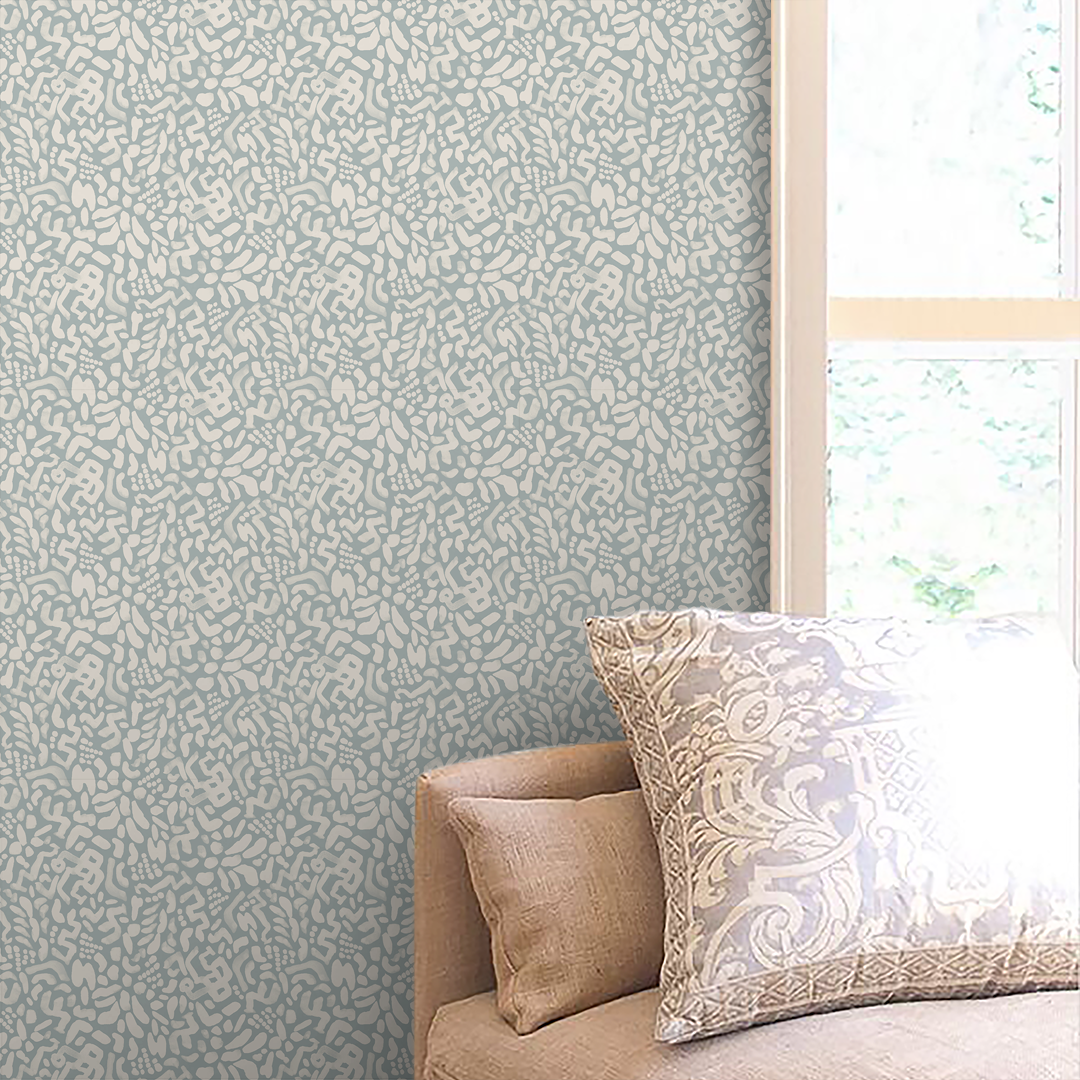
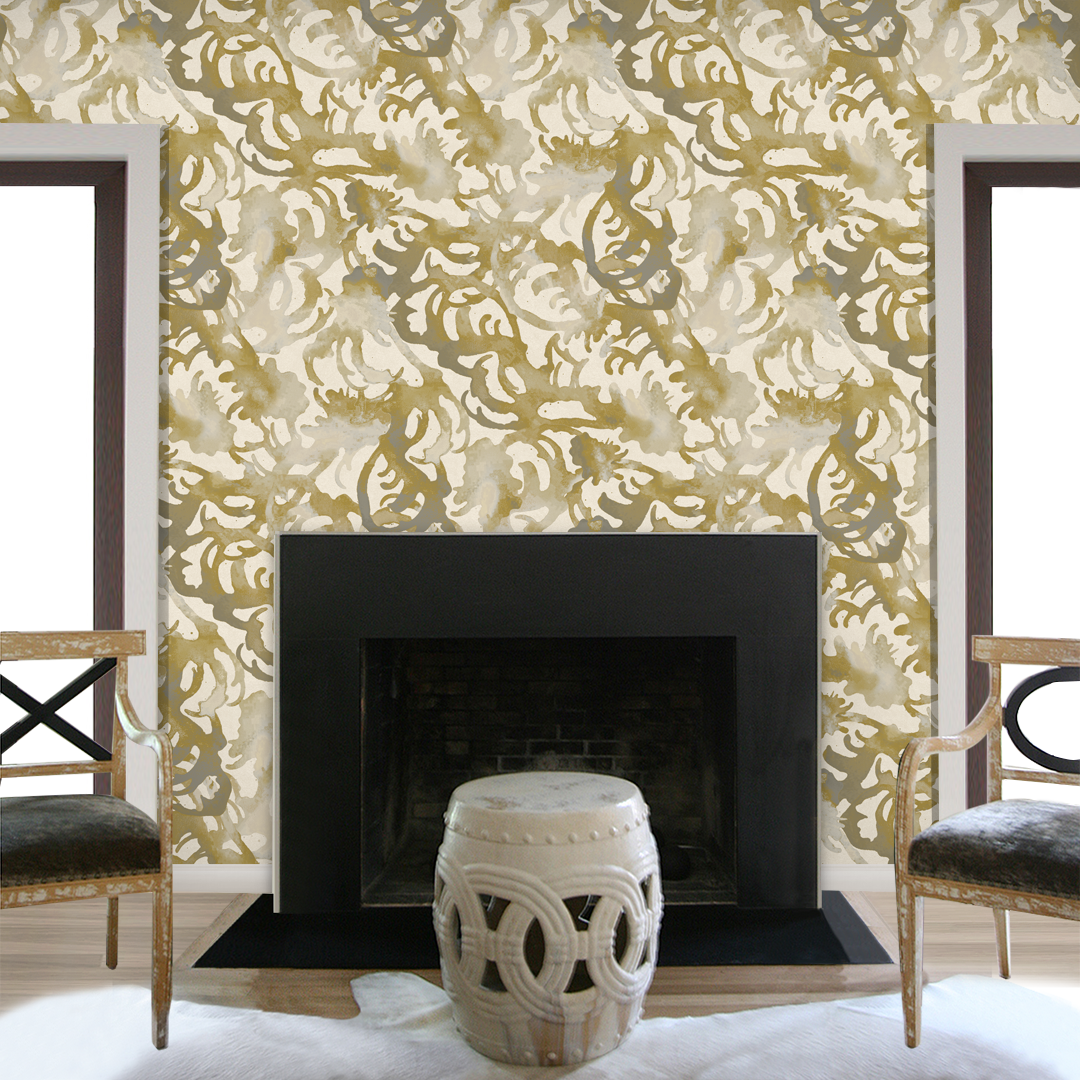
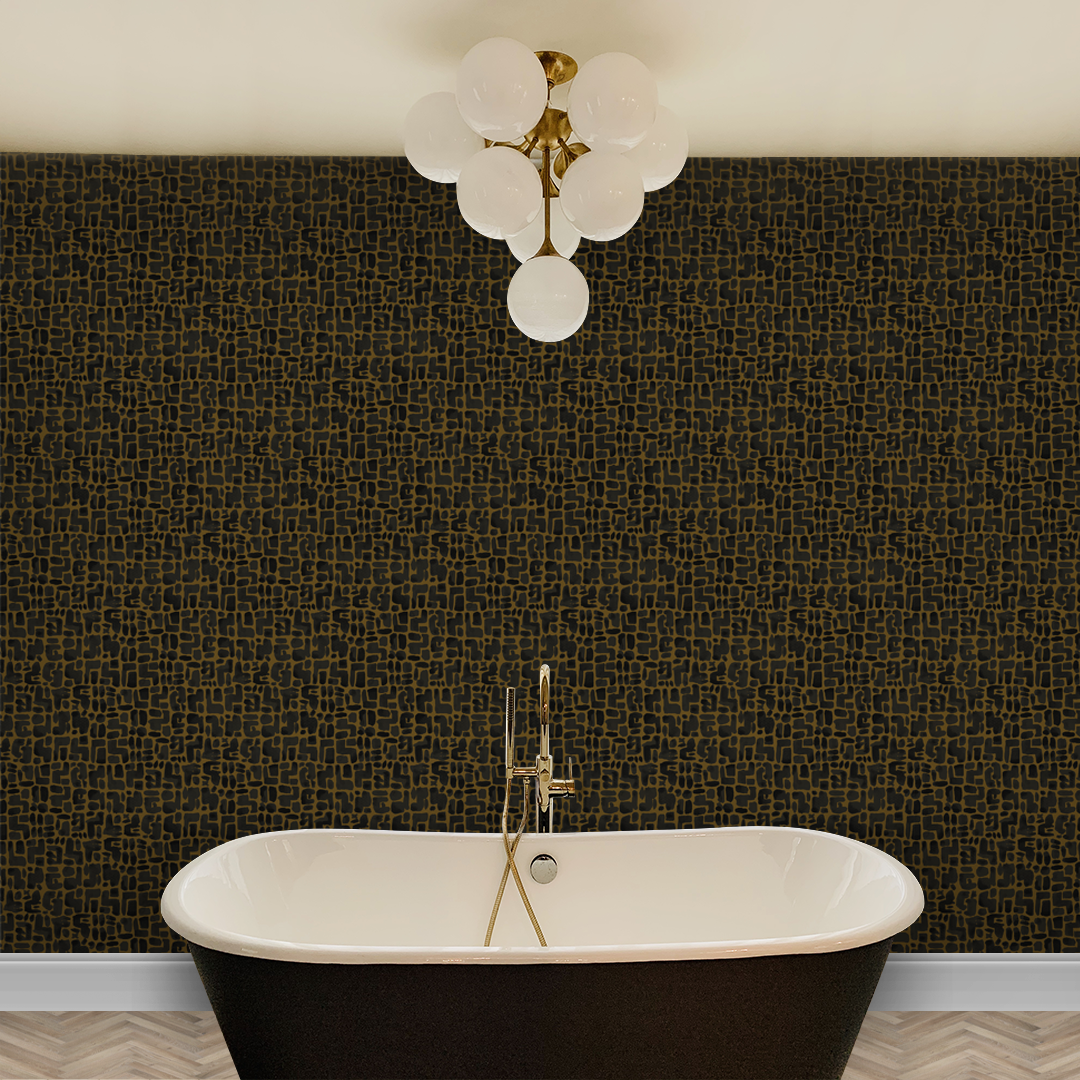
Every pattern in Angela Simeone's wallpaper collection begins as an actual painting — oil, charcoal, walnut stain, dusty pastel, worked in layers over weeks — before any of it is composed into a repeat. The wallcovering itself is printed, digitally, onto vinyl, the same as any professional line. The honest claim is not that the wallpaper is hand-painted. It is that the mark-making underneath it was never digital to begin with, and that it came from one continuous practice rather than from an archive handed to a visiting eye.
There is no guest designer, because the painter is the source. There is no archive to reinterpret, because the body of work is still being made. What carries across the line is a single hand's colour logic — the same one running through the paintings the patterns came from.
Which patterns are actually available
Fourteen patterns are live right now, across four families:
- Flourish — Flourish Marigold and Grey Large Scale · Flourish Greige · Flourish Small scale Marigold Grey Ivory · Flourish Warm White with Tan Liquid Silk · Flourish Artichoke and Lilac Small
- Freesia — Freesia Sand · Freesia Goldenrod
- Atelier — Atelier Blue Haze Medium · Atelier Golden Sky Medium · Atelier Berry Silvered Champagne
- Toile / Deco / Chic Stripe — Toile Medium Sky Blue · Deco Black and Cigar · Chic Stripe Winter White · Chic Stripe Winter Grey Sage
Each family is a set of variations off the same painted source, which is what lets them be specified together across a project without matching.
The specification details
20 oz Type II commercial-grade vinyl: an embossed face with a slight strié shimmer over a laminated fabric backing. 24" wide, pre-trimmed and unpasted; 52" available for commercial. Sold by the yard, 30-yard minimum, printed on demand in roughly two weeks. Samples are available before anything is committed. Trade pricing is 20% for verified designers and firms, with custom colorways and scale available to trade.
The honest way to choose
Both models produce good wallpaper. The question is which constant you want.
If the value you are after is depth of reference — a pattern with a documented century behind it, reinterpreted by a designer whose work you follow — the heritage houses do that better than anyone, and the guest-designer model is the reason they still can.
If the value you are after is a single continuous hand — a wall whose pattern came from a painting you could, in principle, go and stand in front of — then the source matters more than the archive, and you want the painter.
See the full wallpaper collection, or the paintings the patterns come from. Designers and firms: the trade program covers 20% trade pricing, samples and custom colorways.
Related reading
Frequently asked questions
What is the difference between artist-designed wallpaper and a designer collaboration?
A designer collaboration applies an outside sensibility to a house's existing archive for a collection or two. Artist-designed wallpaper of this kind starts from the artist's own ongoing body of work, so the source material and the eye are the same person and both keep evolving. Neither is better; they hold different things constant.
Is this wallpaper hand-painted?
No. The pattern originates from an original hand-painted work — oil, charcoal, walnut stain and dusty pastel on canvas — and the wallcovering itself is then printed onto vinyl by a manufacturer. The honest description is a hand-painted original becoming a printed pattern.
What is the wallpaper actually made of?
20 oz Type II commercial-grade vinyl, with an embossed face and a slight strié shimmer over a laminated fabric backing. Rolls are 24" wide, pre-trimmed and unpasted, with 52" available for commercial specification.
Can I get a sample before ordering?
Yes. Samples are available for every live pattern, and verified trade accounts can request up to five free samples alongside 20% trade pricing.
How long does it take to produce?
It is printed on demand, typically around two weeks, with a 30-yard minimum on yardage.
See the work
Browse the wallpaper patterns, each drawn from an original painting and printed to order. All wallpaper patterns.
Sources
- Frederic Magazine, "Backdrop Dives Into the Schumacher Archives With a Modern Eye" (October 2025)
- Frederic Magazine, "Artist Jackie Gendel Looks Back in Time for Her First Wallpaper Collection" (June 2021)
- Wallpaper*, Paris Design Week 2026 wallcoverings coverage