Immersive Without a Commission: What a Wallcovering Does to a Room
In short
A wallcovering can deliver the immersive feeling hotels are chasing in 2026, and it does not have to imitate a museum piece to do it. Atmosphere is registered peripherally, at walking pace, under a lamp — so the property that matters is what a surface does when nobody is looking straight at it. A pattern drawn from an original painting holds under those conditions; a generic repeat goes quiet.
What does "immersive art" actually mean in a hotel in 2026?
It means a room that reads as one continuous environment rather than a set of decorated planes. Hospitality Interiors named immersive art alongside reinvented Art Deco and sustainable materials as the movements set to dominate hospitality design this year, and put fabrics and wallcoverings at the centre of it — the materials that shape "atmosphere, comfort and identity" in a hotel. That framing matters: it locates the immersive quality in the surfaces a guest is surrounded by, not in a single feature object.
Shaw Contract's own 2026 forecast reaches the same conclusion from the other side, describing art in hospitality as moving from something applied to something embedded, and reporting a renewed pull toward "handcrafted details and moments of visible human expression" worked into the fabric of a property. Applied art hangs on a wall. Embedded art is the wall.
Can a wallcovering do the same work as a commissioned installation?
For atmosphere, often yes — and for a fraction of a commissioned installation's cost and schedule. The two are answering different briefs. A commissioned piece resolves one wall with one object and asks for a focal point. A wallcovering resolves the whole envelope and asks for nothing; it changes the temperature of a room before anyone consciously looks at anything.
The philosopher Gernot Böhme, whose work on atmosphere underpins most current design writing on the subject, defines atmospheres simply as "tuned spaces" — felt, shared, and prior to any individual judgement about what is in the room. Architectural theorist Mark Wigley described the same phenomenon more physically in his 1998 essay The Architecture of Atmosphere: atmosphere as "a swirling climate of intangible effects generated by a stationary object." A wall is the largest stationary object in any guest room. It is generating that climate whether or not anyone specified it to.
What makes one wallcovering atmospheric and another one flat?
A guest almost never faces the wall. They are walking, wheeling a case, finding a room number, holding a phone — the wallcovering arrives in peripheral vision, at speed, and usually under one warm lamp rather than daylight. That is the real specification condition, and it is what separates a hospitality brief from a residential one. A pattern chosen while standing square to a sample board in a lit studio has been judged under conditions no guest will ever reproduce.
Peripheral vision is poor at detail and excellent at tonal movement. So a surface that carries its range inside each colour keeps working at the edge of sight, while a surface whose interest lives in the contrast between two flat colours drops out the moment the light comes down or the head turns. That difference is decided long before printing: it is whether the source had paint in it. A pattern lifted from a hand-painted original arrives with pooled edges, uneven density and passages of different depth already built in. A pattern drawn to a spec has to add interest at the contrast level, which is precisely the level low light removes first.
Which of Angela's patterns do that, specifically?
Every pattern in the line begins as an original hand-painted work — the wall reads as singular because the source was. The product itself is printed by a manufacturer onto vinyl; it is a pattern drawn from a hand-painted original, not a hand-painted wallcovering. The honest version of the story is the better one.
From the currently published collection, three behave particularly well in hospitality conditions:
- Flourish Greige — the quietest in the line, greige on greige. It has no contrast to lose, so there is nothing for low light to take away; a corridor reads as woven cloth at any hour.
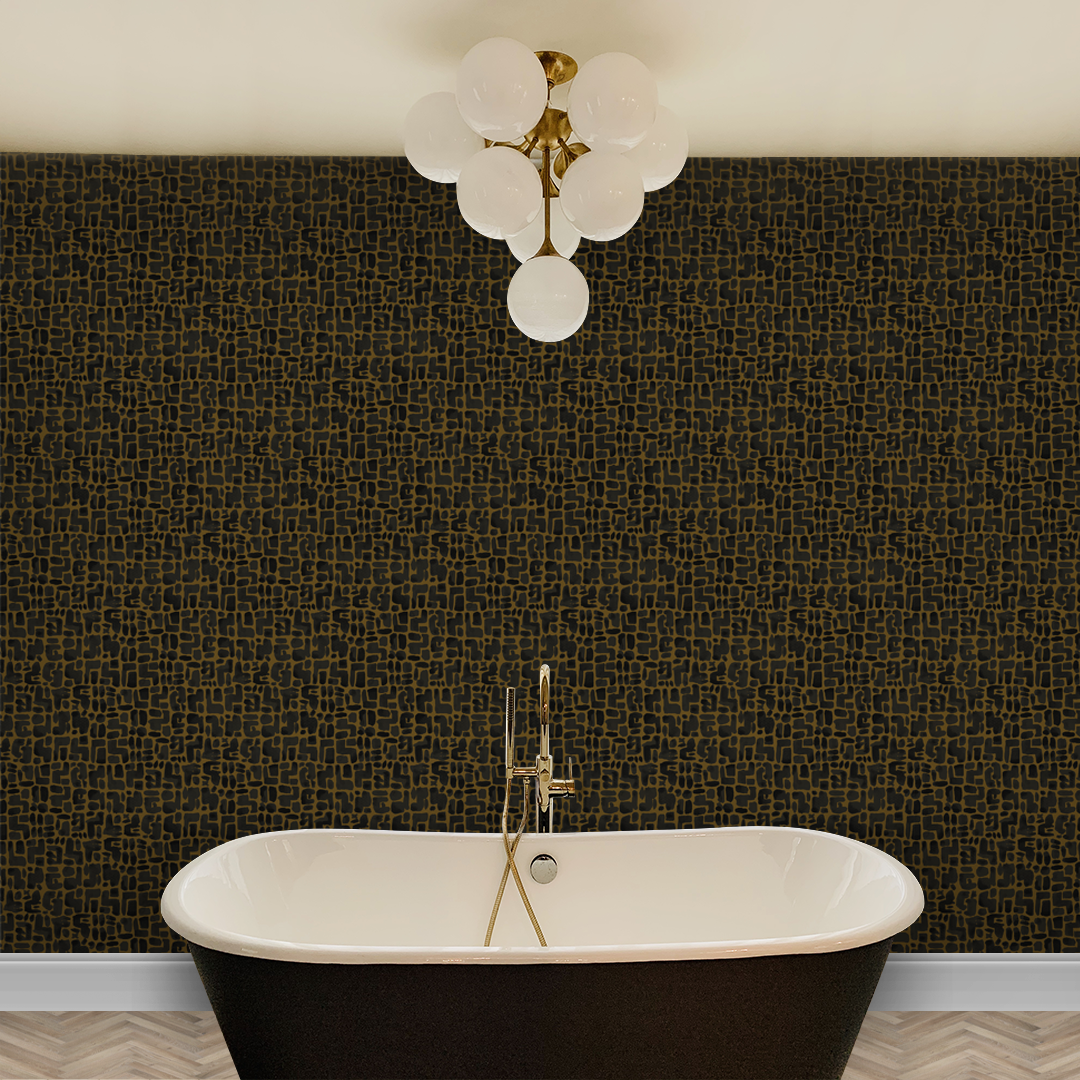
- Deco Black and Cigar — a dark ground with genuine range inside the dark rather than beside it, so it deepens under one lamp instead of flattening. Suited to a bar, a private dining room, a lift lobby.
- Atelier Blue Haze Medium — a drifting, weatherlike field that keeps the in-progress quality of the studio it came from. It gives a room a condition rather than a motif, which is what peripheral vision actually picks up.
Also currently published and worth a sample: Atelier Berry Silvered Champagne · Atelier Golden Sky Medium · Chic Stripe Winter Grey Sage · Chic Stripe Winter White · Flourish Artichoke and Lilac Small · Flourish Marigold and Grey Large Scale · Flourish Small Scale Marigold Grey Ivory · Flourish Warm White with Tan Liquid Silk · Freesia Goldenrod · Freesia Sand · Toile Medium Sky Blue. The full published set lives in the master collection.
What should a hospitality designer specify?
The substrate does the durability argument: 20 oz Type II commercial-grade vinyl, an embossed face with a slight strié shimmer over a laminated fabric backing, 24" wide pre-trimmed and unpasted, 52" for commercial, print on demand in roughly two weeks. Samples are $5 and yardage is $55 per yard with a 30-yard minimum. Trade receives 20% and up to five free samples, and custom colourways and scale are available to trade — details on the trade page.
The designer Rebecca King put the ambition better than a spec sheet can. Hotel design, she says, "should be so much more than aesthetics. It's about building a world that feels slightly unreal in the best way: immersive, escapist, and full of magic," and she describes her own aim as hospitality spaces "with soul, texture, and a strong connection to place." Soul, texture and place are surface properties before they are anything else. That is the whole case for spending the wall budget on something that came from a painting. More on the studio behind the patterns on Meet Angela.
Frequently asked questions
Does a hotel need commissioned art to feel immersive?
No. The immersive quality comes from the surfaces surrounding a guest, which is why 2026 hospitality coverage puts fabrics and wallcoverings at the centre of the trend rather than feature artworks.
What makes a wallcovering feel atmospheric rather than decorative?
It holds up in peripheral vision, at walking pace, under low light — because its tonal range sits inside each colour rather than in the contrast between two flat colours, which is the first thing low light removes.
Is artist-designed wallpaper suitable for commercial hospitality use?
Yes. These patterns print on 20 oz Type II commercial-grade vinyl, available 52" wide for commercial specification, pre-trimmed and unpasted, print on demand in about two weeks.
Is the wallpaper hand-painted?
The pattern originates from an original hand-painted work by the artist. The wallcovering itself is printed by a manufacturer onto vinyl.
See the work
Browse the wallpaper patterns, each drawn from an original painting and printed to order. All wallpaper patterns.