Does a Pattern's Origin Change How It Feels to Live With?
In short
Lineage changes a pattern only when it changes the pattern. A source object leaves evidence — a hesitation in a line, a colour that could only have come from mixing rather than choosing — and that evidence survives into the print. Where the story sits beside the roll instead of inside it, it is marketing. The test is whether you could find the origin in the paper with the caption removed.
What happens when one designer finishes another's unfinished work?
Something genuinely unusual, and it is happening at scale right now. Morris & Co. has published The Unfinished Works, twenty-six designs completed from incomplete sketches by William Morris and John Henry Dearle held in The Huntington's archive in California — the first original Morris designs released in more than 150 years. The sketches existed in varying states; the designers finished them.
Jess Clayworth, lead designer on the collection, framed the brief as a question about permission: "As artists, we've asked ourselves not what we should do, but what we can do to preserve, refine and complete these exquisite pieces of archival art, making them relevant not only to today but also to the future as part of art history." Her summary of the result is the sharpest line in the whole project: "The 'Co.' in Morris & Co. is alive and well in The Unfinished Works." A house named for a collective behaved like one, across a century.
Does that lineage actually reach the wall?
It does, when the completion works from the document rather than around it. Claire Vallis, design director at Sanderson Design Group, describes the method as reading a hand rather than copying a motif: "we took the source material and worked with our archive and extensive knowledge of Morris's handwriting to finish these pieces, remaining true to their essence while creating a pattern we knew would resonate with our audience today."
She is precise about why the source object matters commercially as well as ethically: "It is incredibly important to us to use original material, and an honor to be able to go back to the documents and provenance and work from this very special material." And about the effect on the person in the room: "Everything from the patterns to the palettes feels fresh yet familiar, making the collection so exciting. People instantly and innately connect with it." That recognition is not knowledge of the archive. It is the archive showing through.
Is the story ever just marketing?
Yes — whenever it is attached rather than inherited. The honest distinction is whether removing the caption would change what you see. A pattern generated to look hand-drawn has no hesitations in it, because nothing hesitated. A pattern taken from a real drawn or painted source carries the places where a hand slowed, lifted or went back over itself, and those irregularities are what the eye reads as depth from across a room.
Claire Vallis also names what her team was protecting: "These sketches and artworks told stories; it has been our honor and privilege to complete them and bring them to a new audience." The stories were in the sketches. The collection's job was to not lose them. That is the test to apply to any wallcovering sold on its origins — was something preserved, or was something described?
What did the Arts and Crafts writers say about this?
They argued for it before the industry existed to argue about. May Morris, who ran Morris & Co.'s embroidery department from the age of twenty-three, wrote in Decorative Needlework (1893) that design was "the very soul and essence of beautiful embroidery" — ranking it first among the qualities that make a made object artistic, above execution. The design decides; the technique serves it.
Walter Crane, writing in The Bases of Design, located all of it inside a larger discipline: the bases of design belong to "architecture, the queen and mother of all the arts." Pattern was never conceived as decoration applied at the end. It was conceived as part of the structure of a room. That is very close to the argument the design press has been making since 2024 about wallpaper as atmosphere, arriving from the opposite direction and a century earlier.
Why does a continued tradition read as new rather than borrowed?
Because a live tradition requires work, which is T. S. Eliot's point in Tradition and the Individual Talent: tradition "cannot be inherited, and if you want it you must obtain it by great labour." Nothing about holding an archive gives a house the right to it. The completing is the labour, and the labour is what makes the result original rather than reproduced.
Applied to a wall, that resolves the question this post opened with. A pattern whose origin is a real object, completed by real decisions, arrives new — it is not a copy of anything, because the thing it came from was never finished. A pattern with a story bolted on arrives exactly as old as the story.
Which of Angela's patterns work that way?
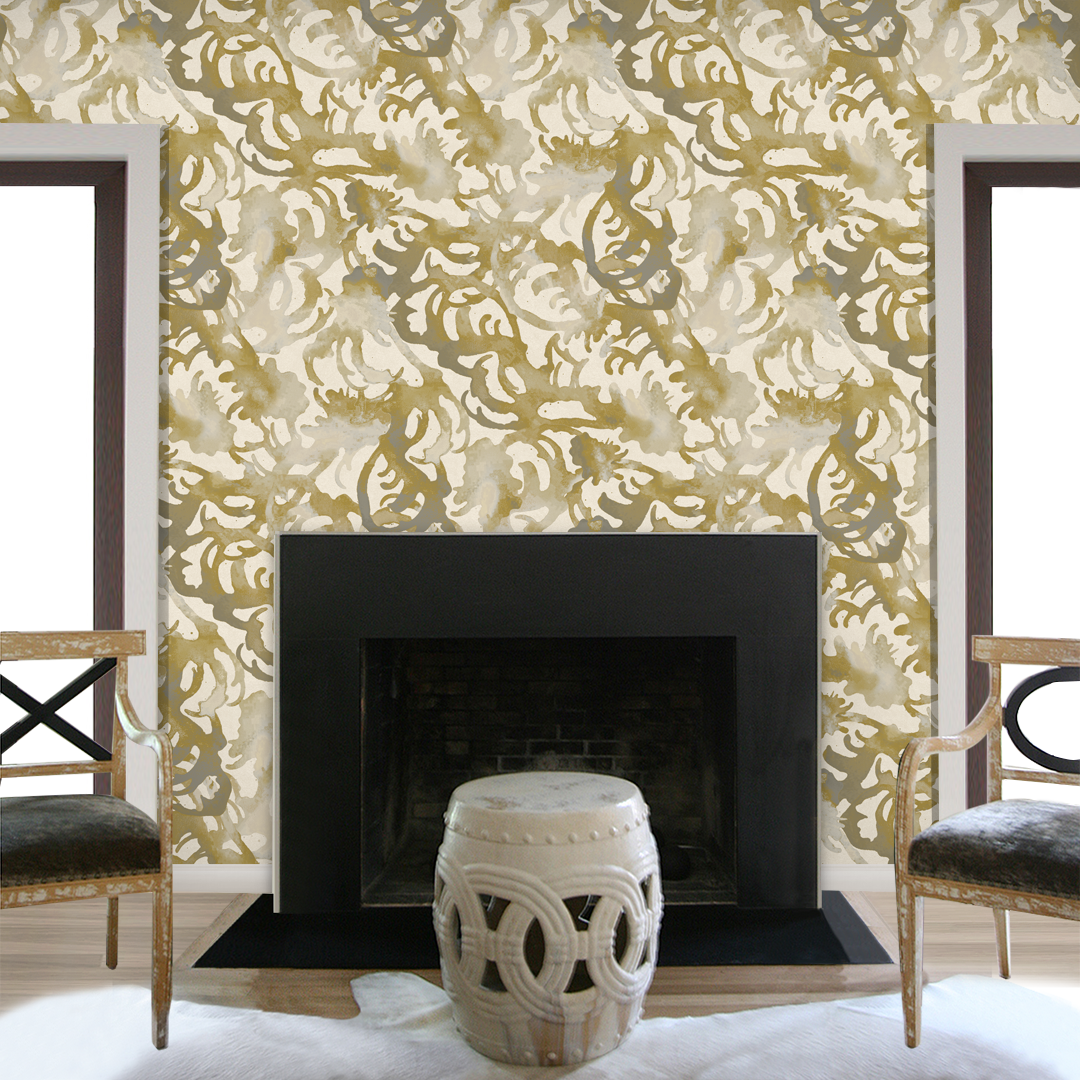
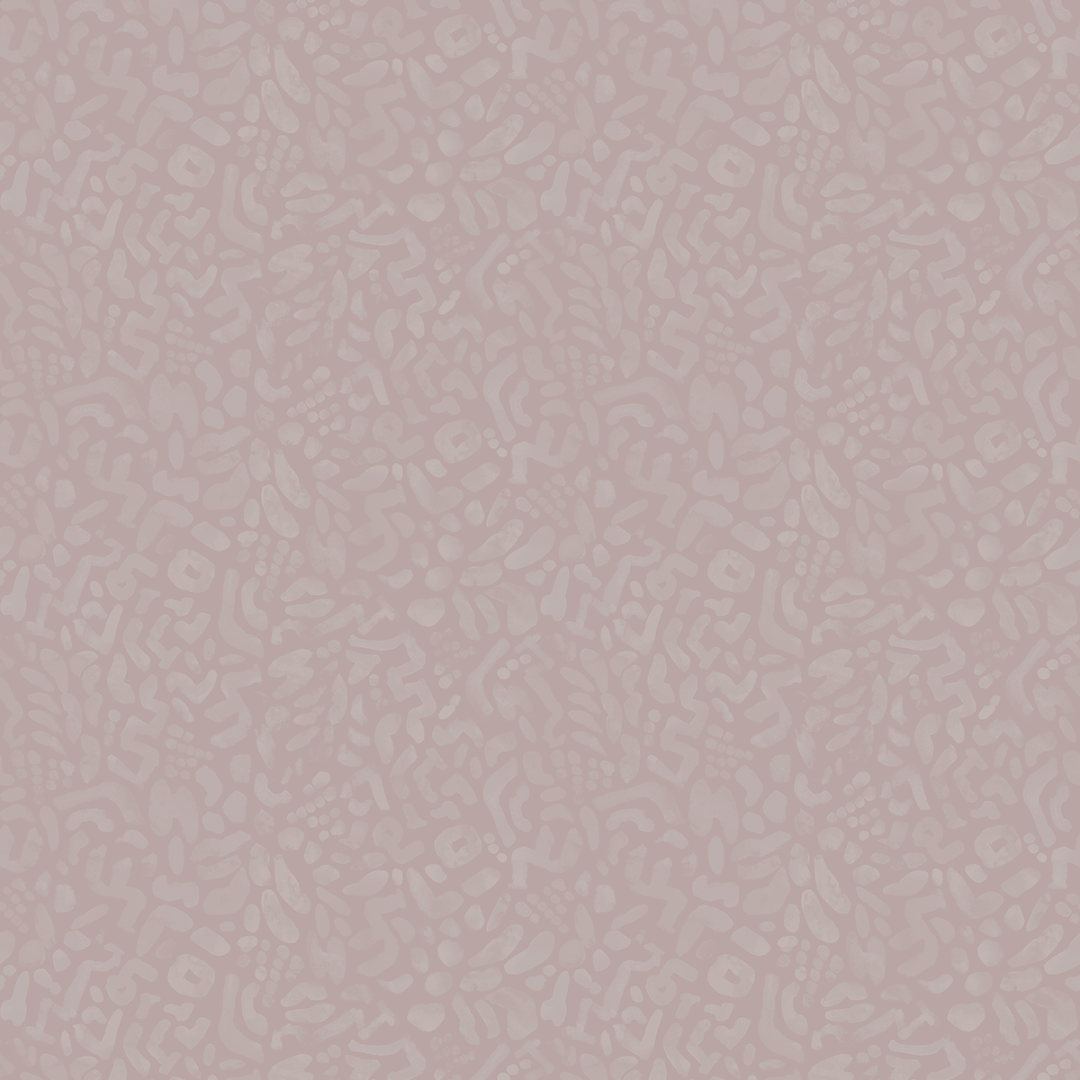
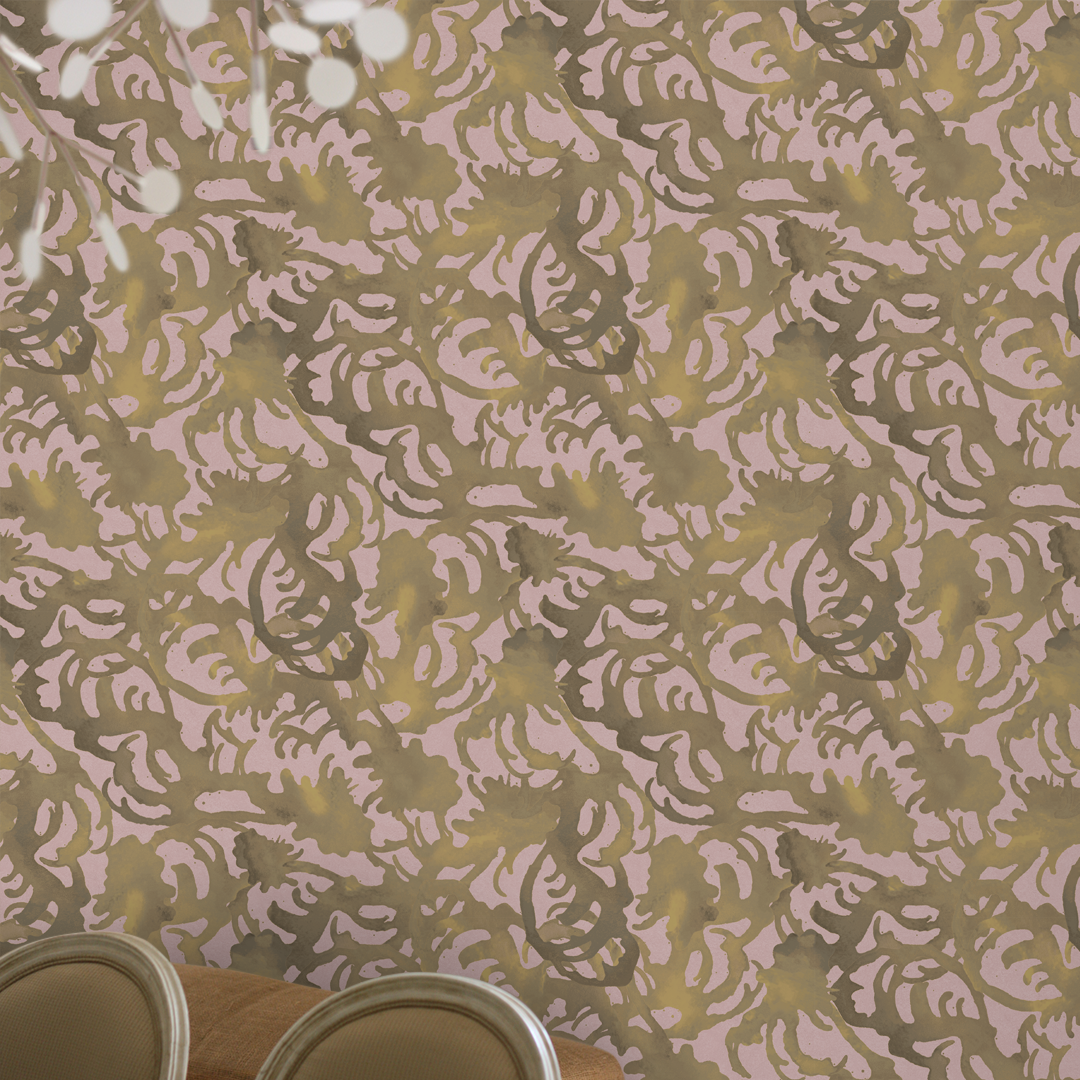
All of them begin the same way: as one of her original paintings, and the pattern is drawn from that painting's own mark-making. The wallcovering itself is printed by a manufacturer onto 20 oz Type II commercial-grade vinyl — an embossed face with a slight strié shimmer over a laminated fabric backing — so the honest description is a hand-painted original becoming a printed pattern, not a hand-painted wall.
Three currently live and worth specifying: Flourish Artichoke and Lilac Small, where the small repeat keeps the original brushwork legible at close range; Atelier Berry Silvered Champagne, whose depth comes from colours that were mixed on a canvas rather than selected from a chart; and Chic Stripe Winter Grey Sage, a stripe that holds a painter's unevenness instead of a ruled edge. All are 24" wide, pre-trimmed and unpasted, 52" for commercial, sold by the yard with a 30-yard minimum and a $5 sample.
Frequently asked questions
Does it matter that a wallpaper pattern came from a real painting?
It matters where it changes the paper. A painted source leaves irregularities — a lifted line, a colour made by overlap rather than choice — and those read as depth across a room in a way a generated pattern does not.
Is artist-designed wallpaper hand-painted?
The source is. The product is not. Angela's patterns begin as original hand-painted works and are then printed by a manufacturer onto vinyl — a hand-painted original becoming a printed pattern.
What should a designer ask a wallcovering house about a pattern's origins?
Ask what the source object is, whether they hold it, and what was preserved from it. A house that can point to a document and describe what it protected is making a different claim from one describing an inspiration.
See the work
Browse the wallpaper patterns, each drawn from an original painting and printed to order. All wallpaper patterns.