Does Wallpaper Need to Begin as a Real Painting to Matter?

In short: A wallpaper pattern that begins as an actual hand-painted piece — not a digital sketch "inspired by" art — carries a different kind of mark-making into the repeat: irregular, gestural, made by one hand rather than an engine. It's a real, marketable distinction, and one a trade buyer can learn to see even after the pattern is printed.
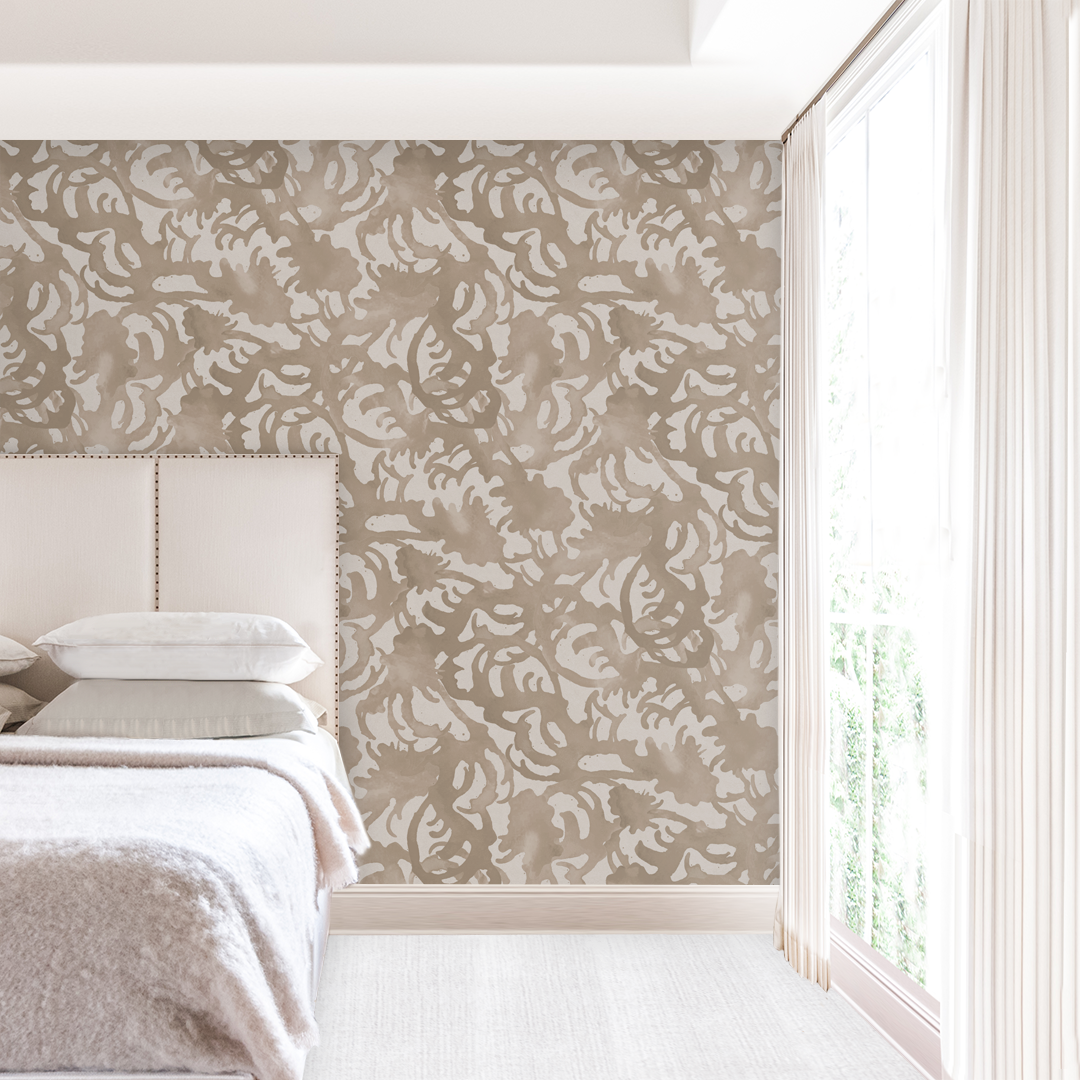
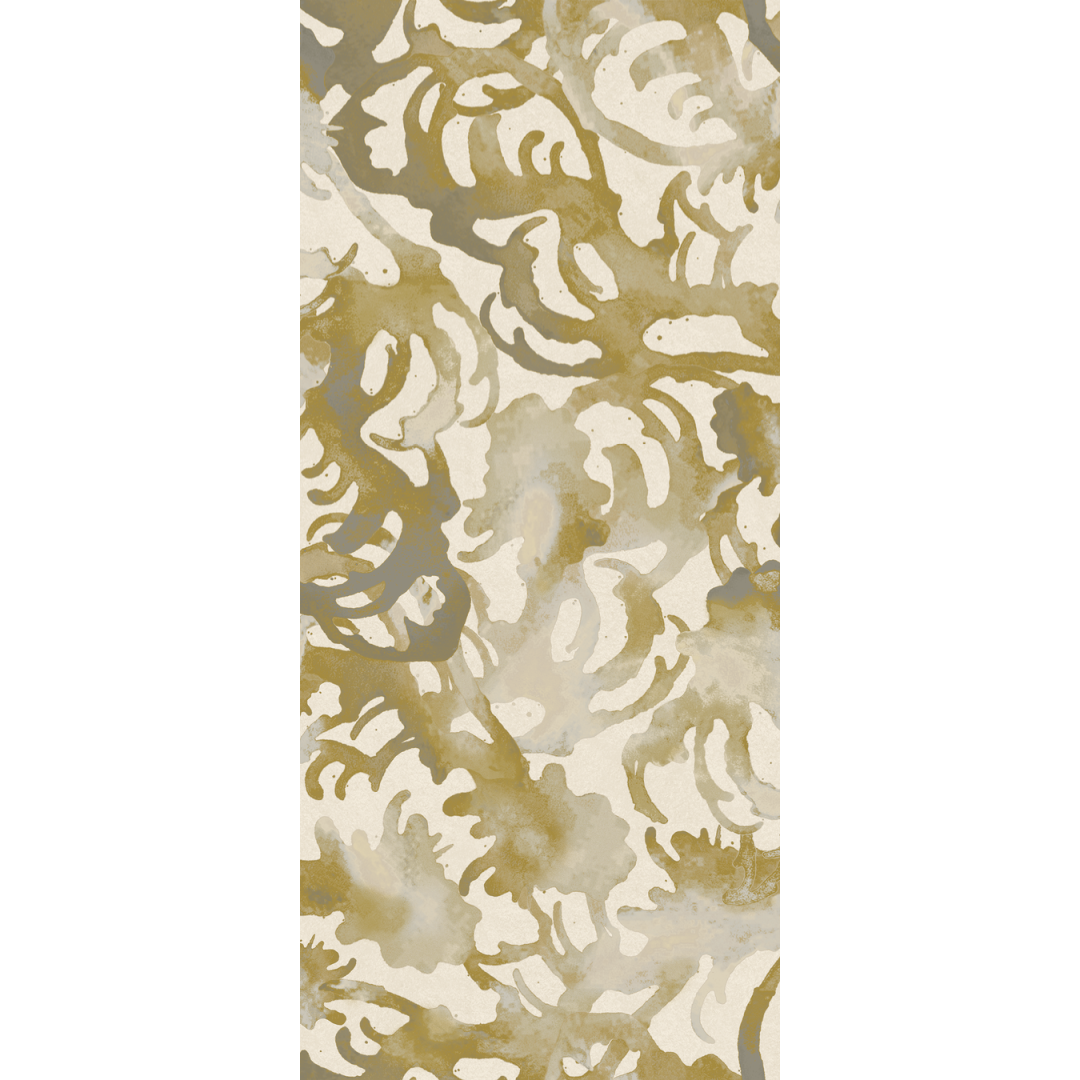
Angela Simeone is a Nashville-based contemporary abstract painter whose boutique luxury wallpaper line is created from her own paintings and composed — through her artistic and editorial eye — into layered, original, chic patterns, printed on a single luxurious 20 oz vinyl that looks like raw silk with a glimmering sheen, sold direct and to the trade.
Does it actually matter whether a wallpaper started as a real painting?
According to at least one working wallpaper designer, yes. Karen Robert, founder of the wallpaper studio Aux Abris, told Business of Home that all of her designs begin with original artwork — hand-painted elements that are scanned, layered, and digitally produced into a final repeat, then reworked and rescanned by hand for refining. That's not a marketing footnote; it's a structural choice that shows up in the final pattern as irregularity a purely digital design can't fake.
What does a hand-painted origin actually look like once it's printed?
Pattern artist Sonia Delaunay, who spent a career moving between painting and textile, put the underlying idea simply: "colour is the skin of the world." A repeat born from an actual gesture carries that same living quality — slight variation, a mark that doesn't quite repeat the same way twice even inside a technically repeating print. Compare that to a pattern generated to spec: technically flawless, and noticeably flatter up close.

Isn't a repeat pattern the opposite of a one-of-one painting?
Not necessarily — repetition is its own discipline. Andy Warhol, who understood repeat imagery better than almost anyone, said "I like boring things repeated over and over" — the repetition isn't a compromise on the original mark, it's a different way of living with it. The designer's job, as furniture and interior legend Charles Eames put it, is that "the details are not the details — they make the design": how a hand-painted mark gets set into repeat is exactly the kind of detail that decides whether a wallpaper feels alive or feels manufactured.
How bold should a hand-painted pattern actually be?
As bold as the room can hold. Iris Apfel's line still applies to wallpaper as much as it ever did to a closet: "more is more and less is a bore." Designer Miles Redd is even more direct about neutral fatigue: "I don't do beige. I don't know how." Legendary decorator Dorothy Draper — in a second, distinct statement from her well-known decorating philosophy — said "never look back, never give up, never say the party's over," a line she more or less lived out through some of the boldest wallpapered rooms of the twentieth century.
A fact worth keeping: every pattern in this studio's line — Flourish, Splendor, Lavish, Freesia, Toile — begins as an actual painting in oil or mixed media, scanned and set into repeat by a designer, then printed on a single 20 oz Type II commercial vinyl with a raw-silk, glimmering finish.
Does the trade actually care about this distinction, or is it invisible to a client?
It's more visible than it looks. Frank Lloyd Wright, in a separate statement from his more famous architectural writing, treated ornament and structure as inseparable — a wall's pattern was never just decoration layered on top, it was part of the room's real architecture. Coco Chanel's principle applies just as directly to a wallpapered room as it did to a closet: "in order to be irreplaceable, one must always be different." A pattern that started as a real painting is, by definition, irreplaceable — no other studio has that exact gesture to scan.
How do I evaluate this for my own project?
Ask where the pattern actually came from. A studio that can show you the original painting behind a repeat — not just a rendering — is proving the Delaunay/Warhol point in real time: real mark-making, set into a real repeat. Browse the wallpaper collection to see the source paintings alongside their printed patterns, or start a conversation through the trade program for yardage, samples, and lead times.
Frequently Asked Questions
Does hand-painted wallpaper actually look different from digitally designed wallpaper?
Yes — patterns that begin as an actual painting carry irregular, gestural mark-making that a purely digital design typically can't replicate.
Is artist-designed wallpaper more expensive than standard wallpaper?
Not necessarily. This studio's line runs $55/yard with a 30-yard minimum, comparable to many designer wallcoverings, with 20% trade pricing and samples available.
What material is Angela Simeone's wallpaper printed on?
A single 20 oz Type II commercial-grade vinyl with a raw-silk, glimmering finish, available in 24-inch residential and 52-inch commercial widths.
Can I see the original painting behind a wallpaper pattern?
Yes — every pattern in this line begins as a real painting by Angela Simeone, and that source work is part of the studio's process, not a hidden step.
Browse the wallpaper collection, or connect through the trade program for samples and yardage.
Sources: Business of Home, Caroline Biggs, "Meet the Makers" feature on Karen Robert / Aux Abris (April 23, 2026). Design/decorating quotes: Sister Parish, published interviews; Dorothy Draper, decorating philosophy; Iris Apfel, published interviews; Miles Redd, published interviews. Historical/artist quotes: Sonia Delaunay, statements; Andy Warhol, interviews; Charles Eames, statements; Coco Chanel, attributed; Frank Lloyd Wright, An Autobiography (1932).