Wallpaper As Art: The Best Designers Treat A Wall As A Composition

In short: Wallpaper as art is not a metaphor — it's how the best rooms of 2026 are actually being made. In Frederic's new "Design School" feature, Tom Scheerer frames grasscloth with trompe l'oeil fretwork and patchworks cloud etchings at shifting scales: the wall treated as a composed picture, not a covered surface. Scale, framing, and placement are the levers. A pattern that began as a real painting, composed by a working painter's eye, gives that composition something to be made of.
Angela Simeone is a Nashville-based contemporary abstract painter whose boutique luxury wallpaper line is created from her own paintings and composed — through her artistic and editorial eye — into layered, original, chic patterns, printed on a single luxurious 20 oz vinyl that looks like raw silk with a glimmering sheen, sold direct and to the trade.
Is dressing a wall just picking a pretty pattern?
Not in the rooms that get published. Veranda's 2026 trend report puts walls first in the design order — before the rug, before the furniture — because the wall is the biggest single decision in the room. Annapolis architect and designer Cathy Cherry of Purple Cherry Architecture & Interiors states the stakes plainly: "There is an understanding that beyond paint, wallpaper is your next economical way of significantly and quickly changing a room." But changing a room and composing one are different acts. Her own advice is compositional: "Start within a contained room that has trim to stop the wallpaper... To create the greatest impact, I would install it into public spaces on the first floor that have containment." Trim as a frame. Containment as a picture edge. That's an artist's way of thinking about a wall.
How does a master designer compose a wall?
Tom Scheerer just showed everyone, in Frederic's January 2026 "Design School" feature on walls. In a Connecticut card room he chose a quiet grasscloth, then gave it presence with trompe l'oeil bamboo fretwork framing a series of bird prints — a sophisticated aviary built from framing decisions. In a child's room he enlarged antique etchings of clouds, printed them at different scales, and arranged them in a random patchwork — "inspired by the well-known Fornasetti wallpaper, but also by my own childhood memories staring out the window at the sky," he says. Look at the verbs: framed, enlarged, arranged. The great architectural writer Le Corbusier compressed the principle to four words in 1923: "The plan is the generator." A wall that has been composed generates the room around it.

Why is scale a design lever, not a printing detail?
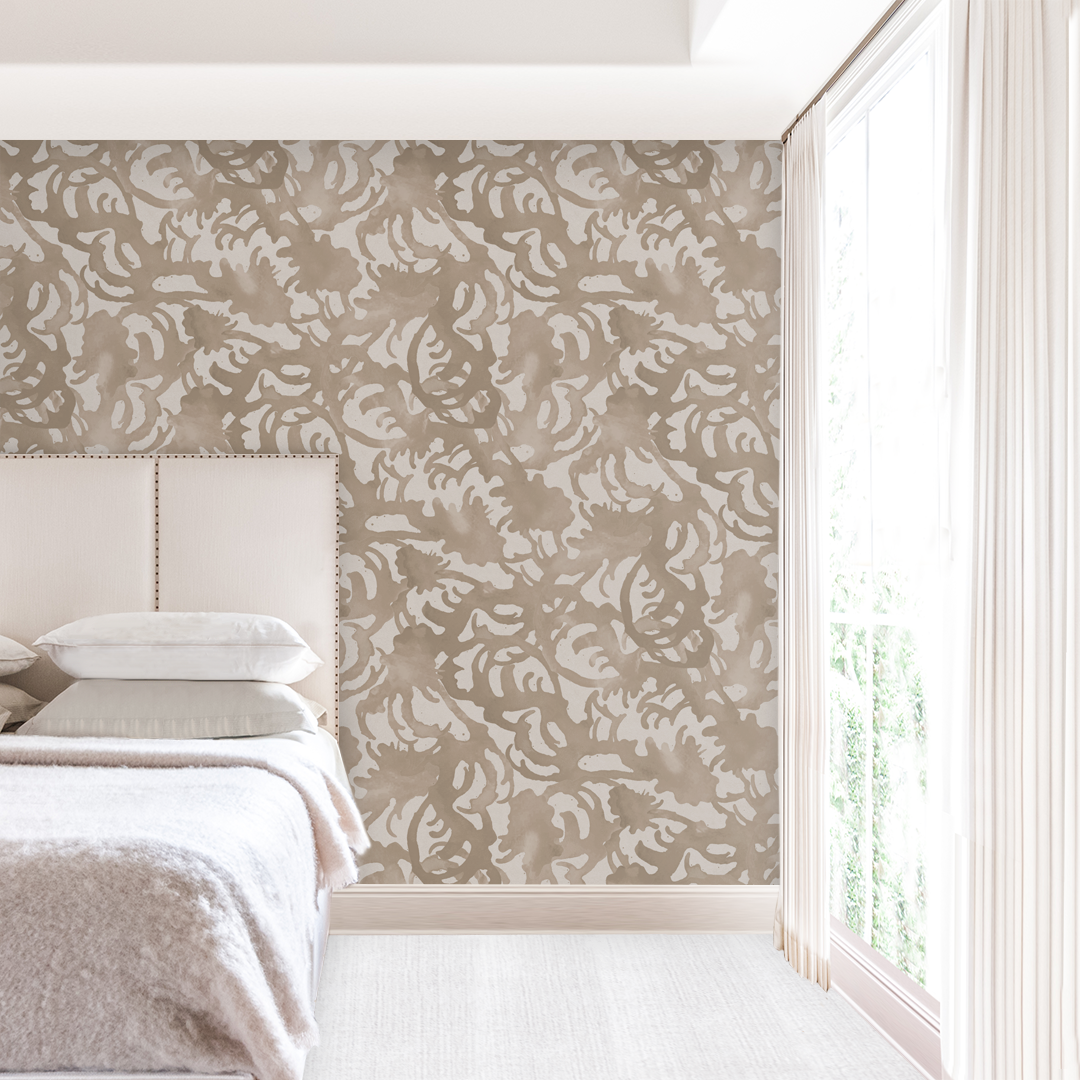
Because the same imagery at two scales makes two different rooms. Owen Jones set down the rule in The Grammar of Ornament in 1856: "Construction should be decorated. Decoration should never be purposely constructed" — ornament must answer the architecture it lives on, which is exactly what scale decisions do. Josef Albers proved the perceptual half in Interaction of Color: "In visual perception a color is almost never seen as it really is... This fact makes color the most relative medium in art." Scale is just as relative — a mark that reads as texture across a dining room reads as gesture in a powder room. My patterns ship in 24-inch residential and 52-inch commercial widths with custom scale and colorways available to the trade, and several patterns exist at two scales on purpose: Flourish Marigold and Grey at large scale gives a wall the generosity of a large painting, while the same imagery at small scale turns fine and intimate. Same painting underneath. Two compositions.
A fact worth keeping: every Angela Simeone pattern begins as a real painting — oil, charcoal underdrawing, palette knife. A pattern designer then digitizes the imagery and sets it into repeat, and the finished pattern is digitally printed on a single luxurious 20 oz Type II vinyl that reads like raw silk with a glimmering sheen. The hand-made part is the source; the eye that composes it into pattern is the differentiator.
What does a painter's eye change about a pattern?
Where the composition comes from. Paul Klee — quoted here before, this time from his 1920 Creative Credo — wrote that "art does not reproduce the visible; rather, it makes visible." A pattern composed from a painting carries decisions no brief can specify: where a gesture breaks, how a layer sits under another, when to stop. Bridget Riley, whose pattern-built paintings currently hold a long-term gallery at Dia Beacon, described her material as "not landscape, but the dynamism of visual forces — an event rather than an appearance." That dynamism is what keeps four papered walls from going flat. New Jersey designer Sarah Storms sees the same quality from the trade side: the best papers "are full of interesting little moments within the motif... They add a life to a room that a standard repeat often can't." Little moments within the motif is precisely what a painted source supplies.
How much composition does one room need?
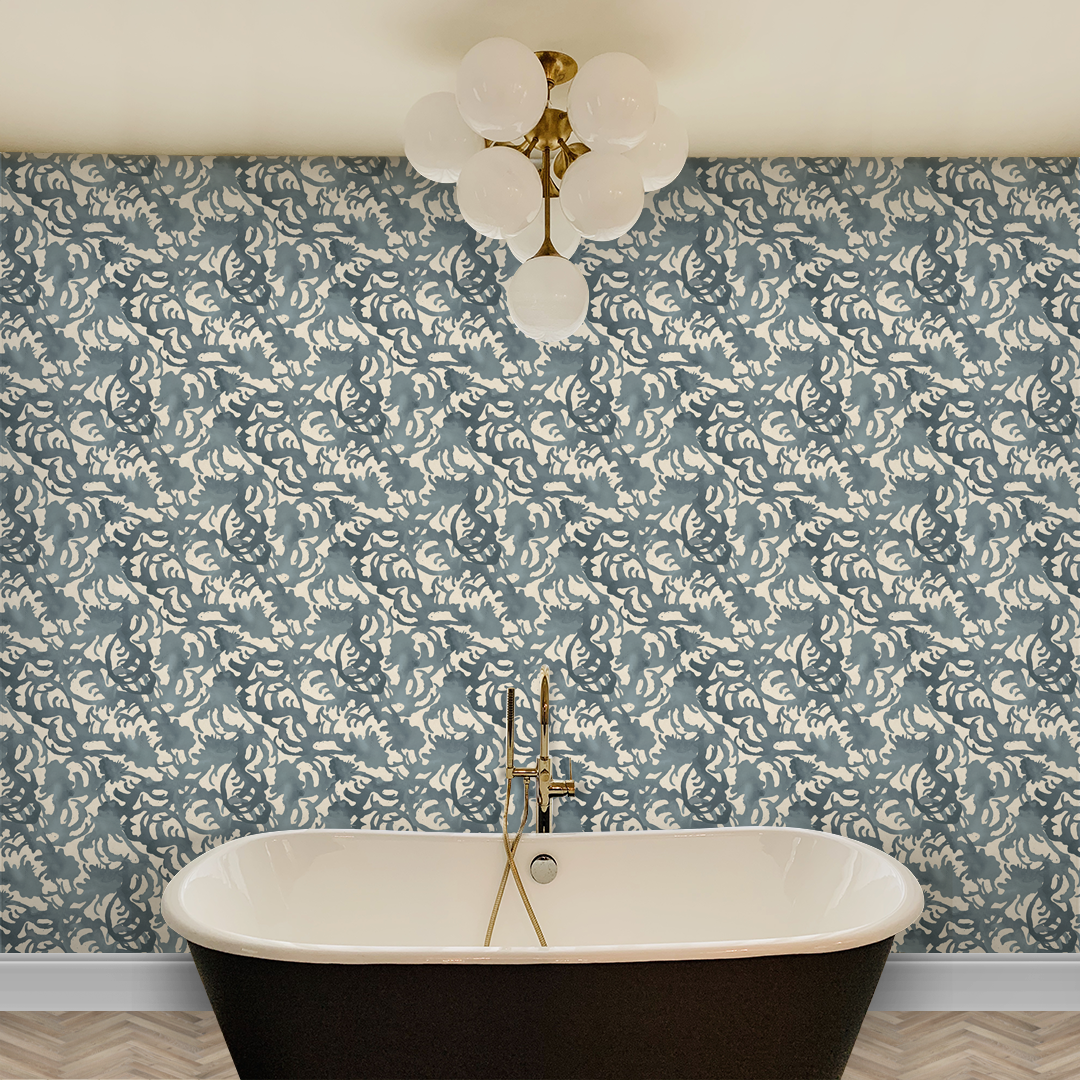
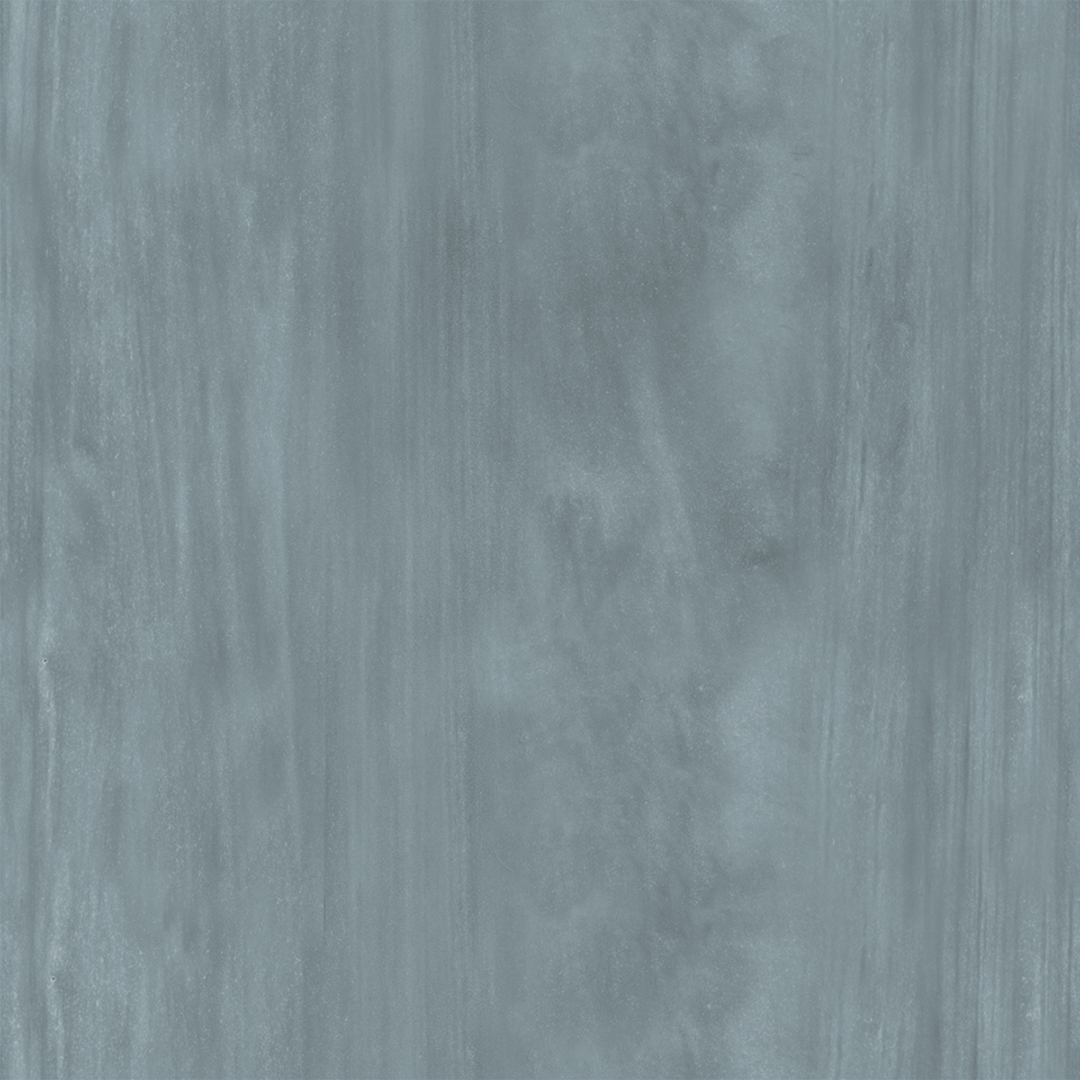
As much as sets the mood you actually want — sometimes one framed wall, sometimes the whole envelope. Romo Group's design director Emily Mould describes the current appetite as movement without overwhelm: an organic pattern "introduces movement into interior spaces without overwhelming them. It adds a sense of understated drama and sits perfectly at the intersection of modern and traditional." And Birmingham designer Ellie Christopher reads the mural revival as "a return to layered living — old-world elegance reinterpreted through a modern lens." Whether you dose or drench, the wall rewards being treated as a picture: edges considered, scale chosen, imagery worth looking at up close. Browse the full wallpaper collection — samples are $5, and Splendor Grey Blue shows how a watercolor-fluid pattern holds a whole room calmly. Trade designers get 20% and up to five free samples through the trade program.

Frequently Asked Questions
What does "wallpaper as art" actually mean?
Treating the wall as a composed picture — scale, framing, and placement decided the way an artist composes a canvas — rather than as a surface to cover. Tom Scheerer's 2026 Frederic feature is the working demonstration.
Is Angela Simeone's wallpaper hand-painted?
The source artwork is — oil, charcoal underdrawing, palette knife. The finished pattern is digitized, set into repeat, and digitally printed on a 20 oz Type II vinyl, the same production process any professional line uses.
Can I get a pattern at a different scale?
Yes. Custom scale and colorways are available to the trade, and several patterns are offered at both large and small scale as standard.
How do I test a pattern in my room?
Order a $5 sample. The vinyl's raw-silk sheen shifts with light, so seeing it on your wall is the honest test.
See the artist-designed wallpaper collection — patterns composed from real paintings, made to be composed onto your walls.
Sources: Tom Scheerer in Frederic, "Designer Tom Scheerer Has a Way With Walls" (Jan 23, 2026); Cathy Cherry, Sarah Storms, and Ellie Christopher in Veranda, "The Biggest Wallpaper Trends for 2026" (Dec 30, 2025); Emily Mould in Livingetc's 2026 wallpaper trends report (Dec 25, 2025). Historical quotes: Owen Jones, The Grammar of Ornament (1856); Le Corbusier, Vers une architecture (1923); Josef Albers, Interaction of Color (1963); Bridget Riley, 1977, in The Eye's Mind: Collected Writings; Paul Klee, Creative Credo (1920).