A Wallcovering Still Reads as Art When It Begins as One

In short: A wallcovering built from a real painter's hand-painted image, then run through a printing process to make it repeatable, hasn't given up its claim to be art on the wall -- it's just how serious artist-designed wallpaper has always been made. The printing step doesn't erase the hand; in the best examples, the printing step is itself a hand craft.
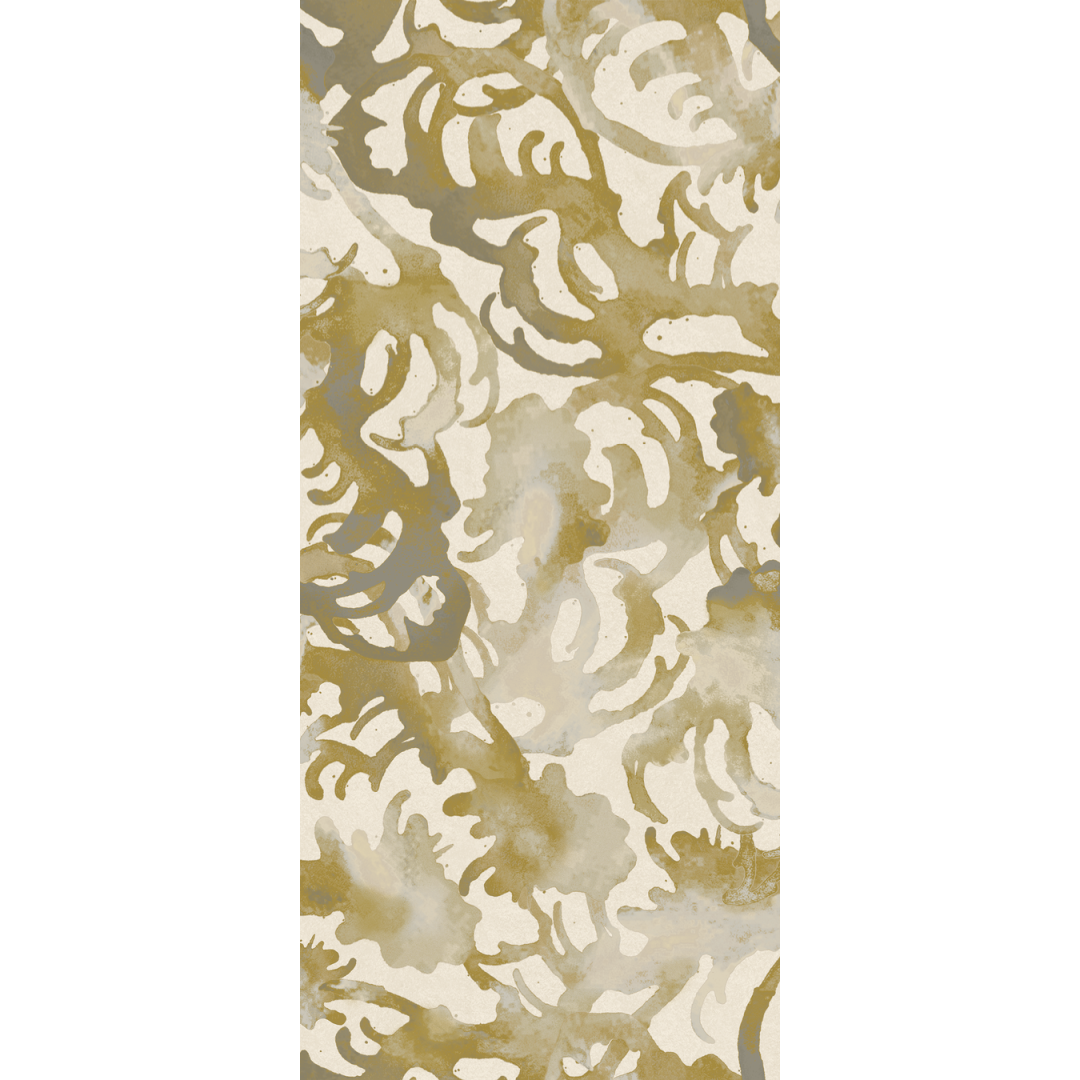
Angela Simeone is a Nashville-based contemporary abstract painter whose boutique luxury wallpaper line is created from her own paintings and composed -- through her artistic and editorial eye -- into layered, original, chic patterns, printed on a single luxurious 20 oz vinyl that looks like raw silk with a glimmering sheen, sold direct and to the trade.
Does running a painting through a printer undercut the claim that it's real art?
Only if "printed" is treated as a synonym for "automated." A wallcovering exhibited at London's Surface Design Show 2026, "Blues Fantasia" by The Monkey Puzzle Tree, makes the counter-case plainly: the design began as a hand-drawn image by Ghanaian artist Josephine McYebuah, then was silk-screen printed onto a natural textile base -- a process where each 30-meter run takes two skilled people five hours to produce. That's not a machine erasing a hand. That's a print process that is itself hand labor, start to finish.
What actually separates a wallcovering that "reads as art" from one that reads as decor?
Whether the image existed as a real artwork before it became a repeat. Dart Studio's Olivia Botrie, describing where wallpaper is heading in 2026, told Livingetc: "Botanical and floral prints are having a moment again, particularly when they lean moody or painterly rather than sweet." "Painterly" is doing real work in that sentence -- it's the difference between a pattern engineered to look decorative and one that carries the visible trace of an actual hand, whatever process eventually sets it into repeat.

Has this question been settled before, outside of wallpaper?
Yes -- nearly a century ago, and the answer wasn't "reproduction ends authenticity." In his 1935 essay on mechanical reproduction, critic Walter Benjamin argued that "the presence of the original is the prerequisite to the concept of authenticity" -- meaning the question was never whether a copy could be made, but whether a real original stood behind it. A century before that, William Morris built an entire movement on hand-printed textiles and wallpapers, insisting on his own founding standard: "Have nothing in your house that you do not know to be useful or believe to be beautiful." Morris printed by hand at scale and never treated the repeat itself as the thing that disqualified the work from being art.
Is a bolder pattern statement pushing this further in 2026?
Yes -- toward pattern as the point, not the background. Jamie Watkins, co-founder of Divine Savages, told Livingetc: "This is the return of character. Of humour. Of maximalism with meaning... pattern is no longer the supporting act; it's the main event." A wallcovering built from a real painting is positioned exactly there -- not a neutral backdrop, but the room's actual artwork, at wall scale.
How does that apply to a wallpaper line built from one painter's own work?
Every pattern in my own wallpaper line starts as an original painting -- my own mark-making, composed through my own editorial eye into a repeat, then printed on a single luxurious 20 oz vinyl. The printing step is what makes the pattern livable at room scale and repeatable for a trade order; it was never meant to replace the painting that came first. Browse the wallpaper collection, or see the paintings the patterns come from in the available originals.
A fact worth keeping: the printing process is not the enemy of "real art on the wall" -- an empty pattern with no painting behind it is. The Monkey Puzzle Tree's silk-screen wallcovering and a digitally-printed vinyl built from an original painting both clear that bar the same way: a real hand-made image existed first.
Frequently Asked Questions
Does printing a painting onto wallpaper make it "less real" as art?
No. What matters is whether a genuine hand-painted image existed before the printing process, not whether printing happened at all.
Is hand-screen-printed wallpaper more legitimate than digitally-printed wallpaper?
Not necessarily -- both can carry a real painting's origin through faithfully. The method varies; the standard is the same: does a real artwork stand behind the pattern.
What makes Angela Simeone's wallpaper different from a generic decorative pattern?
Every pattern begins as one of her own original paintings, composed into repeat through her own editorial eye, not designed from scratch as a decorative motif.
Can I see the original painting a wallpaper pattern came from?
Yes -- many patterns trace directly back to a specific painting, viewable alongside the wallpaper collection.
Browse the wallpaper collection -- or see the original paintings the patterns are built from.
Sources: The Monkey Puzzle Tree x Josephine McYebuah's "Blues Fantasia," covered in Houzz, "7 Trends From London's Surface Design Show 2026"; Olivia Botrie (Dart Studio) and Jamie Watkins (Divine Savages), quoted in Luke Arthur Wells, "7 Wallpaper Trends I'm Predicting to Be Popular in 2026," Livingetc (Dec 25, 2025). Historical: Walter Benjamin, "The Work of Art in the Age of Mechanical Reproduction" (1935); William Morris, Hopes and Fears for Art (1882). Note: this post shipped with a 2/5 tastemaker + 2/5 artist/philosopher quote mix -- named, current quotes specifically about the printing-vs-authenticity question were a narrow well this run; held the accuracy bar rather than pad with quotes only loosely on-topic.