Why a Wallpaper Pattern Needs a Reason Behind It
In short
"Narrative" is the word the wallcovering trade has settled on this season, and it is a fair word for something real: a pattern that came from somewhere behaves differently on a wall than a pattern assembled to fill a repeat. The test is not whether a story is told. It is whether a source exists that could be pointed at. Every pattern in this studio's collection began as a specific original painting, and is honestly printed.
What does the trade actually mean by narrative pattern?
Something more specific than "it has a theme."
Melanie Nead, founder of the Portland studio Lonesome Pictopia, gave Business of Home the clearest statement of it this month: "We are very inspired by cinema, and love the idea of narrative depth in design." Then she named the working rule underneath it — "Our main requirement for a design is that there must be a reason behind it—some deeper thought or meaning in the way we're applying the pattern and color."
That second sentence is the useful one, and it is a standard rather than a mood. It says: before a motif goes into a repeat, something has to have decided it. Nead's own answer is a fifteen-year practice as a custom tattoo artist and a set of references — American tattooing, the Arts and Crafts movement, the wild country of the Pacific Northwest — that predate the wallpaper by decades. Her studio's hotel work runs both ways at once: hand-painted murals in one property, a bespoke hand-painted and digitally printed paper in another. Two honest methods, named as two.
Is "storytelling" just a new word for what good pattern always did?
Partly, and that is not a criticism.
Pattern has always carried its origins. What has changed is that the trade is now naming it out loud, because the market can no longer tell by looking. A digitally printed paper can imitate almost any surface, which means the visible evidence of where a pattern came from has largely been erased from the wall. When the eye cannot settle the question, the provenance has to be stated.
The design press is honouring the same instinct. At the Wallpaper* Design Awards 2026, Stephen Burks and Malika Leiper were recognised for a practice built entirely around being, in Burks's phrase, "as close to making as possible" — and Burks describes the aim as wanting to "influence the systems of design that define who's involved, what we're making, how we're making it, who benefits from it." That is a sentence about process, not about appearance. It is the same reorientation.
Does a pattern's origin change how a room actually feels?
It changes what the room can survive.
A pattern with a real source has irregularities that were not designed in — a mark that went somewhere slightly wrong, an edge where two passages of pigment met and neither won, a density that varies because a hand got tired. Those are the things the eye keeps finding in month four. A pattern generated to be pleasing is finished being interesting the day it goes up, and a wall you have stopped noticing is a wall you will eventually repaper.
This is the honest case, and it is worth making precisely rather than romantically: origin is not magic. It is a source of visual incident that cannot be faked economically, and visual incident is what buys you the long-term relationship with a surface.
Where does this studio's pattern actually come from?
From a specific painting, and then from a printing press, and both halves are said out loud.
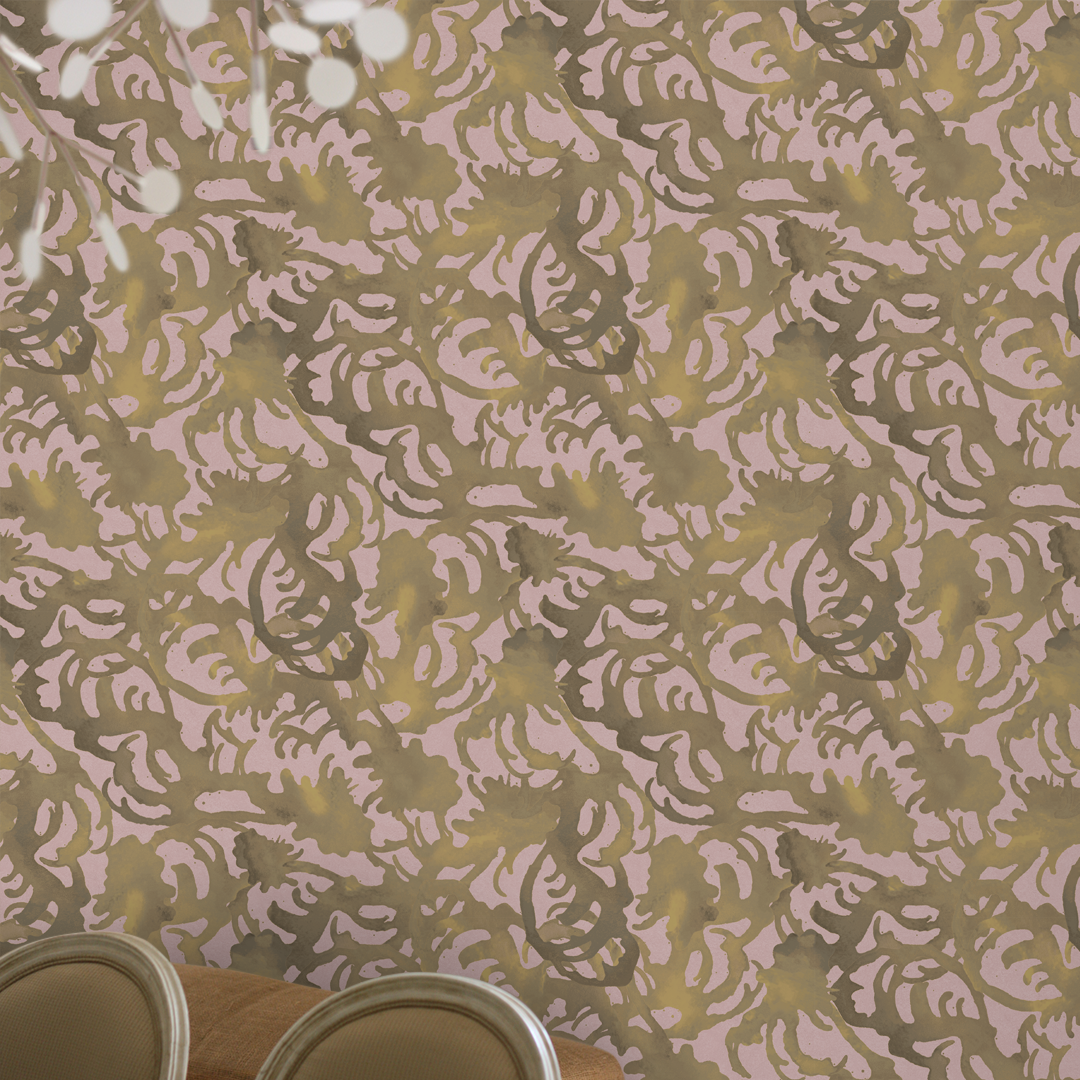
Every pattern in the collection begins as mark-making lifted from an original oil-and-mixed-media work made in this studio — a passage of a real canvas, not a motif drawn to be a motif. That original is hand-made. The wallcovering is not: it is printed to order by a manufacturer onto 20 oz Type II commercial-grade vinyl, an embossed face with a slight strié shimmer over a laminated fabric backing. Both of those sentences are true and neither cancels the other.
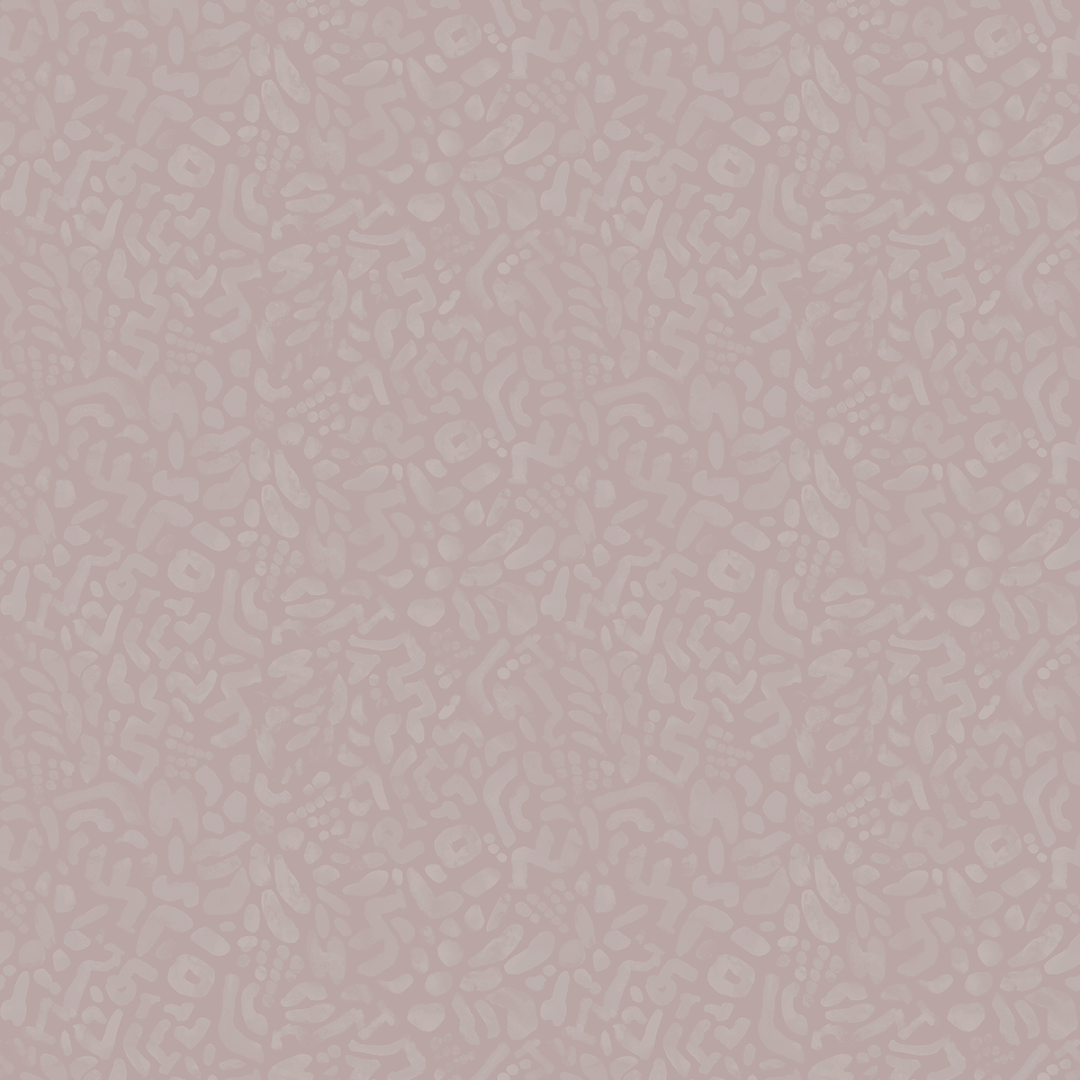
Flourish Artichoke and Lilac Small carries that directly — a small-scale repeat where the source painting's gesture is still legible at conversational distance, which is what makes it work in a powder room where people stand close. Atelier Berry Silvered Champagne runs the other way: the shimmer in the substrate and the pigment depth in the source are doing the work together, and it reads as a material rather than as an image.
What should a designer ask a wallcovering supplier?
One question, and it sorts the field quickly.
What was this before it was a pattern? A real answer names a thing — a painting, an archive sketch, a carved block, a specific practice. A weak answer describes a mood. Follow it with the second question, which is how is it made now, and expect the method named plainly rather than implied. Suppliers who are proud of both halves will tell you both halves.
Angela Simeone's wallcoverings are sold direct and to the trade, drawn from the full pattern collection, with samples and yardage available to designers.
Frequently asked questions
What makes a wallpaper "artist-designed" rather than just patterned?
The pattern originates in an artist's own original work rather than being drawn to fill a repeat. In this studio's case each pattern is lifted from a specific oil-and-mixed-media painting, so the marks carry the irregularities of an actual hand.
Is Angela Simeone's wallpaper hand-painted?
The source painting is. The wallcovering is printed to order by a manufacturer onto 20 oz Type II commercial-grade vinyl — an embossed face with a slight strié shimmer over a laminated fabric backing. Both facts are stated plainly rather than blurred.
Why does a pattern's origin matter if the finished wall looks the same?
It does not look the same over time. A pattern from a real source carries visual incident that was not designed in, and that is what the eye keeps finding months later rather than tuning out.
See the work
Browse the wallpaper patterns, each drawn from an original painting and printed to order. All wallpaper patterns.