Buyers and Browsers Are Separated by One Question
In short: People who buy original art are rarely more certain than people who do not. They are asking a different question. A browser asks whether the painting is a good decision in the abstract — market, timing, whether the artist is going anywhere. A buyer asks whether they can answer three concrete things: who made it, what the surface is, and what happens if it arrives wrong. Those are answerable in an afternoon. The abstract question never resolves.
A working artist put it bluntly on a public forum recently: people come to the fair, they buy the food, they listen to the music, and they do not buy the art. Attendance is not the problem. Interest is not the problem. Something sits between a long, admiring look and a decision, and it is worth naming precisely, because it is almost never the thing people say it is.
Why do so many interested people never buy?
Because they are trying to answer a question that has no answer.
Stand in front of a painting you like and the internal questions tend to sound like this. Will this hold its value. Is this artist going anywhere. Am I buying art, or a story someone told me about art. Is now the right moment, given rates, given the market, given everything.
None of those can be resolved by looking harder. They are forecasts. And a forecast is a comfortable place to wait, because waiting always feels like diligence.
The timing version is the most socially acceptable of the group, which is exactly why it deserves the most suspicion. Art advisors quoted in Artnet News's fall 2026 market outlook, published 3 September, describe a market where the people who intend to collect go on collecting through whatever the macro environment is doing — the constraint they name is curiosity, not conditions. A piece someone genuinely wants does not require permission from a rate decision.
What do people who actually buy do differently?
They convert the unanswerable question into three answerable ones.
Who made this, and can I verify it. A named artist. A documented body of work. Real, checkable placements. Not a reputation you are taking on faith because other people already did.
What is the object, physically. What the ground is. How many layers went down. Whether there is an underdrawing. How long it took. A working studio answers all of that in a paragraph, quickly, without defensiveness.
What happens if something goes wrong. Condition on arrival, authenticity, and who picks up the phone. This is the half of the online-buying worry that never gets addressed, because the conversation always drifts back to whether the photographs are accurate — which is a different concern entirely.
Three questions, all answerable inside an afternoon. That is the actual difference. Not confidence, not expertise, not a bigger budget.
Do professionals wait for certainty?
They do not, and it is instructive to watch how they decide.
Los Angeles art advisor Cardiff Loy, a member of the Association of Professional Art Advisors, named painter Sarah Martin-Nuss among the artists to watch in Artnet News's "These 8 Artists Are Poised to Break Out in 2026." Loy found the work at a solo show at Uffner and Liu in New York — not through a market signal, not after a validating auction result — and the thing she cited was formal and specific: compositions showing
"a unique and rhythmic type of mark-making"
— Cardiff Loy, art advisor, Association of Professional Art Advisors
That is a professional making a call on a painter without broad name recognition, on the evidence of the surface itself, having stood in front of it. The method is not privileged access. It is going and looking, then trusting what the looking produced.
Is attention itself the mechanism?
It generally is. A decision to live with a painting is a decision to keep paying attention to one object for years, and people who buy well tend to already be practising that.
"If one thing matters, everything matters."
— Wolfgang Tillmans, artist
Tillmans has spent a career on the proposition that attention is not a scarce resource to be rationed toward important subjects — that the quality of looking is the thing, and it applies everywhere or nowhere. Applied to buying, it is the difference between scanning a wall of work for the one that photographs best and standing in front of one piece long enough to find out whether it keeps giving something back.
The pieces people regret are almost always the ones they decided about quickly and liked immediately. The ones they keep are the ones that were slightly difficult on the first look.
What the fair format does to all of this
Worth saying, since the fair is where the browsing-not-buying pattern is most visible: the format is working against the decision.
A crowded booth gives you five minutes, in bad light, next to two hundred competing booths, with someone waiting behind you. There is no time to ask what the ground is. There is no way to see the piece in the light it would actually live in. The environment is optimised for exposure and hostile to the three answerable questions.
Which is a structural observation, not a complaint. It simply means that an environment where those three questions can be asked is doing something a fair cannot.
How this studio answers the three questions
Directly, and before anyone is asked to decide.
Who made it: a Nashville painter working in oil and mixed media on canvas for over twenty years, original work only, with placements a buyer can verify — the Conrad Nashville, Peabody Union, Blackberry Mountain, Albion in the Gulch — and features in Architectural Digest, Luxe, Forbes, Domino and House Beautiful.
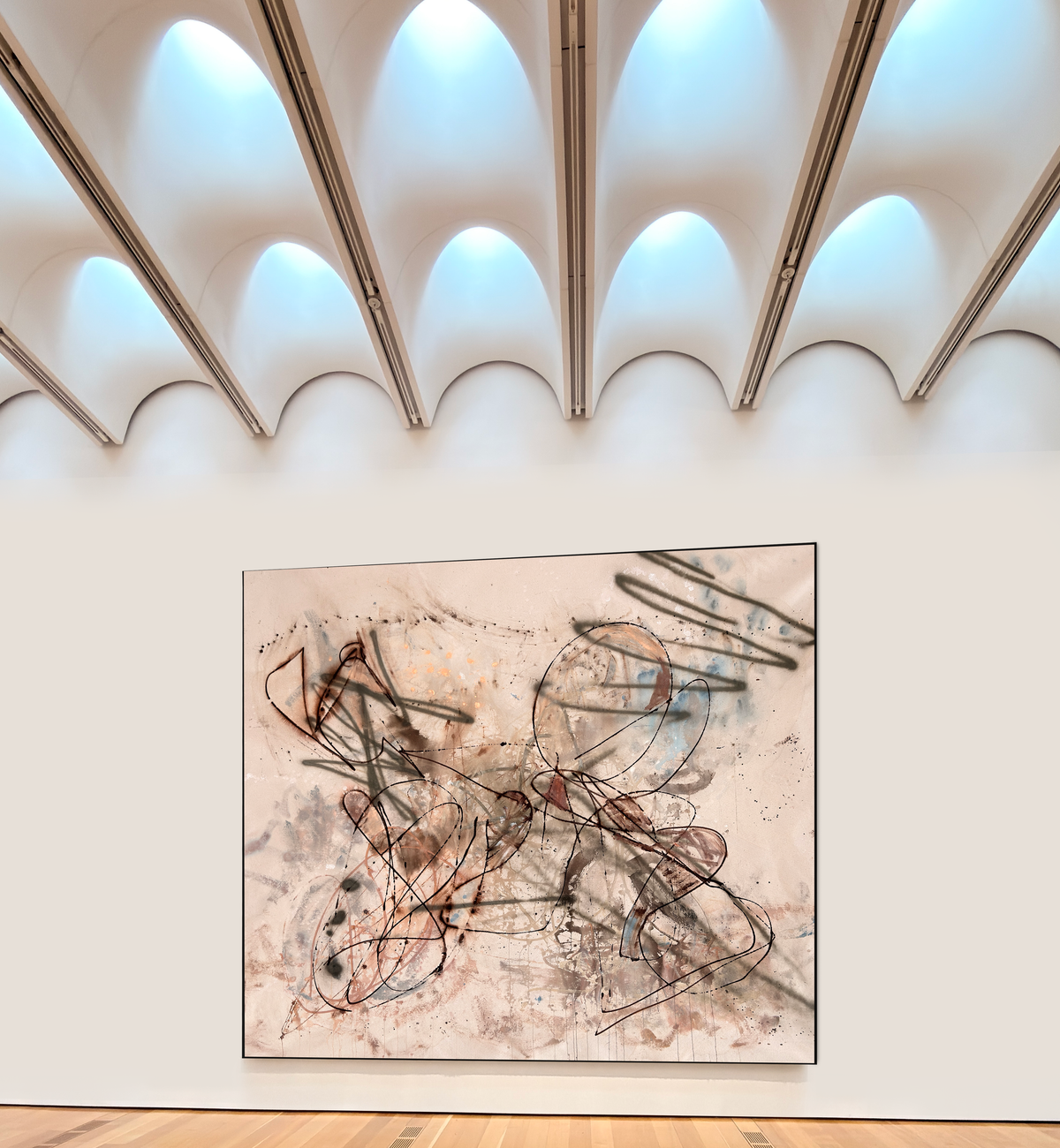
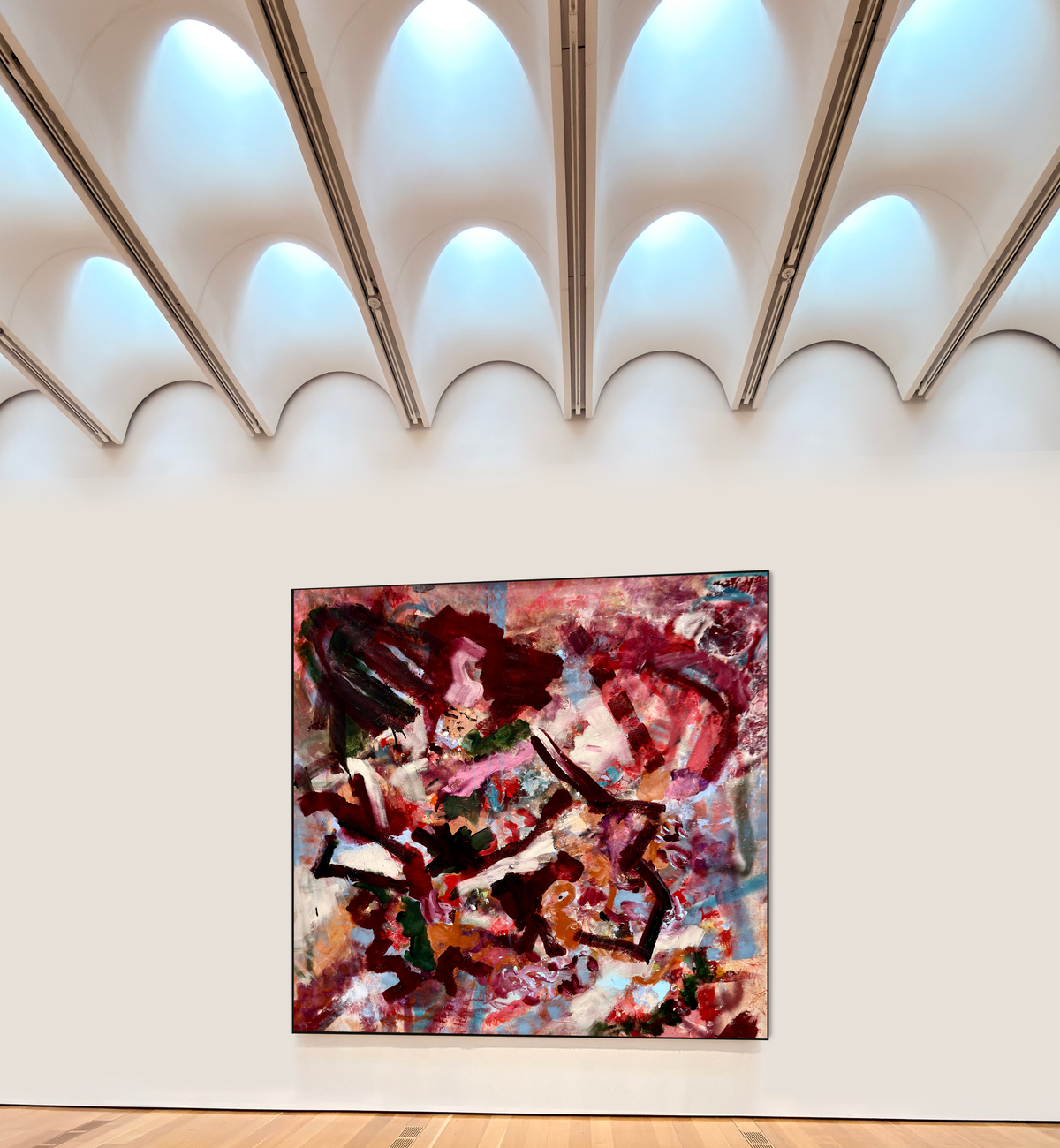
What the object is: charcoal underdrawing, oil thinned with medium, palette knife, fingertip, built up in layers over weeks. Some pieces are painted over repeatedly before they settle. The Astral Thicket series starts with walnuts harvested and boiled from my own yard as the base stain, layered with crushed and ground oil and wax pigments, then lifted by pops of dusty pastel.
What happens next: finished work is filmed in real, moving light at real scale before it ships, so the surface can be read rather than guessed at. The studio handles the work from canvas to wall, and the person answering an email eighteen months later is the same person who mixed the colour.
The question to ask yourself instead
Not is this a good decision. That one stays open forever.
Ask: can I find out who made this, what it is made of, and what happens if it arrives wrong?
If the answer is yes on all three, the only thing left is whether you want to look at it for the next twenty years. And that one you already know.
Related reading
- Original paintings available now
- Commission an original painting
- What designers and collectors say
- About Angela Simeone
Frequently asked questions
What makes someone actually buy an original painting?
Usually the ability to answer three concrete questions: who made it and can that be verified, what the object physically is, and what recourse exists if it arrives damaged or is not as described. Buyers convert an unanswerable forecast about value into answerable facts about the work and the studio.
Is now a good time to buy original art?
Advisors quoted in Artnet News's September 2026 market outlook describe collectors continuing to buy through whatever the macro environment is doing. Timing questions rarely resolve, and a piece bought to live with is not a trade. The more useful question is whether the specific work and the specific studio check out.
Is it safe to buy an original painting online without seeing it in person?
It is, provided the studio closes the gaps. Ask for video of the finished piece in real, moving light at real scale, ask what the ground and layers are, and confirm condition, authenticity and recourse before paying. A working studio supplies all of that quickly.
Why do people browse at art fairs without buying?
Largely because the format prevents the questions that produce a decision. Five minutes in a crowded booth under poor lighting, with hundreds of competing booths, leaves no room to ask about materials, see the work in realistic light, or establish who you are dealing with afterward.
See the work
Browse the original paintings currently available, each one of one. Original paintings available now.
Sources
- Artnet News, "These 8 Artists Are Poised to Break Out in 2026" (art advisor Cardiff Loy on discovering Sarah Martin-Nuss)
- Artnet News, fall 2026 market outlook, published 3 September 2026