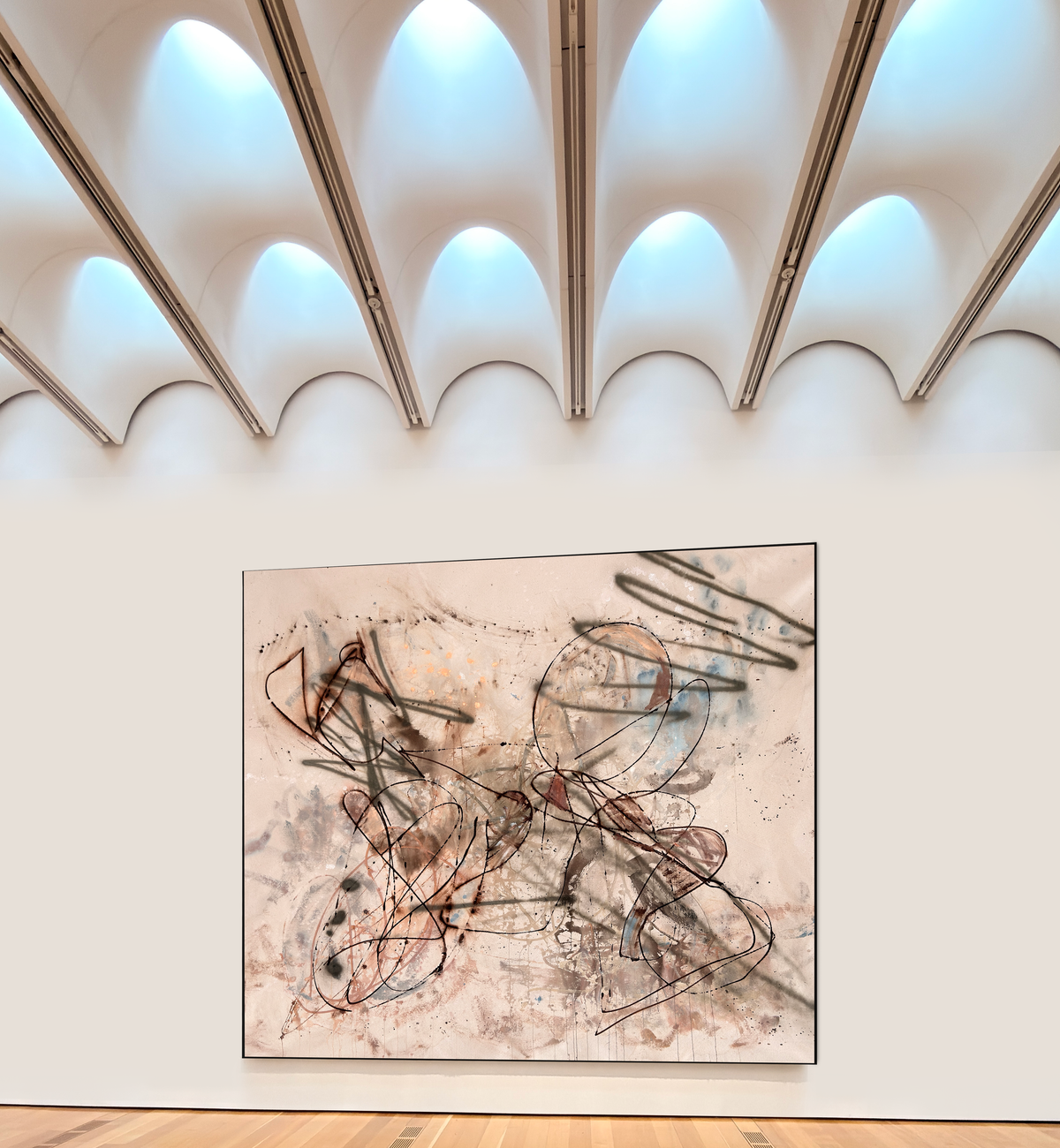
Scale Is the Decision a Room Makes First
In short: Most living rooms need fewer pieces than people expect. One large original, correctly scaled to the wall it sits on, usually does more than four or five smaller works, because a room can only hold one primary focal point before the eye starts negotiating. Groupings work when the pieces read as a single composition rather than a collection. The number is a consequence of the scale decision, not a separate question.
The question arrives as arithmetic — how many paintings does a living room need — and it is almost never actually an arithmetic problem. It is a scale problem wearing a number.
Decide how big the primary piece is, and the count answers itself.
How many paintings does a living room actually need?
Fewer than most people plan for. A room has a limited number of places the eye is willing to stop, and in a typical living room that number is one, maybe two. A single large work occupies the primary stop and lets everything else in the room — the textiles, the wood, the light — behave as support. Four medium pieces spread across three walls create four competing stops, and the eye spends the evening arbitrating.
That is not an argument against ever having more than one painting. It is an argument for deciding which one is primary before buying any of them.
Why does one large piece often outperform several smaller ones?
Because scale is doing work that quantity cannot substitute for.
A large canvas changes the perceived proportion of a room. It reads from the doorway, which is where most people form their impression of a space, and it holds at arm's length, which is where the surface has to survive. Small works generally do one of those two jobs well and the other badly. Scale is also the variable serious painters organise their practice around, rather than a decorating preference.
"Scale has shaped my career because from very early on I thought big."
— Judy Chicago, artist
Chicago has also described the practical consequence plainly: the difference between monumental and intimate work, for her, is the number of people required to realise it. Size is not a stylistic flourish. It changes what the work is and what making it costs.
There is a design-side version of the same observation. Writing for Business of Home's What I Love series in August 2026, Toronto designer Cynthia Ferguson explained why a single painting made her board:
"I chose this painting… because of its expressive use of color, generous scale and approachable abstraction. It makes an immediate visual impact while remaining warm and inviting."
— Cynthia Ferguson, founder, Cynthia Ferguson Designs
Note the order of her reasons. Colour, then generous scale, then approachability — and the payoff she names is immediate impact that stays warm rather than domineering. That is exactly the pair of things a single well-scaled abstract can do and a wall of small framed works usually cannot: arrive instantly, then stay pleasant to live beside.
When is a grouping the right answer?
When the pieces were conceived together, or when the wall genuinely refuses a single object.
A set works if it reads as one composition — a shared palette, a shared hand, consistent framing, tight and deliberate spacing. Two or three works from the same series hung as a horizontal run will read as one gesture across a wall. Seven unrelated frames in mixed sizes will read as seven decisions, and the room will feel busier than the sum of its parts.
Architecture also votes. A long, low wall behind a sectional often takes a horizontal run better than one square canvas. A tall, narrow stair wall wants vertical. Rooms with heavy millwork or a strong fireplace surround already contain a focal point, and the art's job there is to hold a second position rather than compete for first.
How big should the primary piece be?
Big enough that you would not describe it as "a painting on the wall" — you would describe the wall by the painting.
The common practical guidance is roughly two-thirds the width of the furniture below it, which is a reasonable floor and a poor ceiling. Most rooms I work with can take considerably more than the owner initially believes. The failure mode I see most often is not a piece that overwhelmed a room. It is a piece bought one size down out of caution, which then reads as tentative for the next decade.
Scale is also where commissioning earns its keep. A finished painting exists at the size it exists. A commission gets specified to the wall, the sightline, and the ceiling height before the ground goes down — which is why the studio takes work with no upper size limit, and why large-scale pieces suit projects that need a room to hold a story rather than a decoration.
How this studio works at scale
Large-scale painting requires a horizontal working surface and the freedom to approach the canvas from all four sides. The work is composed in the round, not in front of — the body circling, leaning, retreating, returning, until what was made standing above can be read standing in front of. The brush moves from the shoulder; there is very little wrist work. A large piece resists a single focal point on purpose. There is no beginning and no end, so the eye keeps traveling and the painting keeps unfolding.
That is the quiet reason one large original tends to settle a room instead of dominating it. A work with no single focal point does not fight the furniture for attention. It absorbs the attention that was already loose in the room and gives it somewhere to go.
What to do before you buy anything
Stand in the doorway. Decide which wall is the primary one. Measure it, and then measure the largest object you would be comfortable putting on it — and go one size up from there. Count the other stops the room already has: a fireplace, a window with a view, a piece of case furniture. Then buy the primary piece first and let the rest of the room's art be a response to it.
The number was never the question. The first piece was.
Related reading
Frequently asked questions
How many paintings should be in a living room?
Usually one primary work, sometimes with one or two secondary pieces on subordinate walls. A room offers a limited number of places the eye will stop, and a typical living room supports one primary focal point. Decide the scale of the primary piece first; the count follows from that.
Is one large painting better than a gallery wall?
For most living rooms, yes — a single large work reads from the doorway and holds up at close range, while a multi-piece wall tends to do only one of those well. A grouping works when the pieces share a palette and a hand and read as one composition rather than a collection.
How big should a painting be over a sofa?
About two-thirds the width of the sofa is a common minimum, not a target. Most rooms accept more than owners expect, and the frequent regret is a piece bought one size too small out of caution. If the wall and the sightline are unusual, commissioning to the exact dimensions removes the guesswork.
Can a painting be too large for a room?
It can be too large for the wall's clearances — you need breathing room at the sides and above the furniture — but scale itself rarely causes the problem. A large abstract without a single focal point tends to settle a room rather than crowd it, because it is not competing with the furniture for a viewer's attention.
See the work
Browse the original paintings currently available, each one of one. Original paintings available now.
Sources
- Business of Home, "Cynthia Ferguson's fresh take on button-tufted armchairs, grasscloth wallcoverings and checkered rugs" (What I Love, 17 August 2026)
- Judy Chicago, artist site / Smithsonian Archives of American Art oral history