Recognition Runs Decades Behind the Painting
In short: Public recognition and the quality of a painting move on completely different clocks. Institutions work in decades; a canvas is finished in weeks. So an unfamiliar name tells you almost nothing about what the work is doing — only about how much attention has reached it so far. The reliable checks are things you can verify yourself: a coherent body of work over years, real materials, documented provenance, and how the piece holds up on a second look.
This October The Metropolitan Museum of Art opens Krasner and Pollock: Past Continuous — the first major New York presentation devoted to either artist in more than twenty years, and the first to structure the two practices as equals across twelve chapters rather than reading one of them through the other's fame. More than 120 works. Two studios that sat a few rooms apart for over a decade.
The paintings did not change while the world made up its mind about them. Only the reading did.
That gap is worth holding on to if you are looking at work by an artist you have never heard of.
Does an artist's reputation tell you what a painting is doing?
It tells you where the attention has landed. That is a real piece of information, and it is not the same piece of information as whether the work is any good.
Recognition is produced by a slow, expensive apparatus — curators, catalogues, wall labels, twenty-year gaps between surveys. The Met's own curator in charge, David Breslin, describes the premise of the new show plainly: "'Krasner and Pollock: Past Continuous' begins with the fundamental premise that these artists are equals, partners in life, giants in the history of art, and revolutionaries who defined what abstraction could be." That premise is being stated in 2026. The work it describes was made in the 1940s and 1950s.
Associate curator Brinda Kumar puts the structural point even more usefully for a buyer: the exhibition "approaches these artists not as a single story, but as two practices unfolding in proximity over time." Two practices. Unfolding. Over time. That is what you are actually assessing when you stand in front of a canvas — a practice, mid-sentence.
Why does institutional recognition run so far behind the work?
Because institutions are built to be slow on purpose. A museum's job is to be right in fifty years, not first in five, so it waits for consensus, funding, loans, scholarship and a free slot in a building calendar that fills years ahead.
None of those constraints has anything to do with paint. A painting is finished when the surface settles. The apparatus catches up later, or does not.
For a collector this cuts both ways, and both ways are useful. It means a well-known name is genuinely lower-risk in one narrow sense — somebody with a research budget has already looked hard. It also means that the absence of a name is not evidence against the work. It is the absence of evidence, which is a different thing.
What are you actually buying when the name is unfamiliar?
The object, and the practice behind it.
The painter Al Loving put the first half about as flatly as it can be put: "Abstraction is the most direct route to the intellect. In other words when you look at my work, there's nothing else there than what you see. There's no hidden messages. It's about color. It's about material." Nothing is being withheld from you pending a wall label. Colour and material are on the surface, available to anyone standing close enough.
The second half — the practice — is checkable in ways buyers routinely skip:
- How long has the person been at it, and does the work cohere? Twenty years of paintings that argue with each other productively is a different proposition from twenty paintings made this spring in whatever style is selling.
- Are the materials real and named? Oil and mixed media on canvas, charcoal underdrawing, palette knife, walnut stain, dusty pastel — a working painter can tell you what is in a surface and why it is there.
- Is there documentation? A signed verso, a certificate of authenticity, an invoice, and photography or video of the finished work in real light. That paperwork is what makes a piece insurable and re-saleable regardless of whose name is on it.
- Where has the work actually gone? Rooms, buildings, projects — placements are a slower and more honest signal than follower counts.
But advisors are telling clients to be cautious this season — does that change the answer?
It changes who the advice is for.
Artnet News reported this week, in "Less Is More: Inside the Art World's New Season of Recalibration," that working advisors are steering clients away from emerging and speculative names toward artists with a longer track record — one of them putting it flatly: the confidence is not there for emerging work right now.
That is real, current, and worth taking seriously — but read what it is actually about. It is advice for people buying on the expectation of resale. Caution about an unproven track record is caution about a market position, not about a painting.
Two things follow, and they point in opposite directions:
- If you are buying to speculate, the advice stands, and this post is not for you. No working studio can promise you a market.
- If you are buying a piece to live with, the same advice inverts. A recalibrating market is precisely when work is available directly, at a considered pace, from artists who are not being bid up by people who have never seen the surface.
The word doing all the work in that reporting is unproven — and it is a much narrower word than unfamiliar. A twenty-year practice with documented placements is not unproven; it is unfamiliar to you, which the next two sections are about fixing in an afternoon.
How do you judge a painting on its own terms?
Stand in front of it before you look anything up.
Give it two minutes. Notice where your eye goes first, then where it goes after that, then whether it comes back. A surface built up over weeks tends to keep releasing information on the third and fourth look — a passage of ground surfacing through a thin place, an edge where two decisions disagree. A surface made to photograph well often gives you everything at once and then has nothing left.
Then ask the practical questions. How does it read from the doorway? How does it read at arm's length? What does it do at four in the afternoon and again under lamplight? If a piece survives all of those, the name attached to it is a detail you can look up afterwards.
What a long body of work makes checkable
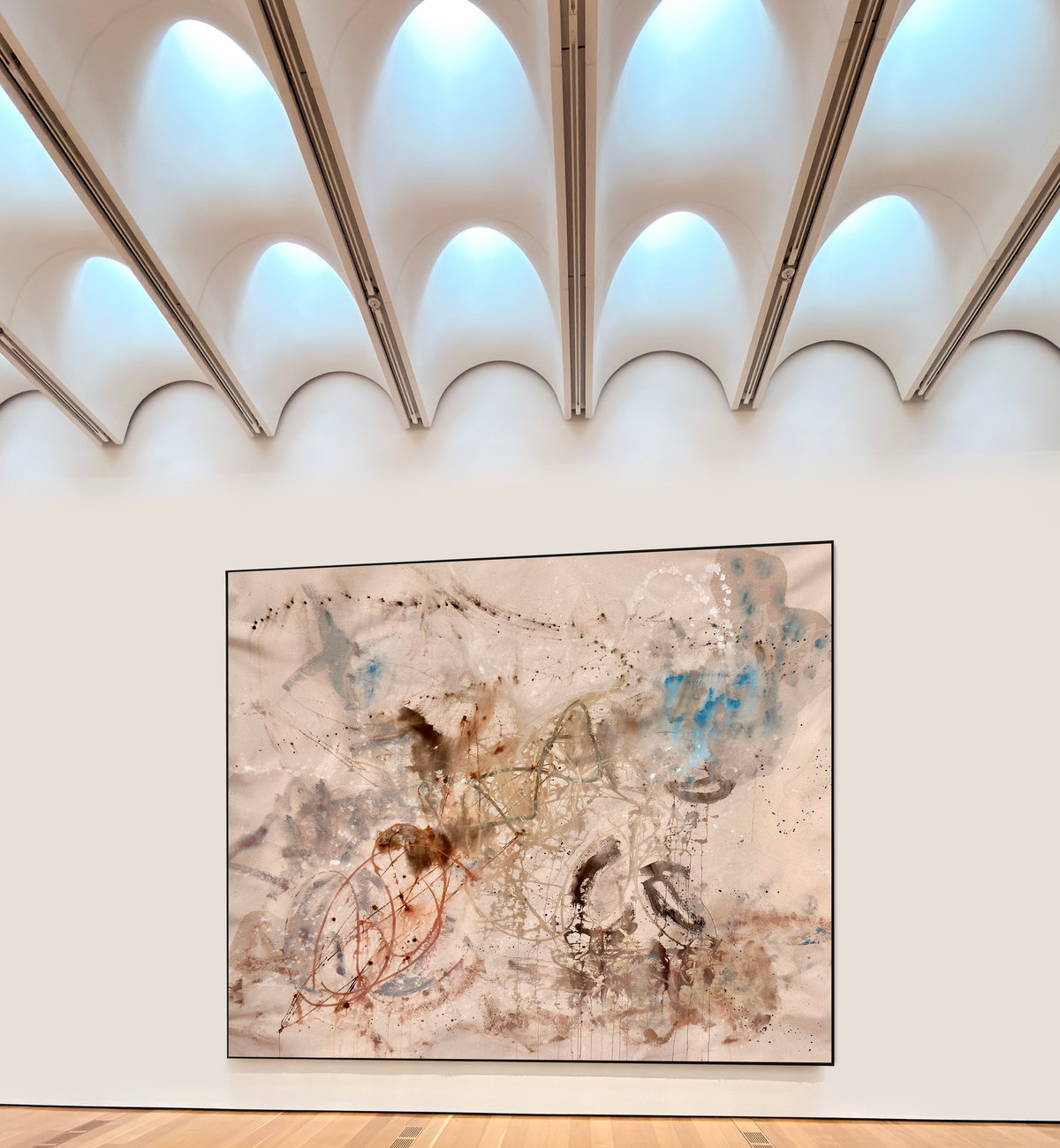
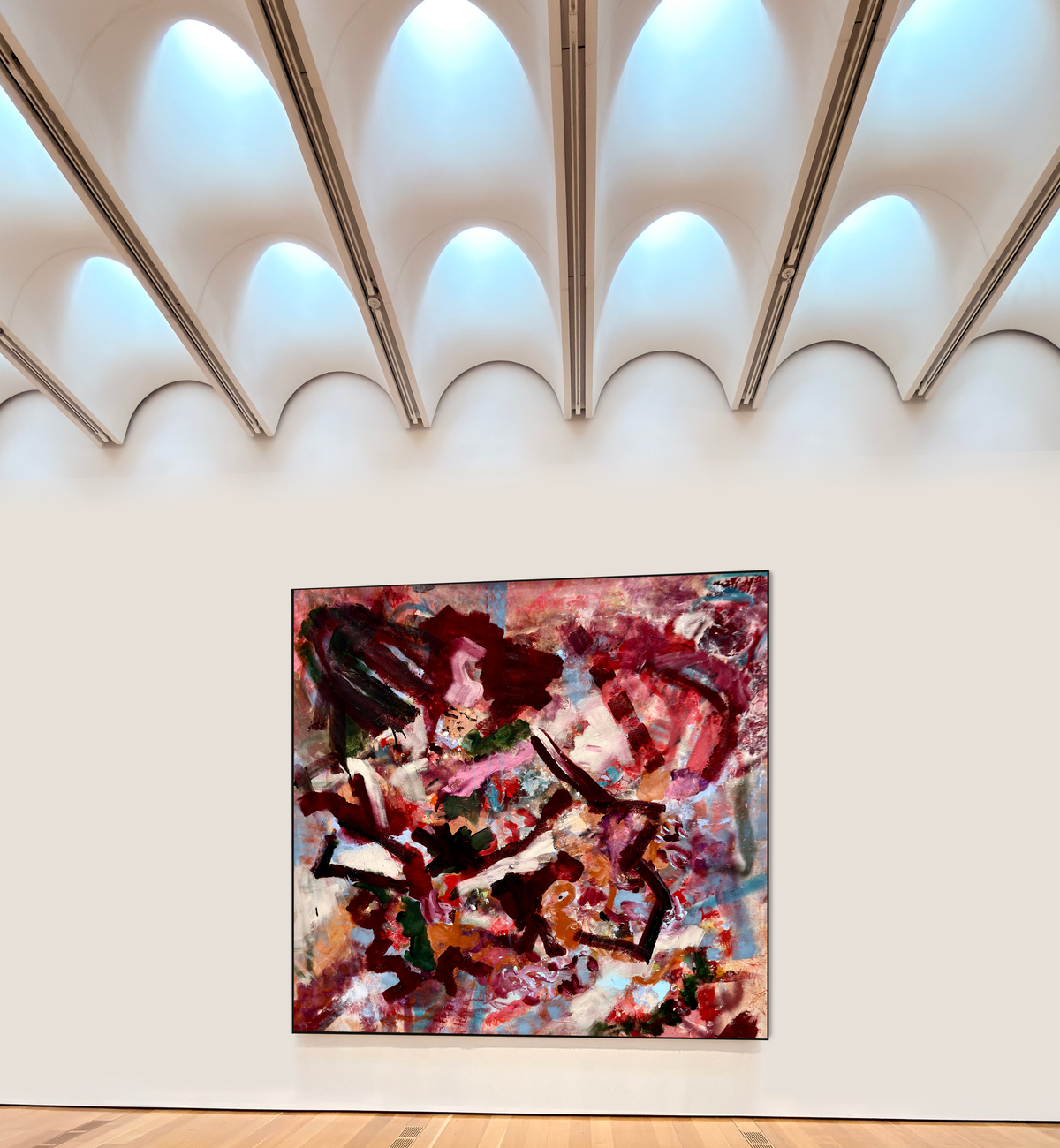
This studio has been painting for over twenty years — oil and mixed media on canvas, original work only, sold direct to collectors and to the trade. That length is not offered as a credential. It is offered because it makes things verifiable: there is a coherent body of work to look through, a stated process, and placements that can be confirmed independently, including work featured in Architectural Digest, Luxe, Forbes, Domino and House Beautiful.
Every finished piece is filmed in real, moving light before it ships, at real scale, so the surface can be judged the way it will actually be seen rather than the way a product photograph flattens it. That is the same test described above, run for you, before money changes hands.
What to do with an unfamiliar name
Treat it as a neutral fact and go back to the painting. Look twice, ask what is in the surface, ask for documentation, ask where the work has gone. Those four answers will tell you more in an afternoon than a reputation will tell you in a decade — and reputations, as the Met is about to demonstrate again, take decades.
Ready-to-ship original work is available now; commissioned work is sized and built to the room. The studio's own record and the practice behind it are both there to be checked.
Related reading
- Original paintings available now
- About Angela Simeone
- Commission an original painting
- Press and published placements
Frequently asked questions
Is it risky to buy a painting by an artist I have not heard of?
It carries a different risk profile, not a larger one. The checks that matter — a coherent body of work, named materials, a signed verso and certificate of authenticity, an invoice, and documented placements — are all available directly from a working studio, and none of them depend on how widely known the artist is.
Does an artist's reputation affect what a painting is worth?
Reputation affects market pricing, which is not the same as what a painting is doing in a room. Buy for the work first. Provenance and documentation are what protect the transaction; a name is what the market prices later, and market timing is not something any studio can promise.
How long should I look at a painting before deciding?
Longer than feels natural — two minutes in front of it, then a second visit if you can. Built-up surfaces release information gradually, so the third look is usually more diagnostic than the first.
What documentation should come with an original painting?
A signed verso, a certificate of authenticity, an invoice, and photography or video of the finished work in real light. That set is what an insurer and a future buyer will both ask for.
Advisors are telling clients to avoid emerging artists this season — should I wait?
That guidance is aimed at buying for resale, where an unproven market position is a real risk. If you are buying a piece to live with, it does not apply in the same way — and "unproven" is a narrower word than "unfamiliar." A long practice with documented placements is neither.
See the work
Browse the original paintings currently available, each one of one. Original paintings available now.
Sources
- The Metropolitan Museum of Art, press release for Krasner and Pollock: Past Continuous (opens 4 October 2026)
- Artnet News, "Less Is More: Inside the Art World's New Season of Recalibration" (this week)
- Al Loving, Garth Greenan Gallery artist page