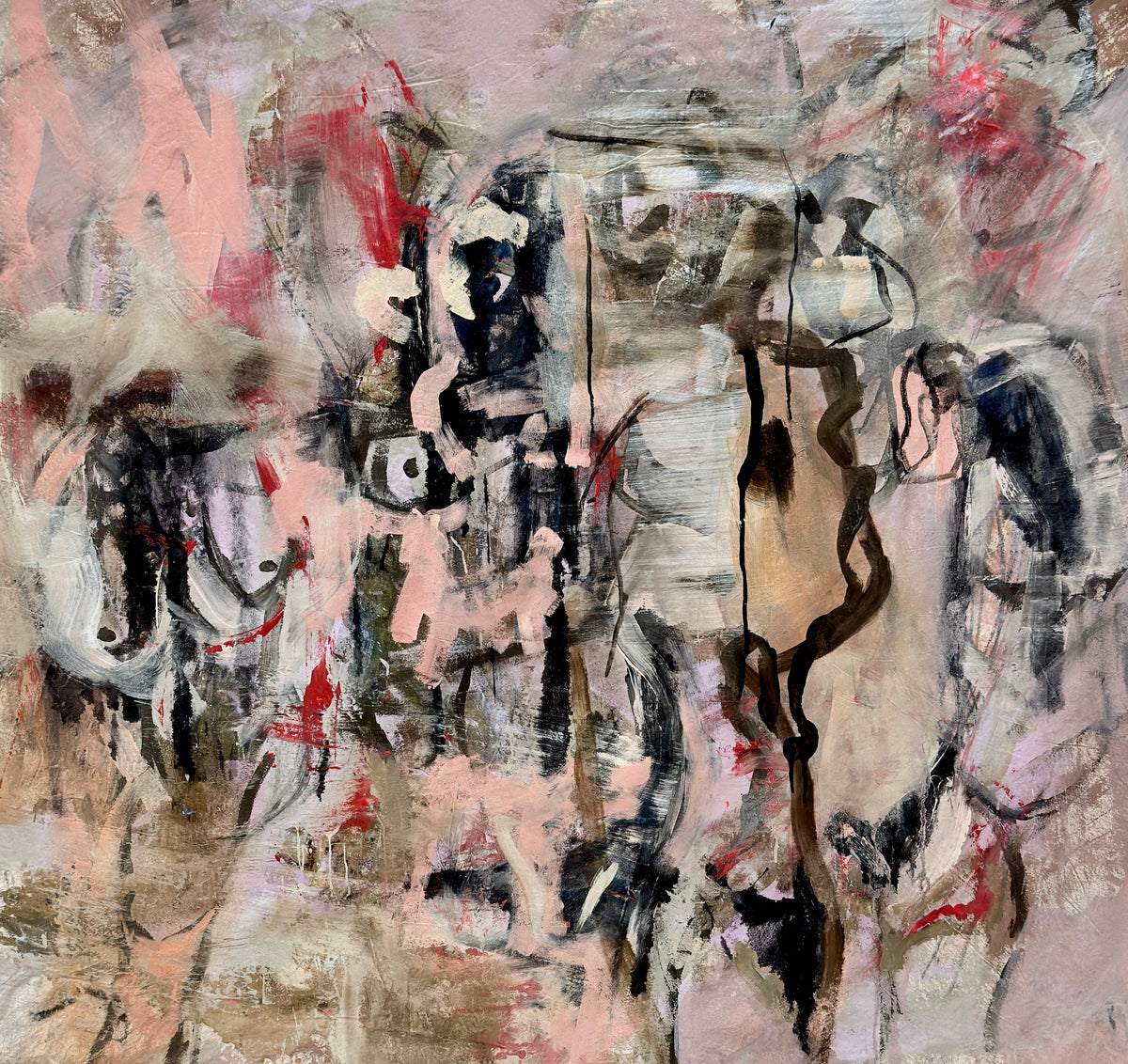
Furniture Wears Out. A Painting Accumulates a Record.
In short: Most art bought in the last thirty years would not resell for what it cost, largely because of transaction costs rather than the art failing. Appraiser Martin Gammon puts the break-even bar at roughly 80% appreciation just to exit an auction position. That is an argument against buying a painting as an investment, not against buying one. A one-of-one original bought to live with is answering a different question, and it answers that one well.
A sofa is worth less the day it leaves the store, and less again every year after. People bringing that arithmetic to a painting want to know whether they are about to do the same thing at a higher price.
It is a fair worry, and it deserves the real numbers rather than reassurance.
Does an original painting lose value like other big purchases?
Not in the same way, and not for the same reasons — but the honest picture is more complicated than either side of this argument usually admits.
Martin Gammon, founder of Pergamon Art Group and author of Deaccessioning and Its Discontents (MIT Press), has spent years appraising private collections. Writing in Artsy, he was blunt about what he found:
1. "After many years of appraising collections assembled in the last 30 years, I would conservatively estimate that a substantial majority would realize less than they cost to acquire if they were to be liquidated, given the enormous transactional costs associated with buying and selling art."
— Martin Gammon, appraiser and author
Read that carefully, because the cause is named inside the sentence. The problem is the transaction, not the object.
2. "Most market participants need to have a minimum of an 80% baseline appreciation simply to break even when entering and exiting an investment in the auction markets."
— Martin Gammon
Buyer's premium, sales tax, shipping, seller's commission, insurance fee, photo fee, capital gains on collectibles. A painting can go up substantially and still leave its owner square.
Is there research behind that, or is it one appraiser's impression?
There is research, and it points the same way. Arthur Korteweg, a professor at the University of Southern California, with Roman Kräussl and Patrick Verwijmeren, built a repeat-sales dataset of 2.3 million paintings sold between 1960 and 2010.
3. Fewer than two percent of those paintings can be shown to have sold more than once across the entire fifty-year window.
— Korteweg, Kräussl and Verwijmeren, art-economics repeat-sales study
Their correction for sample-selection bias — the fact that winners are the works most likely to come back to market — drops the average annual return for paintings from 8.7% to 6.3%, and the risk-adjusted figure far further.
That two-percent number is the useful one for a private buyer. Most paintings never come back to market at all. They stay on walls.
So what are people actually doing with art right now?
Holding it. Kelly Cahn, a New York art adviser, told Crain Currency in 2026 that she is
4. "definitely seeing more ultra-high-net-worth clients holding onto works, primarily in the $1 million-plus range."
— Kelly Cahn, art adviser
At the very top of the market, the people with the most sophisticated financial advice available to them are the ones least interested in selling.
What does a painting do that a sofa does not?
It goes on being looked at, and the looking changes.
Mire Lee, whose work filled Tate Modern's Turbine Hall, described to Art Basel Stories what it is like to see her own work in someone's home rather than an institution:
5. "It reminds me that there's something almost sensual having an artwork living so close to your body."
— Mire Lee, artist
Adam Pendleton, in the same piece, on the same experience:
6. "It's as though the ideas embedded in the work have had an opportunity to settle and thrive in a more intimate space, without the demands of the institution or market. It just is. It's relaxed and breathes; it's present and embraced."
— Adam Pendleton, painter
And Tomás Saraceno, on what carries a relationship between an artist and the people who own the work:
7. "With projects like this, it's about having a leap of faith."
— Tomás Saraceno, artist
None of these is a financial claim. That is the point. What the object accumulates is a record — of where it hung, who lived with it, what the artist did afterwards — and that record has no equivalent in a piece of furniture.
Does the relationship behind a purchase matter to what it is worth?
Historically, more than almost anything else. Writing in Art Central's features for March 2026, Rishika Assomull traced how the collections that mattered were built. Lucy Jones Carroll, widow of the painter Lawrence Carroll, described what her husband got from the collector Giuseppe Panza di Biumo, who eventually held roughly a hundred of his works:
8. "The confidence and trust Panza showed to Lawrence were important, and this inspired an even greater determination to honour this support with his best possible work."
— Lucy Jones Carroll
Panza's grandson Pietro Caccia Dominioni, on how far that went past a transaction:
9. "I can only tell you that their relationship was strong and intense, and I can attest to this from my memory of Lawrence at my grandfather's funeral, where he was perhaps among the most heartbroken, as if he had lost a father."
— Pietro Caccia Dominioni
And Arthur de Villepin, founder of the Hong Kong gallery VILLEPIN, on what actually anchors a collection:
10. "Curiosity, invention, and a certain boldness guide us, because art deserves nothing less."
— Arthur de Villepin, gallerist
What this means for a painting you are looking at now
Buying a one-of-one original from a working painter is a different transaction from buying a name at auction with a resale horizon attached. There is no buyer's premium. There is no auction exit priced in. There is a painting, a documented practice behind it, and a studio you can reach directly.
Twenty-plus years of work, oil and mixed media on canvas, original work only, calibrated for the rooms each piece goes into. Featured in Architectural Digest · Luxe · Forbes · Domino · House Beautiful. Installations including Blackberry Mountain, the Conrad Nashville — thirty-three originals across the private suites, the public areas and both dining rooms, interiors by Champalimaud Design — Albion in the Gulch, the Frist Clinic, Sarah Cannon and Peabody Union. Collectors that include the Titans, the Predators, the 76ers, US senators, country music artists and designers nationwide.
That is a record, stated as fact, with nothing projected from it. What it buys you is not a forecast. It is the reasonable confidence that the person who made your painting is still working, still documented, and still reachable.
A painting is not going to save you money. It is going to be there, at eye level, every day, doing the one thing furniture cannot: rewarding a second look.
Related reading
- Original paintings available now
- What designers and collectors say
- Commission an original painting
- About Angela Simeone
Frequently asked questions
Does an original painting depreciate?
Not through use, the way furniture does. But most art bought privately would not resell for its purchase price, mainly because of transaction costs. Appraiser Martin Gammon estimates that a work needs roughly 80% appreciation just to break even entering and exiting an auction position.
Is original art a good investment?
It is not a reliable one, and nothing here should be read as investment advice. A repeat-sales study by Arthur Korteweg and colleagues found that fewer than two percent of 2.3 million paintings sold between 1960 and 2010 came back to market at all, and their bias-corrected return figures are modest. Buy a painting because you want to live with it.
Why do people say "buy what you love"?
Because the reasons that survive a decade are the ones that had nothing to do with resale. Art adviser Kelly Cahn reports that even collectors at the top of the market are increasingly holding rather than selling.
Does buying directly from an artist change the value question?
It removes the auction transaction costs from both ends and gives you a direct relationship with the person who made the work. It does not make a painting an appreciating asset, and no honest studio will tell you it does.
See the work
Browse the original paintings currently available, each one of one. Original paintings available now.
Sources
- Artsy, Martin Gammon, "The Often-Ignored Problem with Buying Art as an Investment"
- Art Basel Stories, Kimberly Bradley, "How artist-collector relationships are evolving in the 21st century"