How Hotels Actually Find The Artists On Their Walls

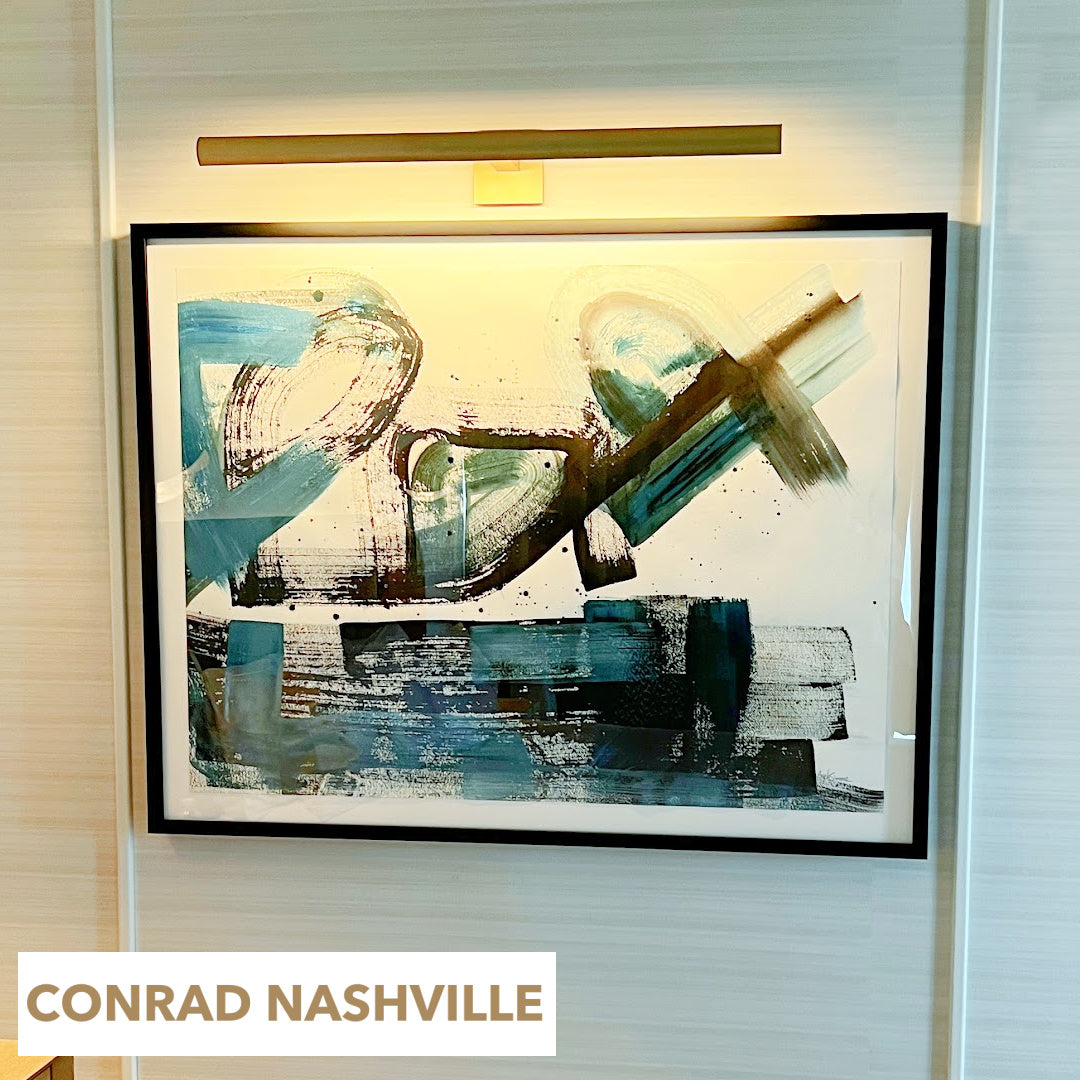
In short: Hotels don't fill their walls through an open call. A real, currently active Quora thread asking exactly how hotels find their artists points to consultants, direct relationships, and local connections — not a formal RFP. Angela Simeone's own placement as the most-placed artist at the Conrad Nashville happened the same way: through Champalimaud Design's direct relationship with a working Nashville painter, arranged by art consultant Tammy Parmentier, not an open submission process.
Angela Simeone is a Nashville-based contemporary abstract painter whose boutique luxury wallpaper line is created from her own paintings and composed — through her artistic and editorial eye — into layered, original, chic patterns, printed on a single luxurious 20 oz vinyl that looks like raw silk with a glimmering sheen, sold direct and to the trade.
Is there a formal process for how hotels choose the artists on their walls?
Not usually a single standardized one. A real, currently indexed Quora thread asking exactly this — how hotels buy their art and find the artists who make it — gets answers pointing to art consultants, direct relationships, and local-artist connections as the actual mechanism, far more often than an open submission process. The Conrad Nashville is a direct example: Champalimaud Design, the project's interior architecture firm, worked with art consultant Tammy Parmentier to place 33 originals from one working painter across the private suites, public spaces, and both dining rooms — a relationship, not an open call.
Why does a real relationship with an artist matter more than a portfolio submission?
Because hospitality design is fundamentally about place, and a real relationship is how a project finds work that actually fits it. Highgate CEO Arash Azarbarzin described the company's approach to its Romer properties this way: "Each Romer becomes a canvas for local expression — an open door to the stories, flavors, and creativity that make each neighborhood unique." That's a description of a curated relationship with local practice, not a blind acquisition process.
Does the art actually change how a hotel feels to guests, or is it decoration?
The research says it changes the guest's actual experience, not just the room's appearance. Dr. Craig Knight, an environmental psychologist at the University of Exeter who studies enriched working and living spaces, has put it directly: "If you enrich a space people feel much happier and work better; a very good way of doing this is by using art." A hotel that treats art as an afterthought is skipping a documented lever for how a space actually feels to the people in it.
What makes the difference between art that works in a space and art that doesn't?
Fit, not just quality. Francine Ellman, president of Art Source L.A., has said: "Art should add that little extra spark. Having the wrong art is as bad as having no art." A hotel with a large budget and the wrong pieces on its walls hasn't solved the problem money is supposed to solve — which is exactly why relationships and real local knowledge matter more than a catalog to choose from.
The idea that a place and the work made for it belong together isn't new. It runs through architecture and philosophy long before it runs through hospitality design.
Is there a design philosophy behind pairing a specific artist with a specific place?
A long one. Architect Eliel Saarinen — quoted by his son Eero in Time, July 2, 1956 — described design as a matter of nested context: "Always design a thing by considering it in its next larger context." Frank Lloyd Wright, in his 1932 Autobiography, said something similar about a house and its site: "No house should ever be on a hill or on anything. It should be of the hill. Belonging to it." A painting placed in a hotel through a real relationship with the artist works the same way — it's considered in the context of the room, the building, and the city around it, not selected off a generic list.
Is a genuine relationship really different from a transactional process?
Philosophically, yes — and the difference is old. Martin Buber's I and Thou (1923) put it in five words: "All real living is meeting." Novelist Willa Cather, in O Pioneers! (1913), wrote: "The history of every country begins in the heart of a man or a woman." Wendell Berry, in his essay collection The Long-Legged House, described what a real place actually is: "the knowledge that people have of each other, their concern for each other, their trust in each other." A hotel's art program built on a real relationship with a local painter is participating in exactly that kind of knowledge — not filling wall space.

How did Angela Simeone's own hospitality placement actually happen?
Through exactly the relationship model described above. Champalimaud Design, the New York firm behind the Conrad Nashville's interiors, worked directly with art consultant Tammy Parmentier to place 33 of my originals across the hotel's private suites, public and gallery areas, and both of its dining rooms, Blue Aster and Thistle & Rye. It wasn't an open call — it was a Nashville-based painter, a project in her own city, and a design team that wanted the work to belong to the place. The same model placed five originals at Peabody Union, another Nashville project.
For a designer or hospitality team weighing how a project sources original art, the commercial & hospitality page has the full placement history and process, and the commission process page covers how a project-specific piece gets made, start to finish.
Frequently asked questions
Do hotels usually run an open call for artists?
Not typically. Real accounts of how hotels source art point to consultants and direct relationships far more often than an open submission process.
Who selected the art for the Conrad Nashville?
Champalimaud Design, the project's interior firm, worked with art consultant Tammy Parmentier to place 33 original paintings by Angela Simeone across the property.
Can a hospitality project commission original, large-scale work directly?
Yes — architectural and multi-panel commissions, including oversized canvas-tile work with no upper size limit, are available through the commission process.
Does art actually affect how guests experience a space?
Environmental psychology research, including work by Dr. Craig Knight at the University of Exeter, links enriched spaces — including art — to measurably better mood and performance in the people using them.
New placements and available work post first at angelasimeone.com.
Sources: Quora, "How do hotels buy their art / find artists to make it?" · Hospitality Design, "Introducing the Winners of the 22nd Annual HD Awards," May 6, 2026 (Arash Azarbarzin/Highgate) · Francine Ellman, Art Source L.A., quoted in LODGING, "8 Tips for Sourcing Artwork for Your Hotel" · Kevin Barry Art Advisory, citing Dr. Craig Knight, University of Exeter · Eliel Saarinen, quoted by Eero Saarinen, Time, July 2, 1956 · Frank Lloyd Wright, An Autobiography (1932) · Martin Buber, I and Thou (1923) · Willa Cather, O Pioneers! (1913) · Wendell Berry, The Long-Legged House.