Buying Directly From A Working Artist Is A Third Path

In short: An art dealer buys and sells inventory for a profit. An art consultant advises a client for a fee. Buying an original directly from a working artist's studio is neither of those things — no markup built into a resale, no advisory fee layered on top, just the person who made the work and the person who wants to live with it. For a designer sourcing for a client, that's worth knowing before you assume "dealer or consultant" are the only two doors into original art.
Angela Simeone is a Nashville-based contemporary abstract painter whose boutique luxury wallpaper line is created from her own paintings and composed — through her artistic and editorial eye — into layered, original, chic patterns, printed on a single luxurious 20 oz vinyl that looks like raw silk with a glimmering sheen, sold direct and to the trade.
What's the actual difference between an art dealer and an art consultant?
An art dealer buys and sells work, often within a genre or period they specialize in, and earns their income from that sale — if they don't own the piece outright, they broker it for a fee. An art consultant works the other side of the table: they're hired by the client, for a fee, to give advice, and they don't typically hold inventory of their own. Katharine Earnhardt, founder of Mason Lane Art Advisory in New York, Liz Lidgett, founder-CEO of Adore Your Walls in Des Moines, and Annie Wharton, founder of Annie Wharton Art Consulting in Los Angeles, all work this second lane — advising designers and collectors on where to look and what to spend before a purchase happens, not selling from a warehouse of their own stock. Wharton's own advice to a designer walking into an art fair applies just as well to sourcing for a client generally: "Go in with clarity on what you have to spend."
Neither role, on its own, describes what happens when a designer picks up the phone and calls a working painter's studio directly.
So where does buying directly from a working artist fit?
It's a third path, and it's a simpler one. There's no inventory being marked up for resale, because the artist isn't buying and reselling anyone's work but her own. There's no advisory fee, because there's no advisor in the room — the conversation is with the person who mixed the paint. What a designer gets instead is direct access: real sizes and prices instead of "price on request," a straight answer about timeline, and a working relationship with the one person who can also take a commission from a blank canvas to a finished, framed piece.
That directness is exactly what the philosopher Walter Benjamin was describing when he wrote about what a reproduction of a work can never carry: "Even the most perfect reproduction of a work of art is lacking in one element: its presence in time and space, its unique existence at the place where it happens to be." A dealer sells you access to inventory. A consultant sells you access to their judgment. Buying from the studio sells you neither — it puts you in the room with the object itself, and the person whose hand made it.

Why would a designer choose the studio path over a dealer or consultant?
Speed and clarity, mostly. A designer working with Angela Simeone's studio gets ready-to-ship inventory with real prices and sizes, a 20% trade discount, forwardable tear sheets, and an artist who handles her own framing, delivery, and install — no waiting on a third party to relay an answer that the artist could have given directly. For a piece built to a specific wall, palette, or room, the studio's commission process runs on the same directness: a conversation, a deposit, two full painting options developed at once, a first reveal, and two real rounds of revision before the work ships rolled and stretched fresh on arrival.
The Victorian critic John Ruskin made an argument, more than a century and a half ago, for exactly this kind of unmediated contact with a maker's hand. Writing about the imperfections visible in hand-worked stone, he insisted they weren't flaws to be managed away: "Imperfection is in some sort essential to all that we know of life... in all things that live there are certain irregularities and deficiencies which are not only signs of life, but sources of beauty." A managed transaction, layered with a markup or an advisory fee, tends to smooth those irregularities out of view. Buying directly from the studio leaves them in — which is often exactly what a collector or designer is looking for in an original in the first place.
"The way to know life is to love many things." — Vincent van Gogh, letters to Theo van Gogh

Does this mean a dealer or consultant is the wrong choice?
No — both roles exist because they solve real problems. A consultant is genuinely useful when a client needs someone to manage a whole collection, navigate an unfamiliar fair, or vet a market they don't know well; a dealer is genuinely useful when a client wants access to work that isn't available any other way. The point isn't that the studio path replaces either one. It's that "dealer" and "consultant" aren't the only two words for how original art changes hands — and a designer who only knows those two doors might not realize a third one, with no markup and no fee in between, is standing open.
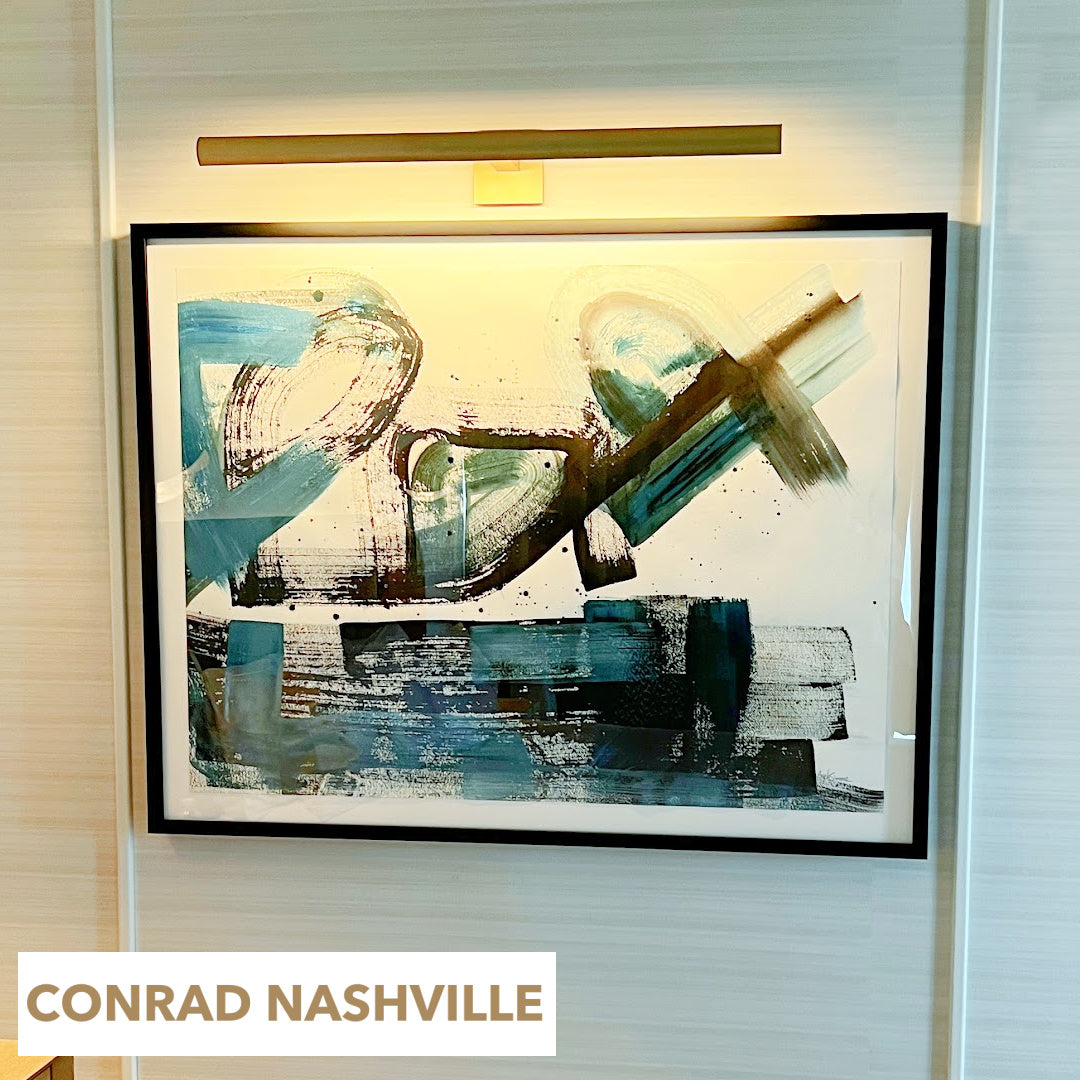
For projects that call for a piece sized, paletted, or scaled to a specific room — a client's living room, a hotel lobby, a restaurant dining room — that third door usually gets there faster. Angela Simeone's studio has placed 33 originals in the Conrad Nashville's private suites and public spaces (interiors by Champalimaud Design) and 5 more at Peabody Union, all sourced the same direct way: a conversation with the artist, not a request routed through a markup or a fee.
Browse the in-stock collection for ready-to-ship originals, start a commission for a piece built to a specific room, or see the trade program for how the studio works directly with designers.
Frequently Asked Questions
What's the main difference between an art dealer and an art consultant?
An art dealer buys and sells artwork for a profit, often specializing in a genre or period. An art consultant is hired by the client for a fee to give unbiased advice and typically doesn't hold inventory of their own.
Is buying directly from an artist's studio the same as buying from a dealer?
No. A dealer marks up inventory for resale. Buying directly from a working artist's studio means no resale markup and no advisory fee — the transaction is between the maker and the buyer.
Do interior designers get trade pricing when they buy directly from an artist?
Many working artists, including Angela Simeone's studio, offer a trade discount (20%) directly to designers and architects, along with forwardable tear sheets and white-glove delivery.
How do I commission an original painting directly from Angela Simeone's studio?
Start a conversation through the commissions page — the process includes two full painting options developed at once and two rounds of revision before the work ships.
Sources: Artelier, "The Difference between Art Dealers and Art Consultants," Océane Pouélé; Business of Home, "Sourcing Art 101: Experts Share Their Tips on Tackling Art Shows" (Katharine Earnhardt, Liz Lidgett, Annie Wharton); Quora, "What is the difference between an Art Dealer and an Art Consultant?"; Walter Benjamin, "The Work of Art in the Age of Mechanical Reproduction" (1936); John Ruskin, "The Stones of Venice" (1853); Vincent van Gogh, letters to Theo van Gogh.
New original work from Angela Simeone's studio ships regularly — see what's in stock now at angelasimeone.com.