Hiring The Local Artist Is The Point

In short: When Kelly Wearstler designed her first European hotel, L'Apogée Courchevel, she didn't treat local artisans as a finishing detail — she built the project around them: "We really wanted to bring in French artisans and artists to celebrate the local culture and craftsmanship." That's the same premise behind the Conrad Nashville's decision to place 33 of my original paintings across its suites, public spaces, and both dining rooms — a working Nashville painter's hand, not a generic art package, doing the job of anchoring the hotel to the city it's actually in.
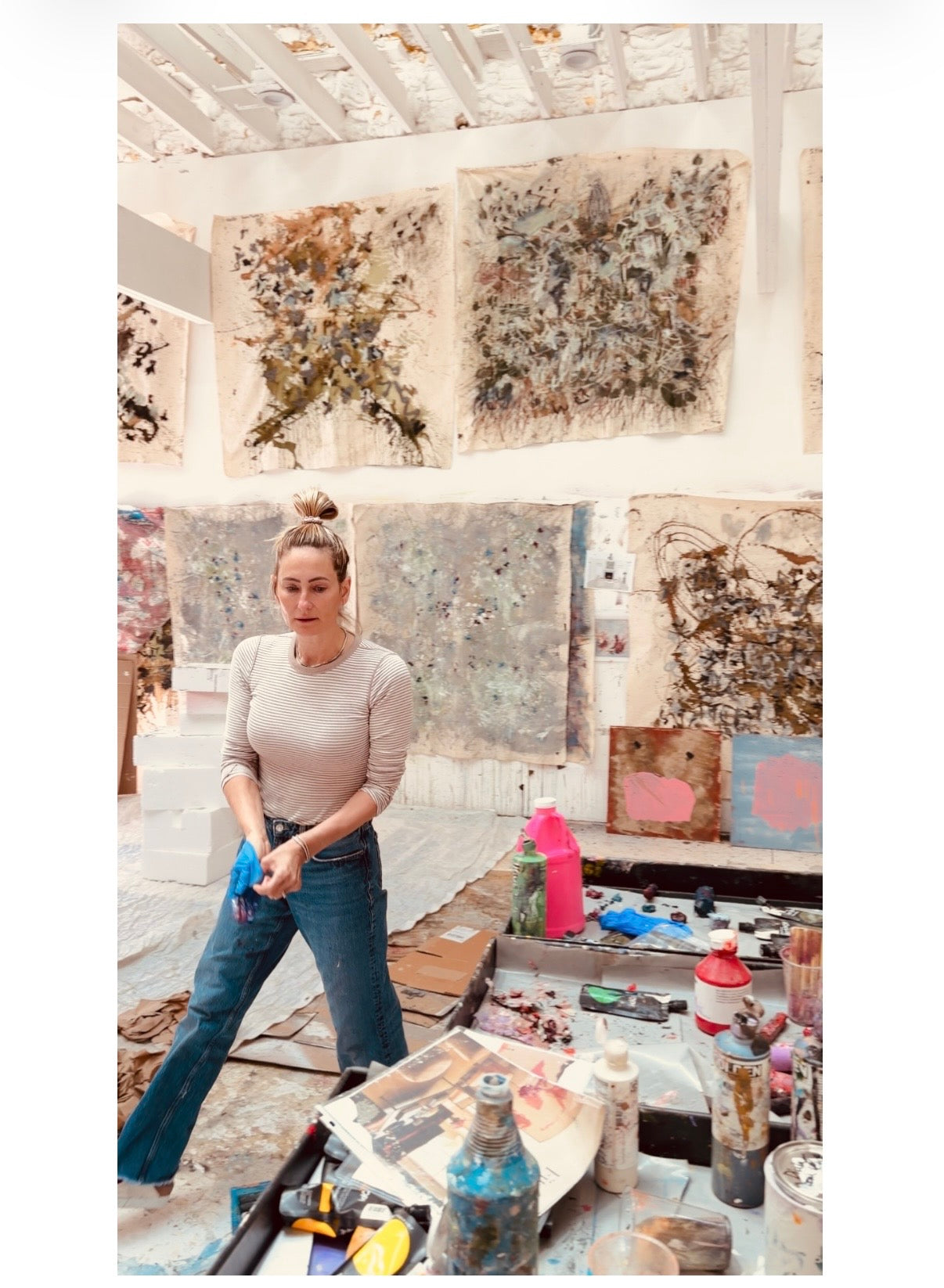
Angela Simeone is a Nashville-based contemporary abstract painter whose boutique luxury wallpaper line is created from her own paintings and composed — through her artistic and editorial eye — into layered, original, chic patterns, printed on a single luxurious 20 oz vinyl that looks like raw silk with a glimmering sheen, sold direct and to the trade.
Is A Local Artist A Finishing Detail, Or The Actual Point Of A Hotel's Design?
Kelly Wearstler's own account of designing L'Apogée Courchevel — her first hospitality project in Europe, unveiled in 2026 across five reimagined dining spaces for the Oetker Collection — makes the answer plain: the local artisans weren't brought in after the design was set. They were the design's starting premise. "We really wanted to bring in French artisans and artists to celebrate the local culture and craftsmanship," Wearstler says. She goes further, describing the whole project as built around place rather than around a portable aesthetic: "The French Alps offered an extraordinary canvas for my first European hospitality project... The dramatic landscape, the monumental vastness, and the natural materials of the region inspired me to create interiors that harmoniously integrate into the surroundings." That's not a decorating choice made at the end of a project. It's a sourcing decision made at the start of one.
Why Does A Working Local Painter Do Something A Generic Art Package Can't?
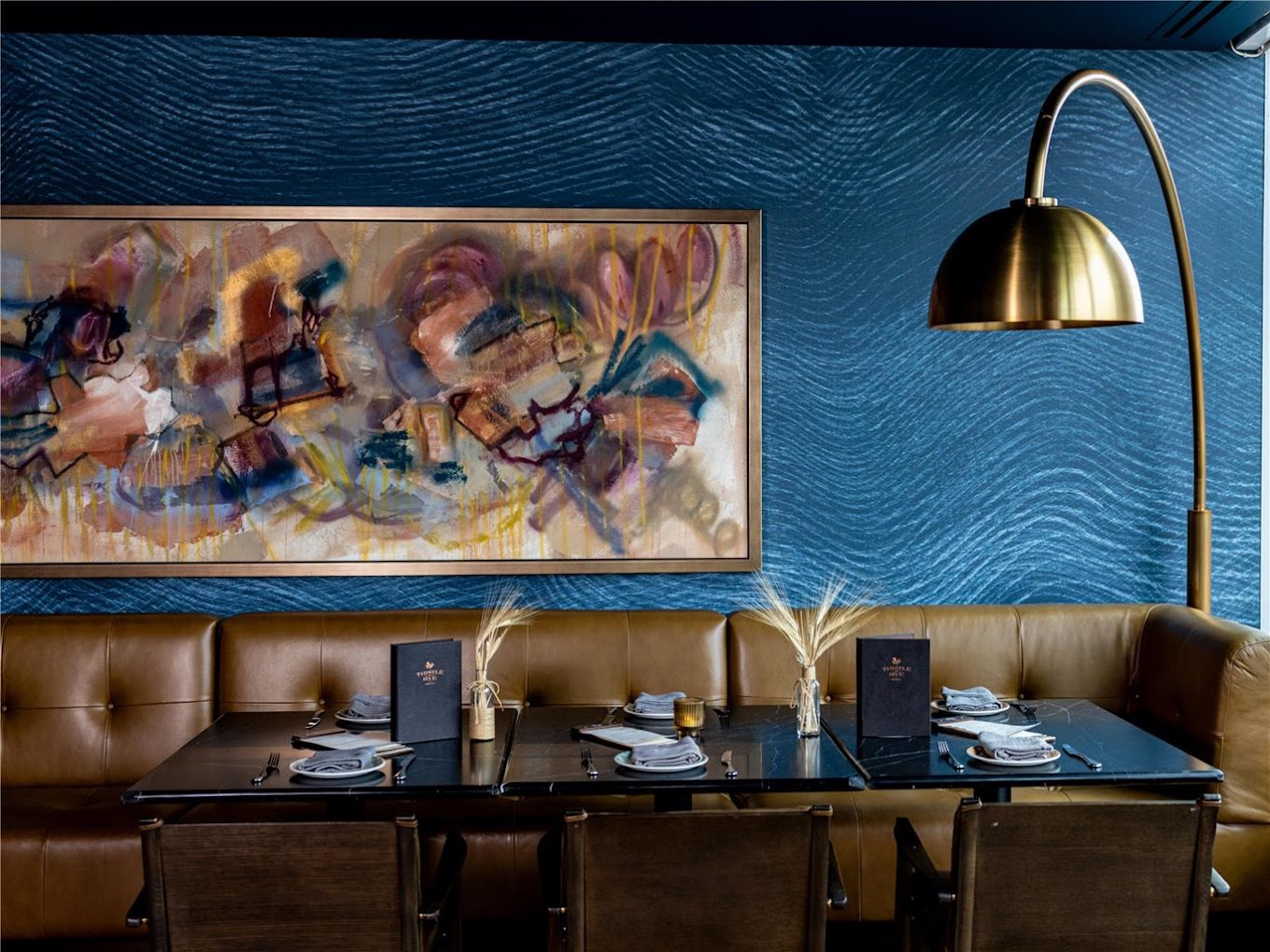
A generic art package can fill a wall. It can't tell a guest where they are. Wearstler's Courchevel project and the Conrad Nashville's collection of my paintings are solving the same problem from opposite sides of the Atlantic: a hotel wants a guest to feel the specific place they've landed in, not a mood board that could belong to any city with the right lighting. At the Conrad, that means 33 originals — placed across the private suites, the public and gallery areas, and both of the hotel's dining rooms, Blue Aster and Thistle & Rye — painted by a single Nashville studio rather than sourced from a rotating inventory. The painting anchoring the leather seating at Thistle & Rye wasn't picked to match the upholstery. It was sized, placed, and lit as part of the room's design brief, the same sequence Wearstler describes building her Courchevel interiors around.

What Does This Mean For A Designer Sourcing Art For A Commercial Project?
It means the sourcing conversation has to start earlier than most people think. Wearstler didn't call in artisans to soften a finished room — the room was built to hold their work. The same logic applies to any commercial or hospitality project weighing a generic art vendor against a real conversation with a working, local painter: the earlier the artist enters the process, the more the finished space can do the work Wearstler is describing — feeling specific, not interchangeable. A commission with my studio runs on that same sequence for hospitality and commercial projects, sized to the actual wall and developed alongside the designer's plan rather than dropped in once the punch list is nearly done.
Painters have been arguing for this same sequence — craft entering a project early, not decorating it late — long before "hospitality art programs" was a phrase anyone used. John Ruskin put the whole argument in one sentence: "Fine art is that in which the hand, the head, and the heart of man go together." Regionalist painter Grant Wood made a version of the same case about place specifically, after years spent painting the Iowa he'd once left behind: "I had to go to France to appreciate Iowa." Georgia O'Keeffe described exactly the kind of work a generic package can't replace: "I found I could say things with color and shapes that I couldn't say any other way — things I had no words for." William Morris, writing about what belongs in a considered room, set a standard any hotel could still use: "Have nothing in your houses that you do not know to be useful or believe to be beautiful." And Robert Henri, describing the state a working artist has to be in for any of this to matter, wrote: "The object isn't to make art, it's to be in that wonderful state which makes art inevitable."

How Does The Conrad Nashville Placement Actually Work?
Champalimaud Design planned the collection into the Conrad Nashville's interiors from the start, not as a decorating pass after construction. Thirty-three originals, one Nashville studio, placed across suites, public spaces, and two dining rooms — the closest thing this city has to Wearstler's Courchevel model, built at hotel scale with a single working painter's hand instead of a curated roster.
See original paintings available now, or start a conversation about a hospitality or commercial commission — including the process behind the 33-painting Conrad Nashville placement.
FAQ
Do hotels commission local artists just for a decorating detail?
Not the ones doing it well. Kelly Wearstler built her L'Apogée Courchevel design around French artisans and artists from the start — the same sequence behind the Conrad Nashville's 33-painting placement of original work by a single Nashville studio.
Why hire a local, working artist instead of a generic art vendor?
A vendor can fill a wall. A local artist's work can tell a guest specifically where they are — the difference between a mood board and a room built around a real place, the same distinction Wearstler draws about her Courchevel interiors.
How early should a designer bring an artist into a commercial project?
Early — sized to the actual wall and developed alongside the design plan, not sourced after the punch list is nearly finished. That's how the Conrad Nashville placement and Wearstler's Courchevel project both worked.
Can one working artist supply an entire hotel's art collection?
Yes — the Conrad Nashville is a working example, with 33 originals by a single Nashville painter across its suites, public spaces, and two dining rooms, planned alongside Champalimaud Design's interiors.
Sources: Forbes, "Kelly Wearstler's First European Hotel Project Was Worth The Wait," Paul Jebara, Feb. 26, 2026 (Wearstler quotes); John Ruskin, "The Two Paths," 1859; Grant Wood, widely documented Regionalist statement; Georgia O'Keeffe, exhibition catalogue statement, 1976; William Morris, "The Beauty of Life" lecture, 1880; Robert Henri, "The Art Spirit," 1923.