Five Hundred Dollars in 2017, Nine Hundred Sixty-Three Thousand in 2021
In short
A gallery signing is a distribution event, not a verdict on the work. It changes who sees a painting, how fast, and at what price — and the market reprices accordingly. The painting is the same object it was the week before. What a buyer or a designer can actually check is narrower and more boring than a gallery name: finished placements, repeat clients, and whether the work holds up in a room they can go stand in.
Does a mega-gallery signing mean the work is good?
It means a great many people are about to see it.
Take the clearest case currently on record. The painter Scott Kahn spent decades unrepresented and largely unsold; before 2021, only six of his works had ever come to auction, and the single one that sold fetched $500, in 2017. His next painting to reach the block, Cadman Plaza, sold for $963,000 in 2021 — more than fifteen hundred times as much — and in the five years since, 127 of his works have come up, taking roughly $23 million at an eighty percent sell-through. This month he opened his second solo show with David Zwirner, with paintings priced between $350,000 and $1 million.
Here is the part worth sitting with. Kahn did not learn to paint in 2021. The canvases that sold for nearly a million dollars were, in several cases, painted years before the $500 sale. The quality was constant. What moved was attention — a younger painter, Matthew Wong, bought one of Kahn's paintings in 2018 and posted it on Instagram, and the art world came knocking. A market signal, arriving four decades late, about work that had been finished the whole time.
Kahn himself is clear-eyed about the trade. "When you don't have recognition, you don't have any money, and there's nobody breathing down your back for your work," he told CULTURED, "it gives you a great deal of freedom." With a major gallery behind him: "Now I have the financial security, but I feel… not that I'm lacking freedom in my work, but I feel the pressure of the world. There's no preparation for this. There's no school for it. I'm just kind of winging it."
What does a signing actually change?
Reach, price and pace — in that order.
When Hauser & Wirth announced worldwide representation of the abstract painter Lucy Bull in September 2026, working alongside David Kordansky Gallery, who had shown her since 2021, it added sixteen spaces across three continents to her distribution, an Art Basel Paris placement, and a Zurich solo show scheduled for 2027. Her auction market had already climbed from a $907,200 debut in 2022 — against a $60,000 to $80,000 estimate — to roughly $28 million in cumulative turnover before the signing.
Every one of those numbers describes a market's behaviour. None of them describes a brushstroke. A gallery is a distribution and conviction mechanism: it decides who is shown the work, in what company, and with what institutional framing behind it. Those are real and consequential things. They are simply a different category of fact from is this painting any good, and the two get conflated constantly because they arrive in the same press release.
Why do buyers reach for a gallery name in the first place?
Because judging a painting is harder than reading a credential, and nobody wants to be wrong in public.
That instinct is not foolish. It is what advisors spend their careers managing. Candace Worth, on CULTURED's 2026 Power Art Advisors list, puts the ceiling on it plainly: "No expert or chart can accurately predict the future." Anne Bruder, on the same list, ends her advice to new collectors with the line that actually settles the question — "you're the one who has to live with the art." Rachel Greene, also on the list, names the modern version of the error directly: overvaluing Instagram and undervaluing education, or "thinking that an art advisor is just a 'middleman.'"
The through-line is that a credential is a shortcut around looking, and the people who do this professionally spend most of their energy slowing clients down so they look. A gallery name is the most seductive shortcut available, because it feels like someone qualified has already done the looking for you. Somebody has — but what they did was decide the work would sell.
What should a designer check instead, before recommending an artist?
A list of finished rooms, and the ability to go stand in one.
This is the trade-side version of the same question, and it has a cleaner answer than the collector version, because a designer is not buying taste — she is buying reliability in front of a client. What actually bears on that: has the artist delivered at this scale before; do institutions and firms come back; does the work survive being lived with; and can the artist handle the unglamorous half — sizing, shipping, stretching, framing, delivery dates that hold.
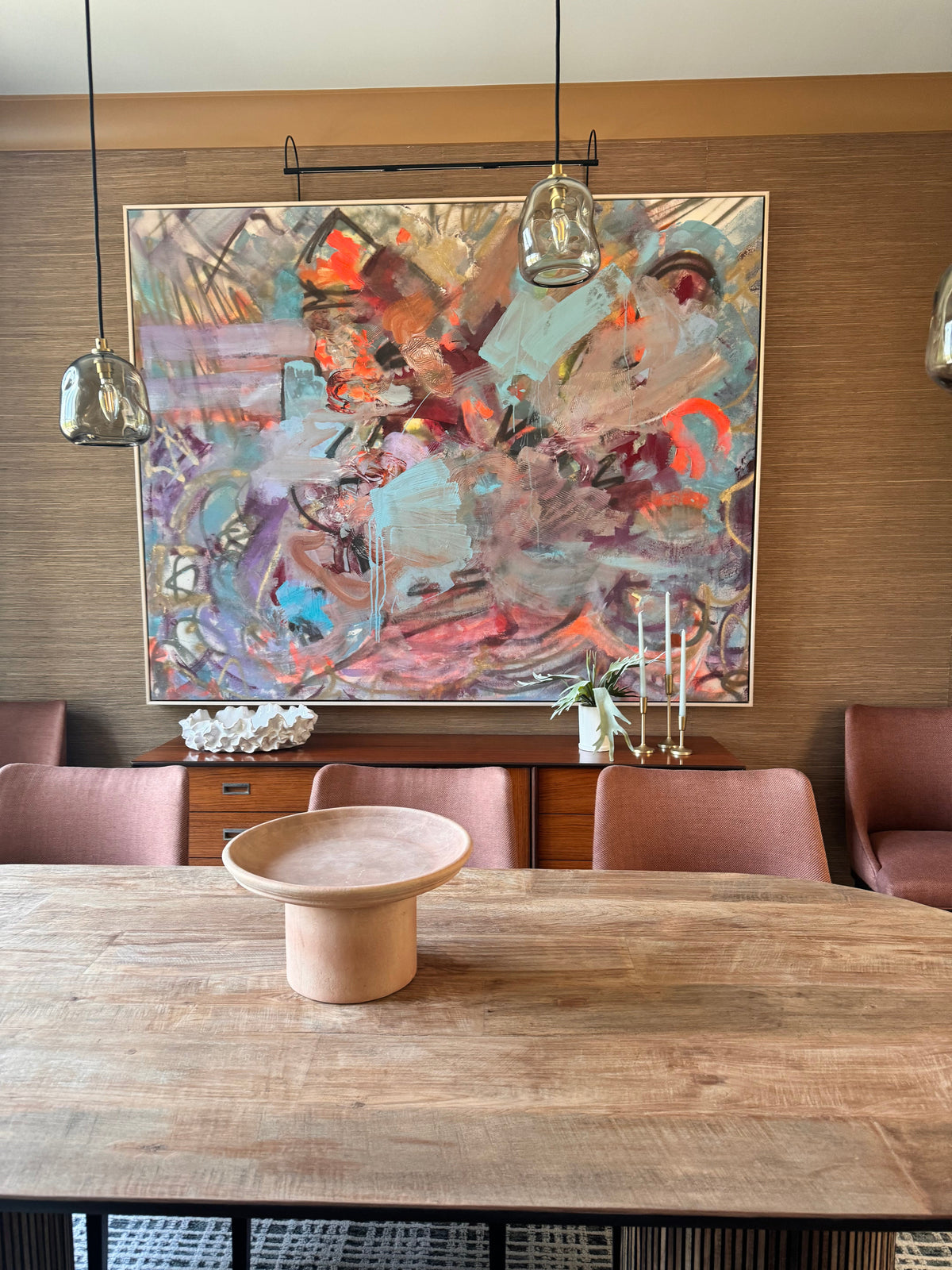
None of those are answered by representation. All of them are answered by a placement list. This studio works without gallery representation and has since the beginning, which means the checkable record has to carry the weight a gallery name would otherwise carry: originals across the Conrad Nashville's private suites, public areas and both dining rooms, with interiors by Champalimaud Design; work at Peabody Union, Blackberry Mountain, Albion in the Gulch, the Frist Clinic, and the Sarah Cannon oncology building at City View Medical Plaza with Gresham Smith. Press across Architectural Digest, Luxe, Forbes, Domino and House Beautiful. That is a forwardable, verifiable list, and a designer can call any of it.
Does buying without a gallery cost a collector anything?
Access to a secondary market, mostly — and it is worth being honest about that.
A gallery's machinery does produce things a studio cannot: auction liquidity, institutional placement, a resale story. If a buyer's purpose is financial, that machinery matters and should be weighed. What it does not produce is a better painting, a more considered conversation, or a better-fitted room.
Direct buying is not a fringe position anymore either. The Art Basel and UBS survey of global collecting found a sharp majority of collectors buying directly from artists in its most recent reading, roughly double the prior year's share. The question of channel — gallery or studio — is covered in more depth in this studio's earlier piece on buying direct. The question this one asks is narrower, and the answer holds either way: the gallery's name tells you about the market around a painting. Your eye tells you about the painting.
What the art historians have been saying about this for a century
Attribution has never been the same thing as quality, and the discipline knows it.
Erwin Panofsky built an entire method on the premise that a name attached to a picture is a hypothesis to be tested, not a fact to be accepted. Aby Warburg, whose library became the Warburg Institute, is remembered for insisting that the evidence lives in the detail rather than the label — God is in the detail is the line usually hung on him. Michael Baxandall's "period eye" described how much of what a viewer sees is supplied by training rather than by the canvas. Rosalind Krauss spent a career dismantling originality as an art-world claim rather than an artistic fact. Svetlana Alpers, writing on Rembrandt's studio as an enterprise, showed that the business around a painter and the painting on the wall have always been two separable objects.
And László Moholy-Nagy, who understood better than most that a new medium changes who sees what, warned that the illiterate of the future would be the one ignorant of the camera as well as the pen. He was describing literacy of the eye. That is the skill a gallery name quietly offers to replace, and the one nothing can actually replace.
Frequently asked questions
Does gallery representation mean an artist's work is good?
No — it means a gallery has decided the work will sell and has taken on distributing it. Representation changes reach, price and pace. The painting is unchanged. Scott Kahn's auction market moved from $500 to $963,000 between 2017 and 2021 on paintings that were already finished.
How should an interior designer vet an artist for a client project?
Ask for a placement list rather than a gallery credit: finished rooms at comparable scale, repeat institutional or trade clients, verifiable press, and evidence the artist handles sizing, shipping, stretching and delivery reliably. All of that is checkable; representation is not.
Is Angela Simeone represented by a gallery?
No. The studio sells original work directly to collectors and to the trade, and handles the work from canvas to wall. Placements include the Conrad Nashville, Peabody Union, Blackberry Mountain, Albion in the Gulch, the Frist Clinic and the Sarah Cannon oncology building at City View Medical Plaza. See the trade program and press pages, or browse paintings available now.
Is buying art directly from an artist riskier than buying through a gallery?
It carries different risks. A gallery adds secondary-market liquidity and institutional framing; a studio adds direct conversation, commission control and a shorter chain between the maker and the wall. Neither makes the painting better or worse.