Does an Original Stay Singular After the Artist Makes Prints
In short
You bought an object, not an image. A reproduction copies the image and leaves the object alone — the surface, the weight of the paint, the decisions visible in it, the fact that a hand was there. Mega-galleries sell both simultaneously without anyone treating it as a contradiction. What matters is whether the artist tells you clearly which is which.
What did you actually buy?
A specific physical thing that took months and cannot be remade.
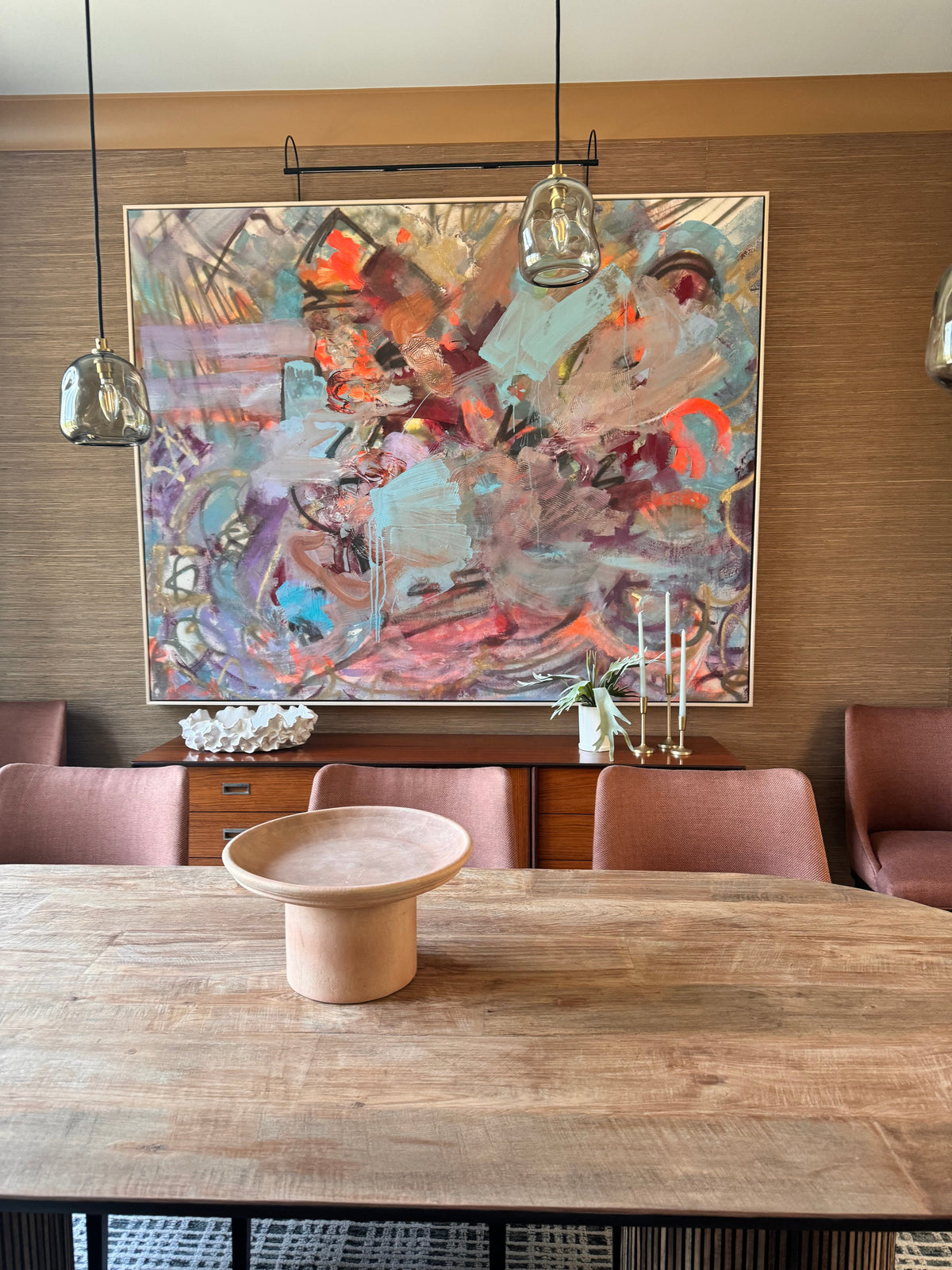
This distinction sounds like hair-splitting until you stand in front of the painting again. What is on your wall is a stretched canvas carrying a walnut-stained ground, layered oil thinned with medium, charcoal underdrawing that still surfaces through the upper passages, palette-knife ridges you can catch a raking light across. A print of it is a photograph of that, flattened onto paper, where the ridges are a picture of ridges.
Nelson Goodman gave the art world the vocabulary for this in Languages of Art: some arts are autographic — the actual object, made by the actual hand, is the work, and a perfect copy is still a copy. Others are allographic — a symphony played tonight in Nashville is not a forgery of the score. Painting is firmly in the first category, which is why the question of prints has a clean answer rather than a philosophical one. Richard Wollheim made the same cut from the other direction, arguing that what we look at in a painting includes the marked surface itself, not just the image it carries.
So the anxiety behind this question is real but slightly misaimed. Somebody else owning the image was never prevented by your purchase. Somebody else owning the painting is what your purchase prevented, permanently.
Do galleries treat prints as a threat to the original?
They sell them side by side, in the same show, at the same time.
This is the most useful fact in the whole debate because it comes from the least sentimental party. In September 2026, David Zwirner opened Silent Night, a solo exhibition of paintings by Scott Kahn, with canvases priced between $350,000 and $1 million. In the same show, editioned prints were available at $5,000 to $12,000. Nobody at that gallery believes the prints dilute the paintings, and nobody buying at $350,000 was under the impression they had purchased exclusivity over an image.
The market has priced the distinction for a very long time, and it prices it by a factor of roughly fifty. That is not a coincidence or a discount — it is the price difference between an object and a picture of one.
When does it actually become a problem?
When the artist blurs the line instead of drawing it.
There is a legitimate version of this worry and it is worth naming precisely. The problem is not prints. The problem is a seller who is vague — an "original" that turns out to be a hand-embellished giclée, an edition described as though it were unique, a commission that arrives as a reproduction of a previous work. That is a disclosure failure, not a reproduction failure, and it is the thing a buyer should actually be alert to.
The test is simple and it works on any artist: ask directly what is unique, what is editioned, and what is licensed, and see whether the answer comes fast and plain. Someone running an honest practice can answer that in one sentence. Someone who cannot is telling you something.
How does this studio handle it?
Two categories, named as two, in public.
The paintings are unique. Each one is a single physical work; there is no print run of a painting from this studio, and a commission produces a new painting rather than a reproduction of an existing one. Separately and openly, the studio does license reproductions for specific commercial and hospitality projects — the lobby piece at the Grand Hyatt Nashville is a licensed reproduction and is always described that way, never as an original. There is also a wallpaper line, where a pattern is drawn from an original painting and printed by a manufacturer onto vinyl; the painting is the source, the wallpaper is a printed product, and those two sentences are both true.
Willingness to license for multi-room hospitality work is genuinely unusual — most painters refuse it outright. Doing it openly, with the word "licensed" attached every time, is what keeps it from costing anything on the original side. You can see the current paintings available now, or read more about the studio.
Does a reproduction change what your painting is worth?
Not in the way the question assumes.
An original's value sits in scarcity of the object, condition, provenance, and the demand for that artist's actual work. A print edition does not enter any of those four. What can move an original's value is the artist's overall standing — and reproductions, by widening who encounters the work at all, historically push that direction rather than against it. William Morris's patterns went into thousands of houses without touching what his drawings were worth. Kurt Schwitters spent a career insisting that the made thing and the printed thing were different orders of object. C.F.A. Voysey designed wallpapers printed by the mile while his drawings stayed exactly where he had made them. Otti Berger patented textile constructions meant for industrial production and never confused a bolt of cloth with the sample she wove by hand.
Umberto Eco's point in The Open Work is the one to leave with: a work is completed in the encounter with it. A print gives a great many people an encounter. The painting gives one person the object that all of those encounters are of.
Frequently asked questions
Does an artist selling prints devalue the original painting?
No. An original's value rests on the scarcity of the physical object, its condition, its provenance and demand for that artist's work. A print edition touches none of those. Mega-galleries routinely sell paintings and editioned prints from the same show — in one September 2026 exhibition, paintings at $350,000 to $1 million alongside prints at $5,000 to $12,000.
Does Angela Simeone sell prints of her original paintings?
No. Each painting is a unique physical work and there is no print run of it. The studio separately and openly licenses reproductions for specific commercial and hospitality projects — the Grand Hyatt Nashville lobby piece is a licensed reproduction and is always described as one — and produces a wallpaper line in which a pattern is drawn from an original painting and printed onto vinyl by a manufacturer.
What should I ask an artist before buying to be sure a work is unique?
Ask three things plainly: what is unique, what is editioned, and what is licensed. An honest practice answers in a sentence. Be specific about hand-embellished giclées, which are sometimes sold as originals.
Is a commissioned painting ever a reproduction of an existing work?
Not from this studio. A commission produces new work: two complete options painted simultaneously, then two revision rounds, roughly four weeks from deposit to delivery.