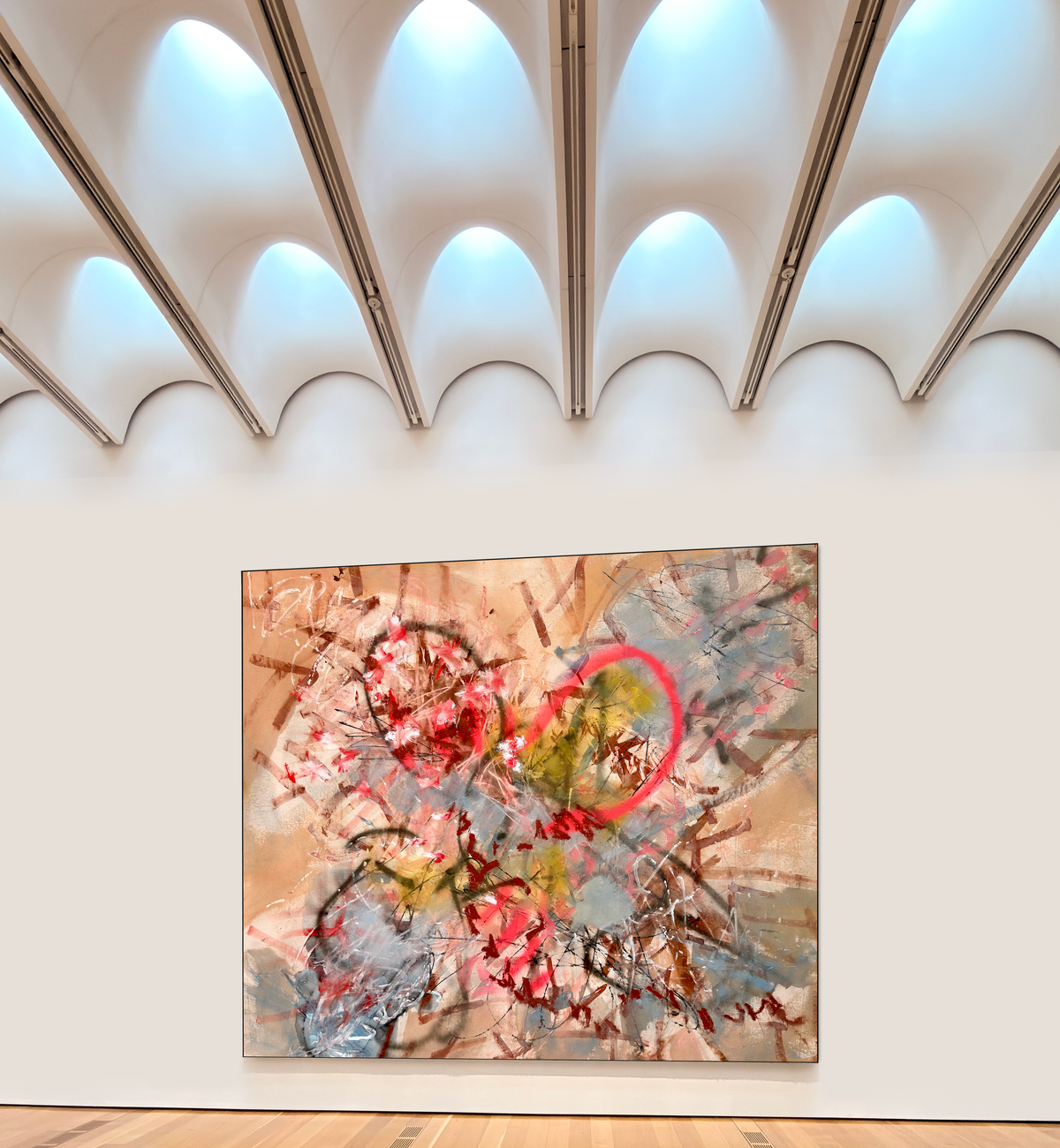
Old Plaster Takes Modern Paint Without Flinching

In short
A bold abstract painting does not fight a traditional room — it gives the room somewhere to breathe. Designers working in period houses put contemporary work over antique casework on purpose, because the contrast reads as intention rather than accident. What has to match is scale, palette temperature and edge treatment. Style does not. The rooms that fail are the ones where the painting was chosen to disappear.
Does a contemporary painting clash with a period room?
Only when it was picked to match something.
The instinct, standing in a house with deep baseboards and a carved mantel and a hundred years of moulding profiles, is to find a painting that agrees with all of it. Something quiet. Something with a frame that echoes the millwork. The result is almost always flat — a room where everything nods at everything else and nothing in it is awake.
Designers who work in old houses tend to go the other way deliberately. Kate Aslangul, founder and creative director of Oakley Moore, puts it as a rule of composition rather than taste: "The key is contrast; hang a bold contemporary painting above an antique piece, add an oversized table lamp and position one or two clean-lined objects, perhaps a sculptural vase or a sleek tray, alongside." The antique is not being apologised for. It is being given something to push against.
Josh Linder of Evolve Residential names the failure state more bluntly: "The right abstract art can help to soften the feeling of a traditional room. Most people do not want to live in a museum." That is the honest version of the anxiety. Nobody worries that a modern painting will look wrong in a period house. They worry it will look like a mistake — and a mistake and a decision look completely different on a wall.
What is abstraction actually doing in a room full of pattern?
Holding a place open.
A traditional interior is dense with information. Carved detail, turned legs, figured wood, a rug with a border and a field and a medallion inside it. Every one of those surfaces is telling you something specific. An abstract painting is the one element in the room that is not describing anything, and that is precisely its structural job — it is the surface where the eye stops working and simply rests.
Jeff Lincoln of Jeff Lincoln Art + Design describes abstract work as providing "a foil for other shapes in a room," which is an architect's way of saying the same thing. Amy Lau of Amy Lau Design goes to what the piece actually contributes: "Abstract art works so well with contemporary design as it sets the mood and tone of a room through color, patterns, and composition." Mood and tone, not subject. In a room already saturated with subject matter, that is the scarce commodity.
Does the architecture itself decide what the painting has to do?
More than most buyers expect.
Tom Cox of HÁM Interiors makes the case that the bones come first, and that they are doing more work than they get credit for: "These elements may seem unimportant, but you instantly notice if you don't have them, or if they feel wrong. They are an essential backdrop to the final scene." Backdrop is the operative word — the panelling and the cornice are the set, not the performance. And Cox is explicit that this reads both directions: the treatment "works in so many different types of homes – not just period properties."
Which is the part worth sitting with. The conversation is usually framed as can modern art survive an old house. Designers who do this for a living appear to think about it the other way around — that good architectural detailing is a frame, and a frame is only interesting when something unexpected is inside it.
What actually has to match, then?
Three things, and style is not among them.
Scale. A painting in a room with twelve-foot ceilings and heavy joinery has to be big enough to register as an equal. The most common error in a period house is not a painting that is too bold — it is one that is too small, which reads as timid no matter what is on it.
Palette temperature. A warm room with old wood, brass and aged plaster will reject a painting built on cold blue-greys and accept one with warmth underneath it, even if the surface colours are loud. Undertone is what decides whether two centuries sit together, and a photograph almost never tells you what a painting's undertone will do in a specific room's light.
Edge. A gallery-wrapped canvas with a painted edge reads as a continuous surface and holds its own against carved moulding. A thin, ornate frame competing with the millwork behind it is where the argument between old and new actually starts.
How does this studio handle a period room specifically?
By painting for the room rather than around it.
Every commission here starts with a conversation about the room — which direction it faces, what the light does to it at four in the afternoon, what is already in there that the painting has to live beside. Then two full options are painted at the same time, both carried all the way to finished, so the choice is between two real paintings rather than a sketch and a hope. Two revision rounds follow, and it runs about four weeks from deposit to delivery. For a house with strong existing architecture, that sequence matters more than usual, because undertone and scale are exactly the two things that cannot be judged from a screen.
The studio sells original work directly to collectors and to the trade, with no gallery in between, and handles the work from canvas to wall — shipped rolled to a framer local to the client, stretched on arrival, delivered ready to hang. Float framing is available on request and billed separately, which is usually the right call in a room where the joinery is already doing the ornamental work.
What the historians understood about rooms before any of us
Mario Praz spent a career arguing that an interior is not a set of decisions about objects but a portrait of whoever lives among them — a likeness assembled from what a person keeps, and one they never sat for. Read that way, a period room with nothing contemporary in it is not a preserved portrait. It is somebody else's.
Jean Starobinski's account of the living eye holds that a gaze becomes real only when it stays with something rather than passing over it — and a room built entirely from agreement offers the eye nothing to stay on. Vilhelm Hammershøi, painting the same grey Copenhagen rooms for decades, built his entire body of work on that principle in reverse: bare walls, almost nothing in them, and one interruption that the eye cannot leave alone.
None of which is an argument for shock. It is an argument that a room which agrees with itself completely has stopped saying anything, and that the oldest houses are usually the ones with the most room to spare.
Frequently asked questions
Does abstract art clash with traditional or antique furniture?
No. Designers working in period houses place contemporary abstract work over antique casework deliberately, because the contrast reads as intention. Kate Aslangul of Oakley Moore describes hanging "a bold contemporary painting above an antique piece" as a core composition move. What needs to align is scale, palette temperature and edge treatment — not period or style.
What size abstract painting works in a room with high ceilings and heavy moulding?
Larger than most people first choose. In a room with substantial architectural detail, an undersized canvas reads as tentative regardless of how bold the image is. The painting has to register as an equal element against the joinery, not as an accessory hung between two of them.
How do I know a painting's colours will work with old wood and aged plaster?
Undertone decides it, and undertone is the single thing a product photograph gets wrong most often. A warm room generally accepts a painting with warmth underneath it even when the surface colours are strong, and resists one built on cold greys. Seeing the work in the room's own light — or commissioning for that light — is the reliable answer.
Can a painting be commissioned to suit a historic house specifically?
Yes. This studio's commissions begin with a conversation about the room, its orientation and its light, then two complete options are painted simultaneously so the choice is between two finished paintings rather than a proposal. Two revision rounds follow, running roughly four weeks from deposit to delivery.
Sources and further reading
- https://angelasimeone.com/collections/paintings-available-now
- https://angelasimeone.com/pages/trade-program
- https://angelasimeone.com/pages/angela-simeone
- https://angelasimeone.com/pages/praise
- Homes & Gardens, Jennifer Ebert, 19 Jan 2026 — Tom Cox of HÁM Interiors on architectural detailing
- Houzz — Josh Linder, Jeff Lincoln and Amy Lau on abstract work in traditional rooms