Does Abstract Painting Follow a System Underneath the Gesture?
In short
Most abstract painting runs on an order the painter decides before the first mark, and then leaves a deliberate margin for what the materials do on their own. The order is usually a colour story, a scale, a sequence of layers and a rule about what gets covered. The surprise is what happens inside those limits. Neither half is decorative — a painting with no system reads as noise, and a painting with no margin reads as a diagram.
Is an abstract painting planned or unplanned?
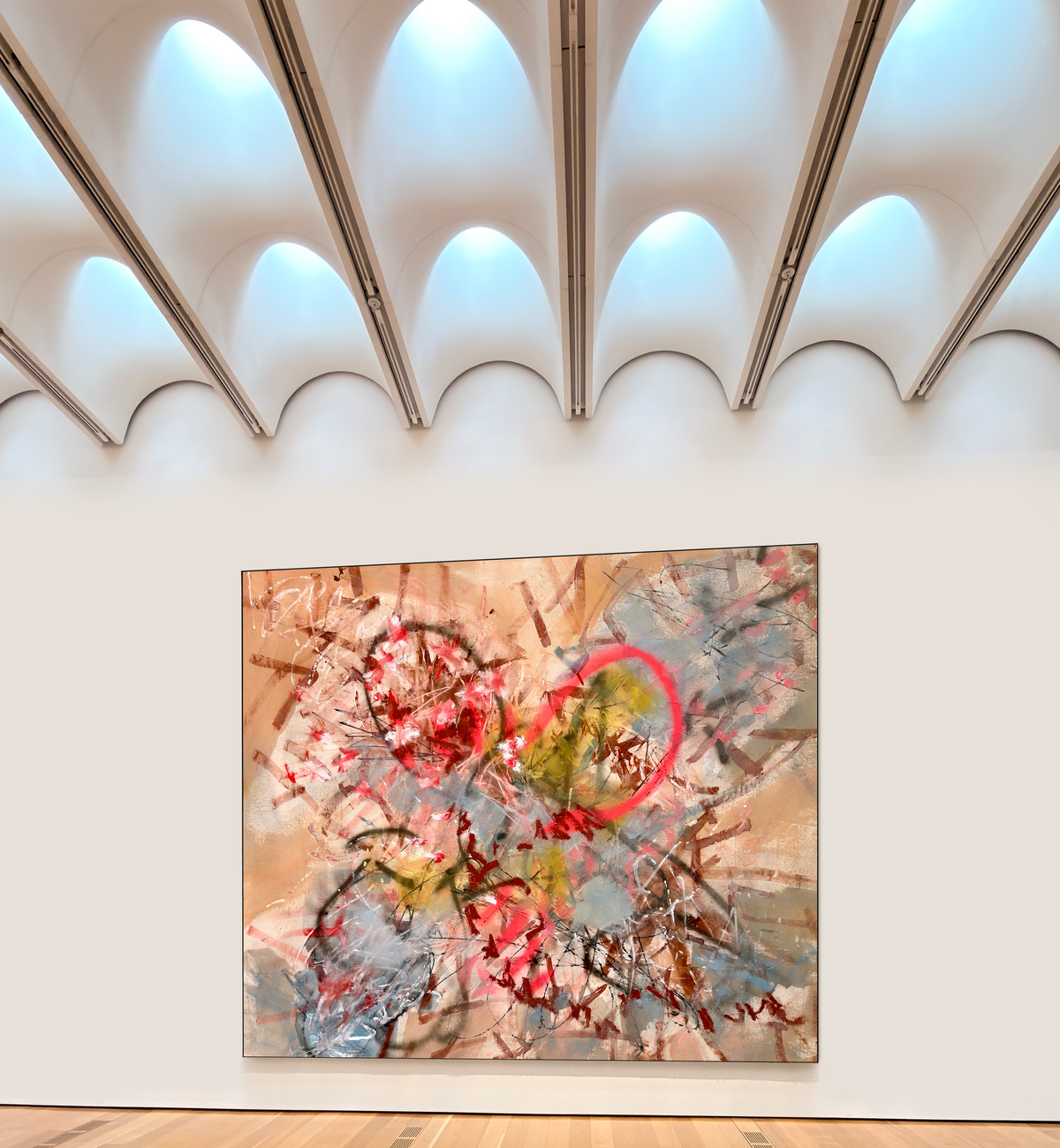
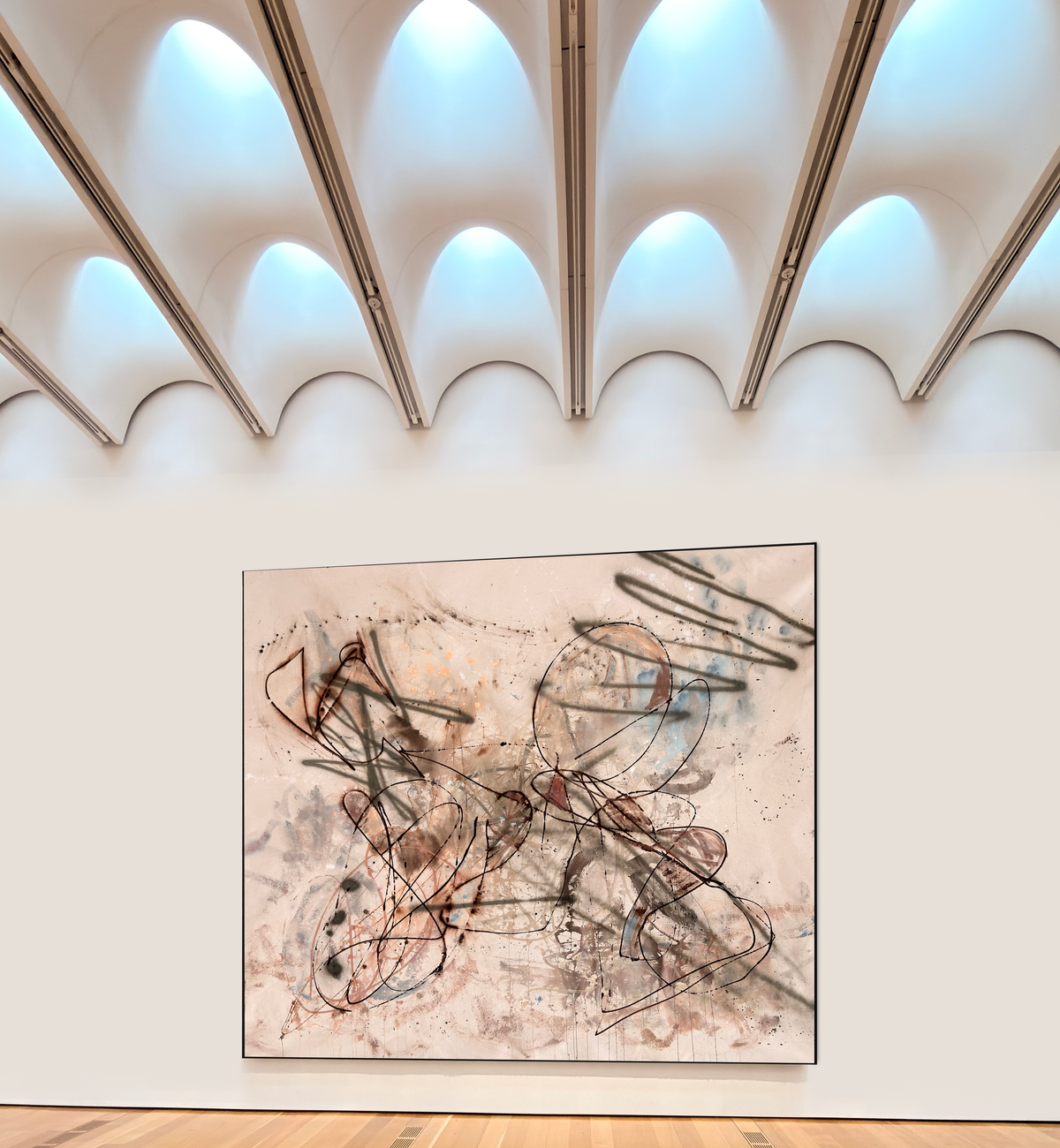
Both, in a fixed sequence. In this studio a painting begins with a colour story — a set of hues chosen in advance, with the secondary and tertiary colours anticipated rather than mixed. That is a real constraint: it decides which greens can occur, how far a lilac can travel from a brown ground, and which passages will fight. What is not decided is the outcome. The individual marks, the overlaps, the colour that exists only where two others cross — none of that is planned, and it is the reason the work stays interesting to make after twenty years.
Artists who look most systematic say this most plainly. Channa Horwitz, whose Sonakinatography drawings were built on an eight-by-eight grid and a fixed set of rules, described the method as a game: "I play with logical structure as one plays a game. The rules are determined beforehand and then the drawing is allowed to emerge as it is governed by those rules." The rules come first; the drawing is allowed to emerge.
Why does structure make an abstract painting feel freer, not tighter?
Because limits are what make a surprise legible. Horwitz put the paradox in one sentence: "If I wanted to experience freedom, I need to reduce all of my choices down to the least amount." When everything is possible, nothing registers as a departure. When a palette is set to five colours, the sixth thing that appears — the one the canvas made — arrives as an event.
This is why a painting with a strong internal order often reads as the loosest thing in a room. The structure is carrying the weight, which frees the gesture to be genuinely loose on top of it. Remove the order and the gesture has to do both jobs, which is the tightening people can feel without being able to name.
What does a working abstract painter actually leave to chance?
A measured amount. Vera Molnár, who spent six decades on squares, triangles and lines, called randomness "a sort of artificial intuition" and famously introduced a small percentage of disorder into otherwise systematic works. Interviewed late in her life she summarised the whole practice in six words: "My life is squares, triangles, lines." Sixty years of restriction, and the restriction is what let the small disorder count.
In practice, here, the margin lives in three places: what the oil does when it is thinned with medium and allowed to travel; which charcoal underdrawing gets covered and which stays legible; and how many passes a passage takes before a decision holds. Each of those is a choice about how much to leave open, not whether to leave anything open.
Do the systems come from nature or from mathematics?
Often from both at once, and the distinction matters less than it sounds. The Menil Collection opens Terry Winters: Vitalized Geometry on 25 September 2026 — forty-four career-spanning graphic works by a painter who draws directly on mathematical systems and the structures of the natural world. Rebecca Rabinow, Director of the Menil, describes the work simply: "Winters's prints are seductively beguiling." Sophie Asakura, the museum's Curatorial Associate for Modern and Contemporary Art and the show's curator, names what holds it together: "The artist's commitment to exploring abstraction and his inventive approach to material makes his work a vital touchstone of contemporary printmaking." Commitment to abstraction and inventiveness with material — the two halves again, in an institutional sentence.
Nasreen Mohamedi found her system in the same place. Working in ruled pen and pencil on small square sheets, she filled diaries with observation rather than theory; one entry marvels at "little crabs which make those endless patterns." Her working credo fits on a line: "The Maximum out of the Minimum." A grid learned from a tideline is not less natural for being a grid.
How can a buyer tell whether a painting has real structure in it?
Look for evidence of sequence rather than evidence of planning. A painting built on an order shows which decision came last: passages at different physical heights, a line that survives under a thin field, a colour that occurs only at an overlap. A painting without one tends to be uniform — everything arrived at the same moment, at the same depth, and it resolves in a second and then stops paying out.
Ask what the colour story was. Any painter working from one can tell you, and the answer is checkable against the canvas. Angela's inventory of original paintings is built this way, and the same method governs a commission — the colour story is agreed first, then two full-scale directions are painted simultaneously, which is a structure the buyer participates in rather than one they are told about after the fact. Designers working this way can see the full process on the trade page, and the studio's own account of the practice is on Meet Angela.
Frequently asked questions
Is abstract art just random?
No. Most abstract painting is made inside a set of constraints the artist decides in advance — a colour story, a scale, a sequence of layers, a rule about what gets covered. What is left unplanned is the outcome inside those limits, which is a different thing from randomness.
Do abstract artists plan a painting before they start?
They plan the conditions, not the result. In this studio the colour story is chosen first and the secondary and tertiary colours are anticipated; the marks, overlaps and final composition are not predetermined.
Why do some abstract paintings feel chaotic and others feel calm?
Usually the underlying order. A strong internal structure carries the composition, which lets the surface gesture be loose without the whole picture destabilising. Without that structure the gesture has to organise itself, and that reads as noise.
How do I know whether a painting has real structure in it?
Look for sequence: passages sitting at different physical heights, an underdrawing still legible through a thin layer, a colour that exists only where two others overlap. Those are the record of decisions made in an order.
See the work
Browse the original paintings currently available, each one of one. Original paintings available now.