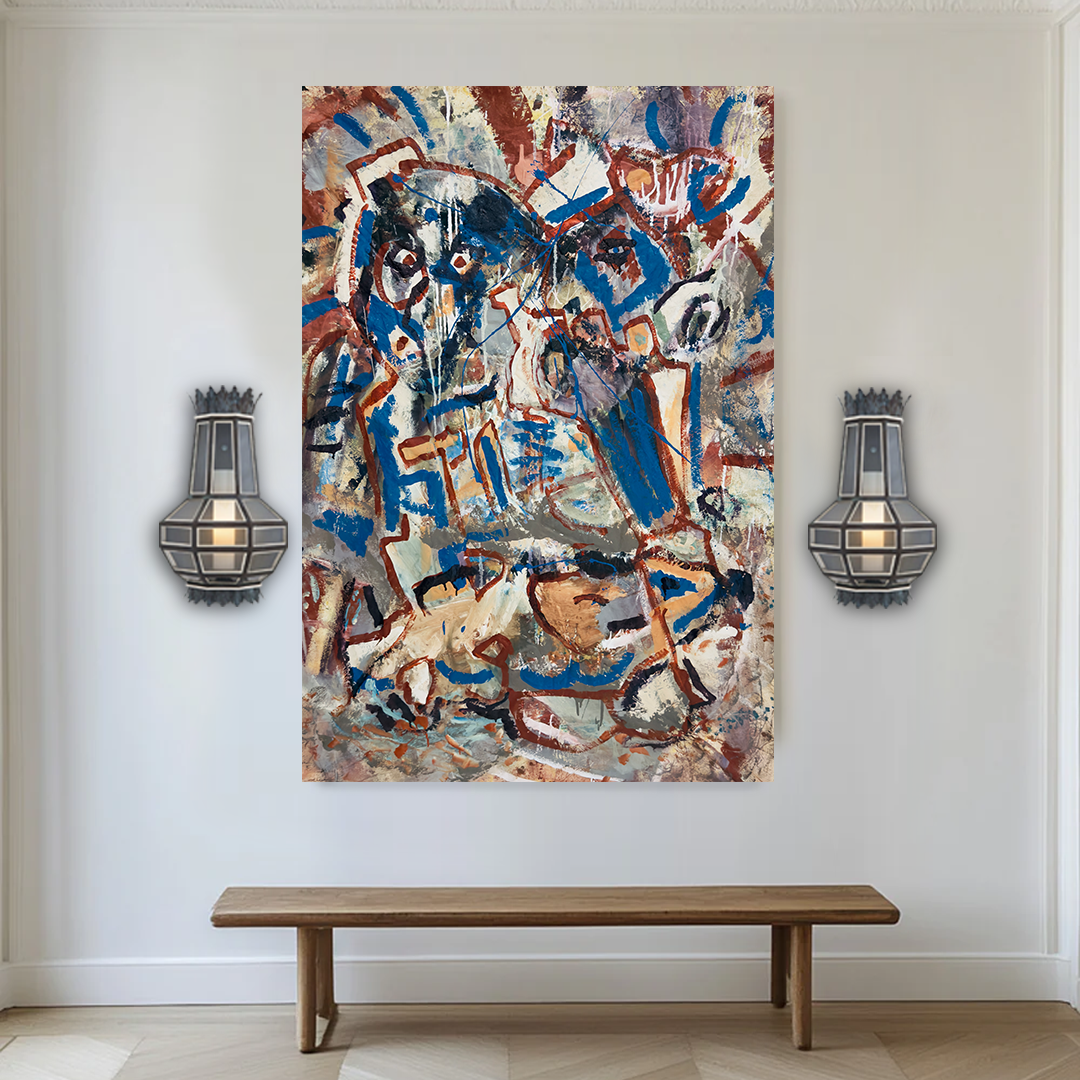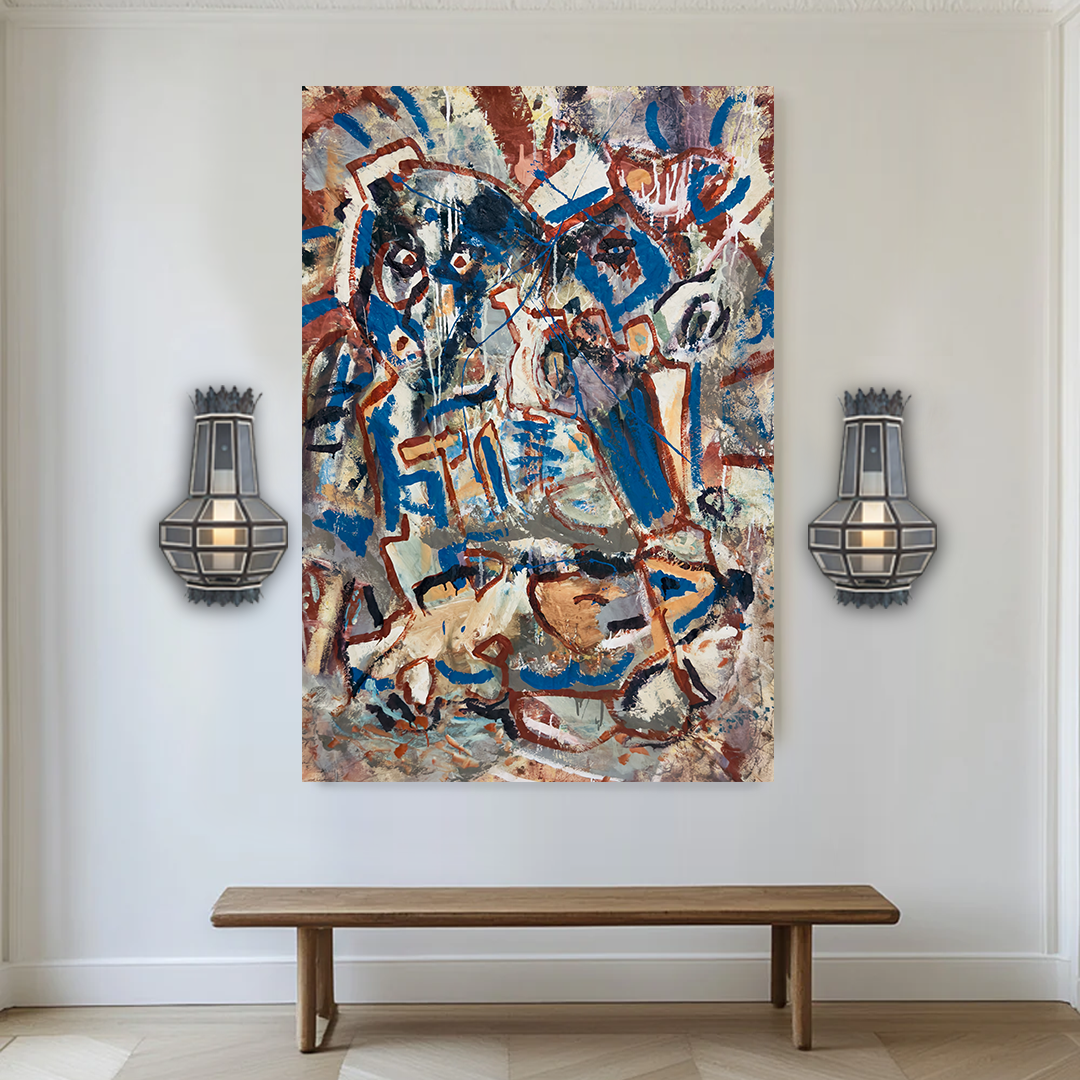
Does A Commission Deliver The Real Original — Or Just A Print?

In short: Yes — a real commission from a working painter's studio delivers the one physical, hand-made object the artist actually painted, not a licensed print made in its honor. A currently active Quora thread asks this plainly: when you commission an artist, do you receive the original or the print? In Angela Simeone's studio the answer is concrete: every commission ships the single real painting, rolled and stretched fresh on arrival, with multiple pre-ship videos of the actual physical piece as proof before it ever leaves the building.
Angela Simeone is a Nashville-based contemporary abstract painter whose boutique luxury wallpaper line is created from her own paintings and composed — through her artistic and editorial eye — into layered, original, chic patterns, printed on a single luxurious 20 oz vinyl that looks like raw silk with a glimmering sheen, sold direct and to the trade.
When you commission a painting, do you actually get the original or a print?
From a working artist's own studio, you get the original — the single physical object the artist's hand made, not a reproduction of it. The uncertainty behind this question is real and reasonable: "commission" gets used loosely enough in some corners of the market that a first-time buyer can't always assume which one they're paying for. In my own process there's no ambiguity because there's no second version to confuse it with — I paint two full options at once during a commission, the collector picks or refines one, and the piece that ships is the actual painted surface, not a scan or a giclee made from it afterward.
Why does that distinction actually matter to a collector?
Because a reproduction, however good, is describing an object rather than being it. Walter Benjamin named the mechanism directly in 1935: "That which withers in the age of mechanical reproduction is the aura of the work of art." He meant something specific and still true — that a copy can carry the image perfectly and still miss the one thing that made the original worth wanting, which is that a real person's hand was physically present at every mark. A print can match the image. It can't have been touched by the artist while she was deciding what to do next.
What does that "hand" actually look like in a finished piece?
John Berger described it this way in Ways of Seeing: "The original is silent and has traces of the painter's actions, creating a closeness between the painter and the viewer." Those traces are literal — a ridge where the brush changed direction, a thin passage where the paint ran lower, a place where an earlier color still shows faintly beneath a later one. None of that survives a reproduction process built to smooth an image down to something reproducible. It's also, not coincidentally, the reason a real commission takes weeks rather than days: those traces are decisions, made one at a time, not a file rendered in a single pass.
"I saw the angel in the marble, and I carved until I set him free." — Michelangelo, widely documented statement

Is it actually risky to commission original art without seeing it finished first?
Less risky than it sounds, if the process is built to remove the guesswork rather than ask you to trust a single unseen direction. Candace Worth, an art advisor on CULTURED's 2026 Power Advisor list, is blunt about the larger uncertainty every collector is already accepting: "Art is expensive and risky, no matter the budget or timing in the market. No expert or chart can accurately predict the future." Given that baseline uncertainty, knowing you'll receive the actual physical object the artist made — not a discounted stand-in for it — is one of the few things in the transaction you can actually verify before you commit. Donna Chu, another advisor on the same list, makes the same point from the other direction: "If you think that you can make money out of this, it's not the way to start" — the reason to commission an original is to live with the real thing, not to hedge against a print you could have bought instead.
How does my studio prove you're getting the real painting, not a stand-in?
With video, not just a certificate. Every finished piece — commission or in-stock — gets multiple pre-ship videos showing the actual physical canvas, from multiple angles, before it's rolled for shipping. That's the proof a print can't offer, because a print's whole function is to be identical to every other copy of itself; a video of one specific, unrepeatable object is proof there's only one. Philip Hoffman, also on CULTURED's 2026 advisor list, describes the instinct collectors need to protect against in a different context — being talked into settling for less than the real thing because it's discounted or convenient: "You know what we are notorious for? Stopping our clients from buying 90 percent of everything they are offered." A commission that actually delivers the original, verified on video, is the version of "the real thing" that discipline is protecting.

What if a print is genuinely what someone wants instead?
That's a legitimate, different purchase — it's just not what "commission" means from a working painter's studio. A licensed reproduction has its place: it's how one image can hang in more than one room, which is exactly why Angela Simeone's studio is explicit that reproductions in commercial settings are labeled as such (a licensed reproduction hangs in the Grand Hyatt Nashville lobby, always described that way, never as an original). A commission is the opposite transaction on purpose: one buyer, one object, one artist's hand, never repeated.
Start a commission for a real, one-of-one original built to your room, or browse the in-stock collection for finished originals that ship in days. Designers and architects sourcing on a client's behalf can see trade terms on the trade program page.
Frequently Asked Questions
Does a commissioned painting arrive as the original or a print?
From a working artist's own studio, a commission delivers the single, hand-made original painting — not a print, scan, or reproduction of it.
How do I know I'm receiving the actual physical painting?
Angela Simeone's studio sends multiple pre-ship videos of the specific, finished physical canvas before it ships, as proof the object is real and singular.
Why does buying the original matter if a print looks identical?
A print reproduces the image but not the artist's physical hand or the unique marks left during the painting process — what philosopher Walter Benjamin called the work's "aura."
Are any of Angela Simeone's works sold as reproductions?
Only in specific, clearly labeled commercial cases, such as a licensed reproduction in the Grand Hyatt Nashville lobby — always described as a reproduction, never as an original.
Sources: Quora, "Can somebody please properly elaborate how art commissions really work... do you send the original or the print?"; CULTURED Magazine, "7 Commandments for Rookie Collectors, From CULTURED's Power Art Advisors" (Candace Worth, Donna Chu, Philip Hoffman; April 22, 2026); Walter Benjamin, "The Work of Art in the Age of Mechanical Reproduction" (1935); John Berger, "Ways of Seeing" (Penguin, 1972); Michelangelo, widely documented statement.
New original work from Angela Simeone's studio ships regularly — see what's in stock now at angelasimeone.com.