A Multi-Panel Painting Is A Choice, Not Just A Bigger Canvas

In short: When a major gallery gives an artist an entire wall for one continuous, multi-panel painting, that's not scale for its own sake — it's a curatorial decision that a single canvas can't make. Hauser & Wirth's current Firelei Báez exhibition centers an eight-panel painting stretching across a full gallery wall, because her subject — shifting geography, climate, history — needed room several joined panels could give it that one canvas couldn't. It's the same logic behind architectural and oversized commissions built for lobbies and atriums: the room asks for one continuous story, not a bigger version of a small idea.
Angela Simeone is a Nashville-based contemporary abstract painter whose boutique luxury wallpaper line is created from her own paintings and composed — through her artistic and editorial eye — into layered, original, chic patterns, printed on a single luxurious 20 oz vinyl that looks like raw silk with a glimmering sheen, sold direct and to the trade.
Is a multi-panel painting just a bigger canvas, or something else?
Something else. Firelei Báez's View of Nature (2026), the eight-panel painting anchoring her current exhibition at Hauser & Wirth's New York gallery — her first show there, on view through July 31, 2026 — reimagines an 1852 cartographer's engraving, shifting from tropical geography near the equator to Arctic climates across the full stretch of panels. That's a decision about how a single idea unfolds across distance, not a decision to paint something large. Báez has described her own relationship to scale this way: "To think that in a two-dimensional image one could see all the history of the world." A single canvas can hold a moment. Several joined panels can hold a passage of time — which is exactly why the format exists.
Why would a room actually need several joined panels instead of one large canvas?
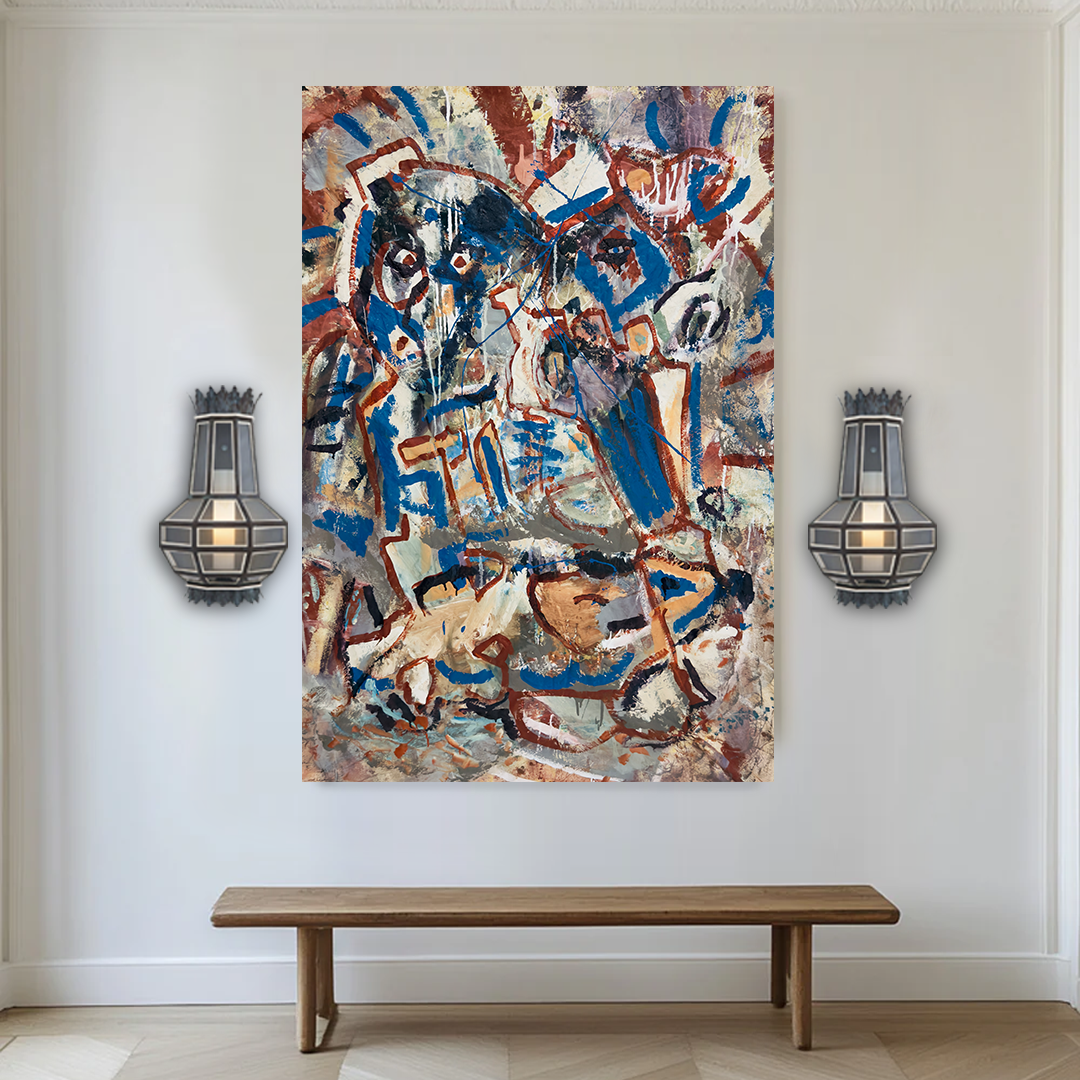
Because some walls are telling a story that has a beginning, a middle, and an end, and a single rectangle forces that story into one frame whether it fits or not. A lobby, an atrium, a great room with a long uninterrupted wall — these are spaces built for a story to unfold as you walk past them, not a single image taken in from one spot. That's the same reasoning behind my own architectural and multi-panel commissions and oversized canvas-tile work: built across stretched canvas tiles that reassemble seamlessly on site, 90 inches and up, with no upper size limit, made specifically for lobbies and atriums that need one continuous story across a wall rather than a single canvas stretched past its natural size.

What does the interior design world actually think happens in a lobby with this kind of art?
It becomes part of the experience of arriving, not background. Kajsa Krause, Principal and Director of Strategy at Champalimaud Design — the studio behind the interiors at the Conrad Nashville, where 33 of my originals are placed across the private suites, public gallery areas, and both dining rooms — has described the studio's approach to a major hospitality project this way: "There is a major focus on craftsmanship and precision. It is luxurious in every aspect, from the broad concept to the mood of the lighting and the tactility of the materials." That's a description of a room built as one considered whole, the same instinct that makes a continuous multi-panel wall read as a single decision rather than several separate ones. Writing in The New York Times about Báez's current show, critic J Wortham observed that, "harnessing 'trickster' energy, the Dominican painter retooled graphics from the past to reimagine the future" — a reminder that a body of work spread across panels is still one artist's single continuous thought, however far it stretches.
Does breaking one vision into panels change what a viewer actually experiences?
It slows the read down, on purpose. Walt Whitman, writing about a single self holding more than it seems it should, put it as plainly as anyone has: "I am large, I contain multitudes." A multi-panel painting works on the same principle — the wall holds more than one frame could, and a viewer moving past it experiences it the way they'd experience a passage of music or a walk through a garden, not a single glance. John Ruskin argued that real craft only happens when "the hand, the head, and the heart of man go together" — which is as true of a single 30-inch canvas as it is of an eight-panel wall, just harder to sustain the longer the piece runs. Simone Weil called sustained looking a form of generosity in itself: "Attention is the rarest and purest form of generosity." A wall built to be walked past slowly is asking for exactly that.
Is a large-scale or multi-panel commission actually a different process than a standard commission?
The process is the same considered structure, scaled to the wall. My own commission process starts with a real conversation, then I paint two full options at once, followed by a first reveal and two real revision rounds before anything ships — architectural and multi-panel work is quoted individually because the scale changes the engineering, not the collaboration. Henri Bergson wrote that "to exist is to change, to change is to mature, to mature is to go on creating oneself endlessly" — a fair description of what happens across the weeks a large commission takes shape, one revision informing the next until the whole wall agrees with itself.

What does this mean for a designer or hospitality project weighing a single canvas against something larger?
It means asking what the wall is actually for before asking how big it should be. A single strong canvas is the right call when a room needs one focal point. A continuous multi-panel or oversized piece is the right call when the wall itself is the room's whole story — a lobby guests walk the length of, an atrium seen from multiple floors, a great room where the art has to hold its own across real distance. My own work for hospitality and commercial projects is built for exactly that second case. Rainer Maria Rilke's line about staying open to what's still unresolved — "let everything happen to you, beauty and terror, just keep going, no feeling is final" — is as good a description as any of what a multi-panel wall asks of a viewer moving through it: don't expect the whole story from the first panel.
Frequently asked questions
What's the difference between a diptych, a triptych, and an architectural multi-panel commission?
A diptych is two panels, a triptych three — both are traditional, fixed formats. An architectural or multi-panel commission has no fixed panel count; it's built to the wall's actual dimensions, sometimes across dozens of stretched canvas tiles that reassemble seamlessly on site.
Is there an upper size limit on an oversized or canvas-tile commission?
No — that's the specific advantage of the tile method over a single stretched canvas, which does have practical shipping and handling limits. Oversized work built across tiles has no upper size limit and is made for spaces like lobbies and atriums.
Does a multi-panel commission cost significantly more than a single large canvas?
Architectural and multi-panel work is priced by quote because scale changes engineering, shipping, and install — it isn't a simple per-square-foot multiple of a standard commission. A real conversation about the wall is the first step.
Can a multi-panel commission still go through the same two-option process as a standard commission?
Yes — the collaborative structure doesn't change with scale. Two full options, a first reveal, and two real revision rounds still apply; only the production timeline and installation logistics scale up.
See art for hospitality and commercial projects or start a commission conversation at angelasimeone.com.
Sources: Hauser & Wirth, Firelei Báez, "feet squelching on wet grass, nourished by uncertainty" · Ocula, "View of Nature," 2026 · The New York Times, J Wortham on Firelei Báez · Hospitality Interiors, Champalimaud Design / Kajsa Krause