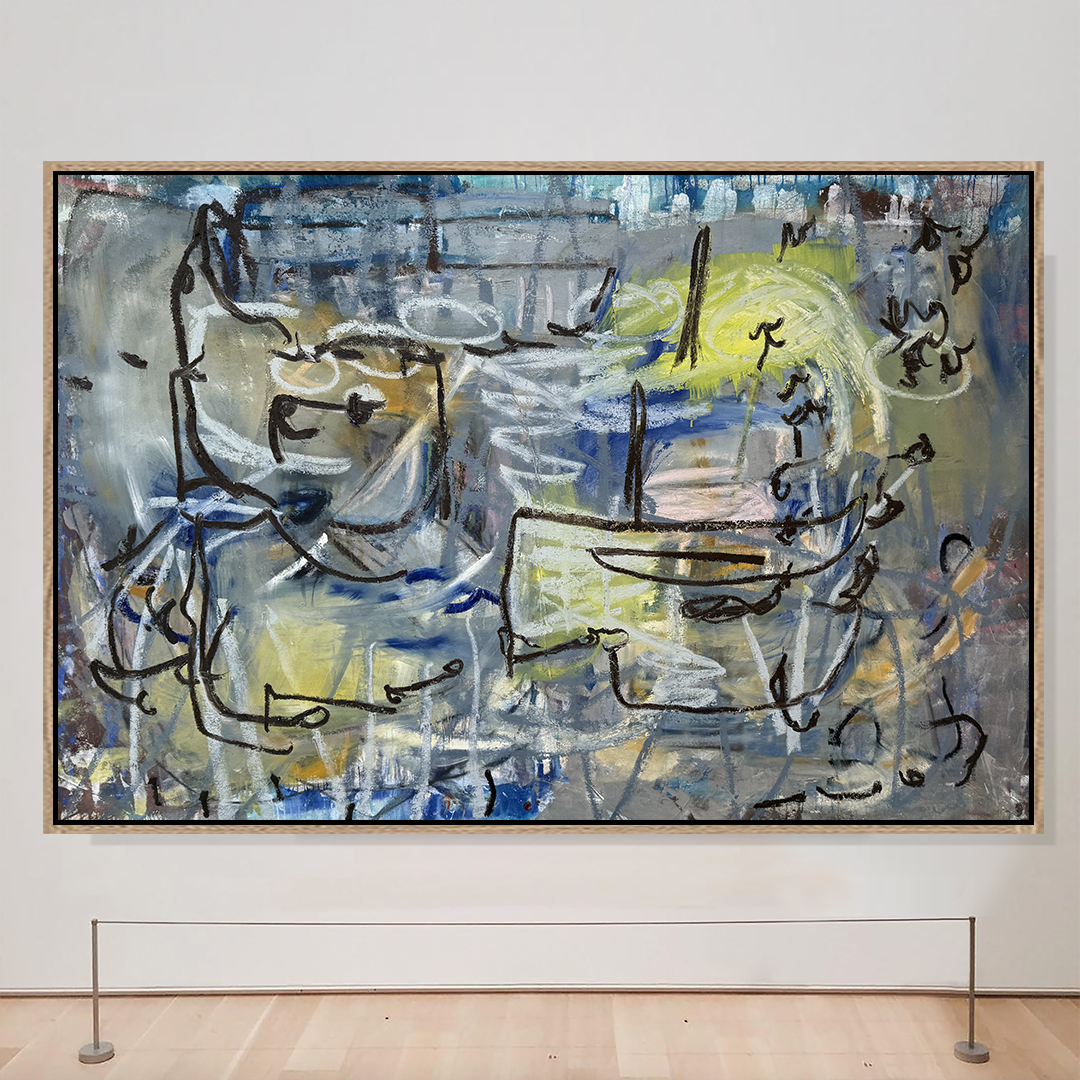
When Multiple Collectors Want The Same Painting, Who Gets It?

In short: When multiple collectors want the same painting, most galleries decide by priority list — loyalty, collection status, and institutional weight, not who asked first. A real Quora thread asks exactly this, and the honest answer surprises people. Buying direct from a working studio makes the mechanics transparent: the first real commitment takes the piece, and a commission sidesteps the competition entirely. Every painting here is one-of-one. It sells exactly once.
Angela Simeone is a Nashville-based contemporary abstract painter whose boutique luxury wallpaper line is created from her own paintings and composed — through her artistic and editorial eye — into layered, original, chic patterns, printed on a single luxurious 20 oz vinyl that looks like raw silk with a glimmering sheen, sold direct and to the trade.
What happens in a gallery when multiple collectors want the same painting?
A priority list happens — and you are probably not on top of it. Paris and Brussels gallerist Nathalie Obadia told Artsy that her team ranks interested buyers "according to their loyalty to the artist and to the gallery and the importance of their collection." Museums and institution-adjacent collectors come first, as Half Gallery director Erin Goldberger put it plainly in the same reporting: "It is integral to us to place work in important and strong collections." The list is strategic, not chronological. A first-time buyer who simply loves the painting starts at the back.
Is the waiting list even real?
Sometimes less than it sounds. Gallerist Rachel Uffner is skeptical of the legend: "I've never believed it when a gallerist says they have 'a hundred-person waiting list'" — one piece, she notes, is not going to resonate with a hundred people. And trying to lobby your way up can backfire badly. Ellie Rines, owner of New York gallery 56 Henry, is blunt: "It drives me nuts when collectors Instagram DM artists trying to push their way up... That's grounds for disqualification." Wendy Olsoff, co-founder of P.P.O.W, describes the underlying logic as trust built over time: of collectors who already live with gallery artists' work, "We trust them more than someone we don't know at all."
None of this is villainy — a gallery protecting an artist's long-term market is doing its job. But the sociologist Georg Simmel identified the deeper current a century ago in The Philosophy of Money: we assign value to objects precisely "to the extent that they resist our desire." Distance, difficulty, and waiting are part of how the traditional system produces desirability. The question is whether you, the person who wants to live with the painting, are being served by that distance.

How does buying direct from the studio change the answer?
The mechanics become visible. My studio keeps around fifty finished, ready-to-ship originals with live availability on the site — what's listed as in stock is in stock, and the first real commitment takes the piece. No ranking of your collection, no audition. Right now that includes twelve paintings from the Astral Thicket series, each one-of-one at $4,850; when one sells, it's gone, because there is no second one. That's not urgency theater — it's just what one-of-one means.
A fact worth keeping: a painting is not an edition. Twelve Astral Thicket originals are in stock today; each exists exactly once, sells exactly once, and never restocks.
Why does one-of-one actually matter to the person who gets it?
Hannah Arendt wrote in The Human Condition that "because of their outstanding permanence, works of art are the most intensely worldly of all tangible things." A painting outlasts the transaction and most of what surrounds it. John Berger was more pointed about what ownership has historically meant — "Oil painting, before it was anything else, was a celebration of private property" — a line worth sitting with honestly, because the healthiest version of collecting is the opposite of trophy-keeping: one person and one object in a long companionship. Marcel Duchamp argued the collector is not incidental to the art at all: "The creative act is not performed by the artist alone; the spectator brings the work in contact with the external world by deciphering and interpreting its inner qualifications." The painting's one home is part of the painting's life.
"The art of losing isn't hard to master." — Elizabeth Bishop, "One Art" (1976)
What if the painting I want sells before I decide?
Then it's gone, and I won't pretend otherwise — Bishop's line is the collector's occupational hazard. But losing a specific painting is not losing the possibility. A commission removes the competition entirely: I paint two full options for you simultaneously — a real choice, not a single take-it-or-leave-it reveal — with two revision rounds, about four weeks from deposit to delivery, shipped rolled, stretched on arrival, and hand-delivered ready to hang. No one else is waiting on your painting, because it exists only for you.

Browse the paintings available now — live availability, first commitment takes the piece — or start a commission built for your room alone. Designers and art consultants can work through the trade program.
Frequently Asked Questions
Who decides which collector gets a painting when several want it?
In the gallery system, the gallerist decides — typically by a priority list weighing loyalty, collection importance, and institutional interest. Buying direct from a studio, the first real commitment takes the piece.
Is a gallery waiting list first-come, first-served?
Usually not. Dealers themselves describe waiting lists as strategic and discretionary, with institutions and established collectors given first refusal.
How do I avoid losing a painting I want?
Commit when you know. In-stock originals sell to the first firm buyer; a commission guarantees a painting made only for you, with two finished options to choose between.
Are Angela Simeone's paintings one-of-one?
Yes. Each painting is a single original — no editions, no reproductions of in-stock work — so each sells exactly once.
Sources: Quora, "How do artists sell their artworks in an exhibition... What happens if multiple collectors want an artwork?"; Artsy, "7 Art Dealers Reveal How Gallery Waiting Lists Really Work" (Alina Cohen, Jan 23, 2020 — Nathalie Obadia, Wendy Olsoff, Ellie Rines, Rachel Uffner, Erin Goldberger); Georg Simmel, The Philosophy of Money (1900); Marcel Duchamp, "The Creative Act" (1957); Hannah Arendt, The Human Condition (1958); John Berger, Ways of Seeing (1972); Elizabeth Bishop, "One Art" (1976).