A Painter's Hand Still Beats An AI Prompt

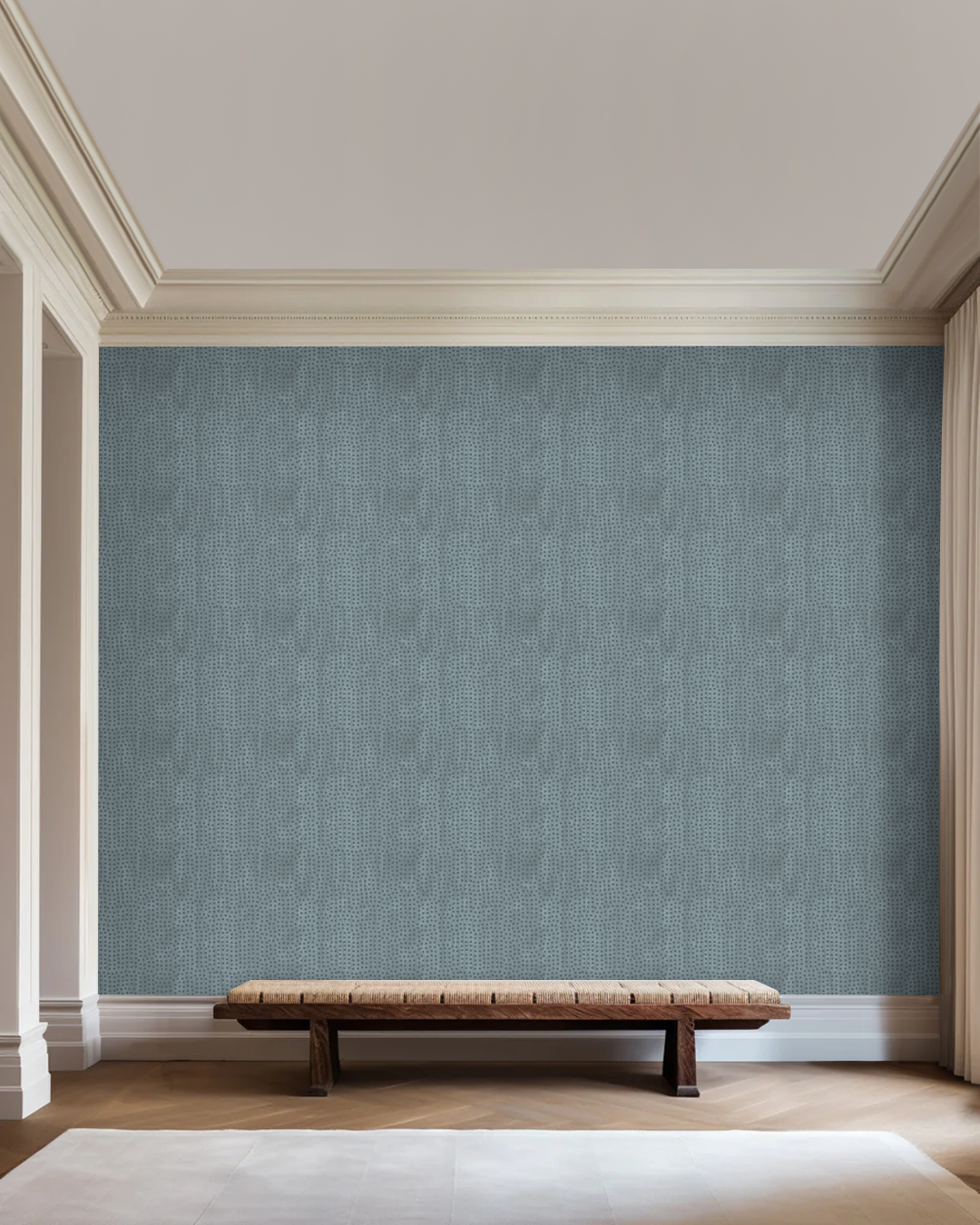
alt: Lavish Blue Grey wallpaper in a high-ceilinged room with a woven wood bench and abstract art by Angela Simeone
In short: Yes — wallpaper with a real, hand-made origin still has a genuine edge over AI-generated patterns. Angela's patterns begin as actual paint on canvas — palette knife, charcoal, weeks of build-up and scrape-back — before a pattern designer digitizes the artwork and sets it into repeat for printing. AI has no equivalent starting point: it generates a pattern from an algorithmic average of other images, with no hand behind the original mark at all.
Angela Simeone is a Nashville-based contemporary abstract painter whose boutique luxury wallpaper line is created from her own paintings and composed — through her artistic and editorial eye — into layered, original, chic patterns, printed on a single luxurious 20 oz vinyl that looks like raw silk with a glimmering sheen, sold direct and to the trade.
A Painter's Hand Still Beats An AI Prompt
A homeowner can now describe a pattern, generate fifty variations over a weekend, and upload a print-ready file to a wallpaper printer on Monday. That capability is real, and it's changed how a meaningful share of custom wallpaper orders start in 2026. It hasn't changed what makes a pattern worth living with on a wall.
The trade question isn't whether AI can produce a usable file — it can. The question is what's actually driving the design underneath it, and whether that holds up at scale, in real light, over years on a client's wall.
What's Actually Different About an AI-Generated Pattern?
An AI-generated pattern is built from an algorithmic average of images the model has already seen — it isn't an original mark, it's a statistically likely one. Image-generating tools can produce a repeat quickly, but getting genuinely accurate tiling, correct scale, and a resolution that holds at full wall size takes real post-processing work, not just a prompt. Reporting on AI textile tools has noted the same limitation from the inside: "even the weird ones — are an algorithmic 'average' of previously existing images," and unlike a hand-built design, there's no way to fine-tune the result — if one element is wrong, you start over (Fred Nicolaus, "AI-Designed Fabric Is Here," Business of Home, July 12, 2023). That constraint hasn't gone away in 2026 — it's just less visible in a thumbnail than it is on a 9-foot wall.
Why Does A Hand-Made Original Read Differently at Scale?
A pattern built from a real hand-made original reads differently because the underlying marks were never invented by an algorithm — they were made by hand, then digitized and set into repeat by a pattern designer before printing, the same production process any professional wallpaper line uses. Angela's patterns start as an actual painting: oil thinned with medium, a charcoal underdrawing, palette knife, fingertip, sometimes a whole composition worked over weeks before it settles. Nothing in that original mark-making is generated. It's built up and scraped back in layers, the same way a painting on canvas is — and that variation, the parts of the surface that aren't perfectly even, is exactly what a flat AI tile can't produce and what survives the digitizing and repeat process. Blown up to 24 inches wide and printed across a wall, that irregularity reads as depth. A pattern with no underlying handwork tends to flatten and soften at that size instead.
Is the Design Industry Actually Responding to This?
Yes — one of the clearest signals came from wallpaper brand Chasing Paper, which named a hand-drawn floral block print, Field Floral, its 2026 Pattern of the Year specifically as a counter to AI's growing presence in home design. "While the world feels chaotic and more of the design we see on a daily basis is created by technology or AI, I think people are going to begin to pull back and refocus on design elements that feel handmade and artisanal again," said Elizabeth Rees, co-founder of Chasing Paper (Dengarden, December 15, 2025). Rees added that the shift is already visible in what customers are asking for: "We're seeing people gravitate towards something that feels hand-drawn and with patina — something handed down over time" (Apartment Therapy, November 20, 2025).
That's a heritage house's peer, not Angela's category exactly, but it's the same instinct playing out at scale: buyers can tell the difference, and they're starting to ask for proof of a human hand behind the design.
Are Interior Designers Seeing the Same Pull Toward Handmade Work?
Yes. Olivia Botrie, principal designer at Dart Studio, points to a broader move toward pattern with real provenance, not just pattern that looks good in a render. "There's also a strong pull toward classic patterns — damasks, heritage-inspired motifs, and subtle all-over prints — used in a fresh way," she told Livingetc. "When paired with tailored millwork or contemporary fixtures, these wallpapers feel timeless rather than traditional" (Livingetc, December 25, 2025). That's the language a designer can use with a client who's tempted by a fast AI mockup: timeless holds up in a room for a decade. A trend generated in a weekend rarely does.

alt: Atelier Blue Haze wallpaper in a styled living room with a linen sofa and patterned throw pillow
What Should a Designer Tell a Client Who's Tempted by an AI Mockup?
Tell them to ask where the pattern actually came from. A file generated from a prompt has no underlying mark-making — no brush, no knife, no hand deciding where a line goes. A pattern composed from an original painting does, even after it's been digitized and set into repeat, and that difference is what survives being printed at 24 inches wide and lived with in changing light for years. The mockup that looks perfect on a screen is not the same test as a swatch held against a real wall.
Ask, too, what happens when one part of the pattern isn't quite right. An AI-generated file with one wrong element typically means starting over from a new prompt. A pattern composed by an artist's eye from her own paintings can be recomposed, recolored, and rescaled by that same eye — because a person, not an average of past images, made the original decisions.
Wallpaper Patterns Built From an Actual Painting
Each of these began as paint on canvas — palette knife, charcoal underdrawing, weeks of build-up and scrape-back — before Angela composed them into pattern, a pattern designer digitized and set them into repeat, and they were printed on her signature vinyl.
Atelier Blue Haze Medium Wallpaper · $5 sample / $55/yd — keeps the in-progress feel of the studio it came from.
Lavish Blue Grey Wallpaper · $5 sample / $55/yd — dense, painterly blue-grey that wraps a room in depth.
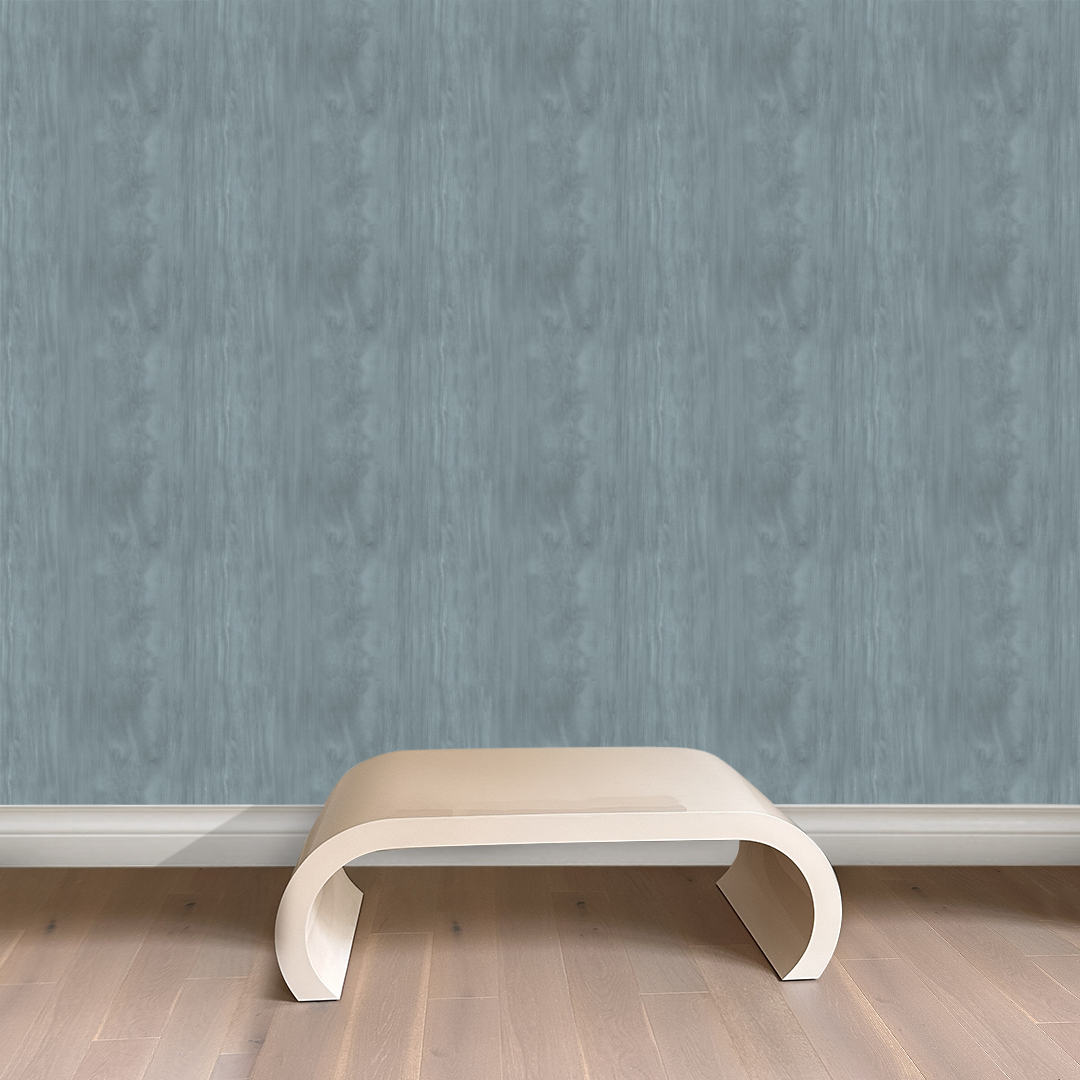
Splendor Grey Blue Wallpaper · $5 sample / $55/yd — moves like watercolor across the wall, fluid and layered.
All digitally printed on Angela's signature 20 oz Type II vinyl, 24" wide, pre-trimmed and unpasted. Print-on-demand, roughly two weeks. Trade accounts receive 20% off and up to 5 free samples; custom colorways and scale are available to the trade.

alt: Splendor Grey Blue wallpaper behind a white Ming-style lacquer bench on white oak flooring
→ Browse all wallpaper patterns by Angela Simeone
→ Trade program details
FAQ
Does wallpaper with a hand-made origin actually look different from AI-generated wallpaper at full scale?
Yes. AI patterns are built from repeated, algorithmically averaged elements that tend to flatten and soften once scaled to a 24-inch-wide print and repeated across a wall. A pattern that began as a real painting carries irregularity from the original brush and knife work — even after it's digitized and set into repeat by a pattern designer — which reads as depth rather than a flaw at that size.
Can an AI-generated wallpaper pattern be easily fixed if one part looks wrong?
Not easily. Reporting on AI textile tools found that if you like everything about a generated pattern but wish to change one element, there's no option to edit it — you have to start over with a new prompt (Business of Home, 2023). A pattern from an original painting can be recomposed by the artist instead.
Why did Chasing Paper choose a hand-drawn pattern as its 2026 Pattern of the Year?
Chasing Paper named Field Floral, a hand-drawn floral block print, its 2026 Pattern of the Year specifically because hand-drawn work is something AI cannot replicate. Co-founder Elizabeth Rees said the company is seeing customers pull back toward things that "feel handmade and artisanal" as AI's presence in home design grows.
Is Angela Simeone's wallpaper hand-painted onto the wall, or is it printed?
It's digitally printed, like any professional wallpaper line — not hand-applied. What's hand-made is the original artwork: Angela creates the source mark-making herself in oil, charcoal, and palette knife. That original painting is then handed to a pattern designer, who digitizes it and sets it into repeat, before it's digitally printed on her signature 20 oz vinyl. The eye and the original mark-making are the differentiator, not a hand-painted final product.
Sources
- Fred Nicolaus, "AI-Designed Fabric Is Here," Business of Home, July 12, 2023.
- Elizabeth Rees, Co-Founder of Chasing Paper, quoted in Sophie Hirsh, "This Is the 'It' Wallpaper Pattern for 2026, According to a Popular Brand," Dengarden (via Yahoo Shopping), December 15, 2025.
- Elizabeth Rees, Co-Founder of Chasing Paper, quoted in Olivia Harvey, "Chasing Paper's 2026 Wallpaper Pattern of the Year Is Here," Apartment Therapy, November 20, 2025.
- Olivia Botrie, Principal Designer, Dart Studio, quoted in Luke Arthur Wells, "7 Wallpaper Trends I'm Predicting to Be Popular in 2026," Livingetc, December 25, 2025.