A Real Hand-Painted Archive Beats A Pattern Designed From A Brief

In short: Broadway scenic designer Scott Pask just built a wallpaper collection with Voutsa from a hand-painted sample pulled straight out of his own theater-design archive. A hand-painted wallpaper archive doesn't have to come from a fine-art painter's studio to carry real weight — but it does have to be a real, hand-made image, not a pattern designed to a brief. That's the exact premise Angela Simeone's own wallpaper line has been built on for years.
Angela Simeone is a Nashville-based contemporary abstract painter whose boutique luxury wallpaper line is created from her own paintings and composed — through her artistic and editorial eye — into layered, original, chic patterns, printed on a single luxurious 20 oz vinyl that looks like raw silk with a glimmering sheen, sold direct and to the trade.
Does A Hand-Painted Wallpaper Pattern Have To Come From A Fine-Art Painter?
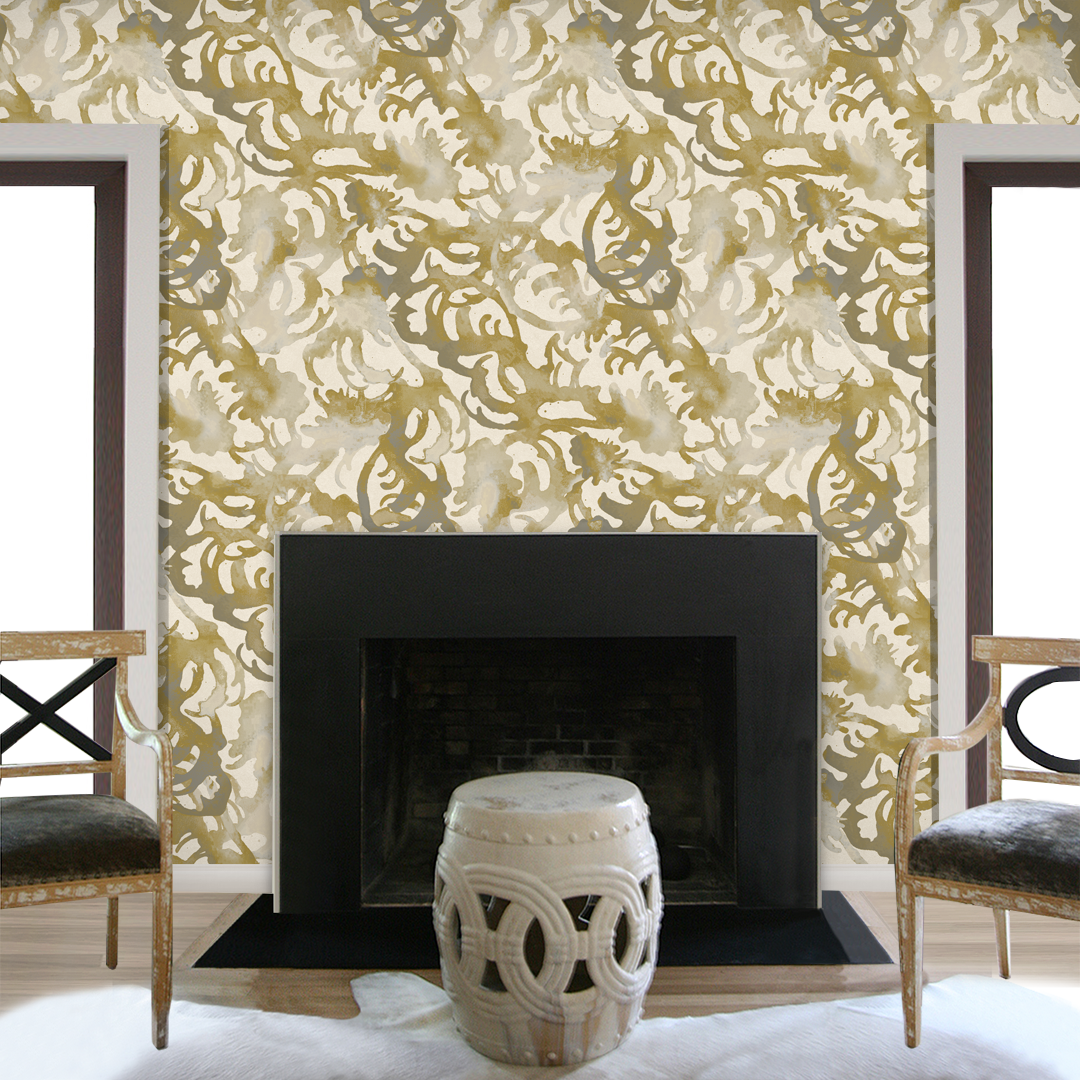
Not according to the newest collection in the category. Galerie Magazine's coverage of the "Fizz Collection" — Scott Pask's new wallpaper line with Voutsa, inspired by Champagne bubbles, Art Deco glasswork, and the Jazz Age — traces the pattern back to a single real object from Pask's career: "The original artwork, a hand-painted sample from my Broadway scenic design archive, references the qualities and character of René Lalique's hypnotic glassworks, bubbled vessels, and flowing water fountain glass panels," Pask says. Pask is a Tony Award-winning Broadway scenic designer, not a fine-art painter by trade — and the source image still carries real weight, because it's still a real, hand-made mark, made by his own hand, for a completely different discipline.
What Makes A Source Image Legitimate, Regardless Of Where It Came From?
The wallpaper world's current season backs this up from more than one direction. Marie Karlsson, Creative and Managing Director of the 150-year-old British house Cole & Son, described building a new collection directly from another creative discipline's archive — a capsule with fashion house Vivienne Westwood — the same way: "It is a privilege to introduce this collection into the world of interiors. Vivienne Westwood has long been a profound source of inspiration for me — her uncompromising design language, boundless creativity, and unwavering individuality." Alex Krenn, Accessories and Specials Designer at Vivienne Westwood, described the process of translating that archive directly: "To explore our archives and select prints and hand drawings by Vivienne herself has been a joyful experience. To see how these graphics from our collections translate into an entirely new medium and scale — from being draped on the body, to surrounding you in a room — shows the power of beautiful, timeless design." Neither Pask nor Westwood trained as a wallpaper designer. Both had a real hand-made archive worth translating faithfully.

Does This Idea Hold Up Outside Of One Season's Collaborations?
Javvy Royle, co-founder of House of Hackney, made the same case while working from a 19th-century archive rather than a living designer's studio, reworking William Morris's own designs and writings: "Through the collection, we want to revitalize the legacy of William Morris for today — not through nostalgia, but with creativity as a form of activism." The pattern doesn't need a contemporary fine-art pedigree, and it doesn't need to be freshly painted this year. It needs to be real — a genuine hand-made mark someone actually made, not a motif generated to fill a brief. Great houses have built entire reputations honoring exactly that distinction, and it's worth honoring them for it: Cole & Son has done it for 150 years, Voutsa is doing it now with Pask's theater archive, and House of Hackney is doing it by returning to Morris's own hand.
What Have Artists Said About One Hand's Work Crossing Into A New Medium?
Edgar Degas put the underlying principle simply: "Art is not what you see, but what you make others see." John Ruskin argued that the value sits in the whole maker, not the category of object: "All great art is the work of the whole living creature, body and soul, and chiefly of the soul." Isamu Noguchi — a sculptor who also designed for the stage, for furniture, for playgrounds — described his own view of material without hierarchy: "Everything is sculpture. Any material, any idea without hindrance born into space, I consider sculpture." Man Ray, who moved constantly between photography, painting, and object-making, explained the logic behind letting one hand work in more than one medium: "I paint what cannot be photographed... I photograph the things that I do not wish to paint." And Piet Mondrian offered the plainest version of the idea: "The position of the artist is humble. He is essentially a channel."

Where My Own Patterns Begin
My own wallpaper starts exactly where Pask's and Westwood's archives start — as one real, hand-made image from my own studio practice: oil, charcoal underdrawing, and palette knife, the same physical process behind my canvas work. A pattern designer then digitizes that original artwork and sets it into repeat, and the finished pattern is digitally printed on a 20 oz Type II commercial-grade vinyl that reads like raw silk with a glimmering sheen — the same production process any professional wallpaper line uses. The painting is hand-made. The wallcovering is a professionally printed product built faithfully on top of it, and the source is what makes it a pattern worth hanging, not a brief someone wrote to spec one.
Splendor Grey Blue, one of the patterns shown above, began the same way — a real painting, translated into repeat rather than designed from scratch. Browse the full wallpaper collection, or learn more about ordering through the Trade Program.
Frequently Asked Questions
Does hand-painted wallpaper have to come from a fine-art painter?
No. What matters is that the source image is a real, hand-made mark from the designer's own archive — Scott Pask's Fizz Collection with Voutsa comes from his Broadway scenic-design archive, not a fine-art painting practice.
Is the finished wallpaper itself hand-painted?
No — only the source artwork is hand-made. The finished wallcovering is professionally, digitally printed on commercial-grade vinyl, the same production process any professional wallpaper line uses.
How do I tell if a wallpaper pattern has a real hand-made origin or was designed to a brief?
Ask where the source image came from. A pattern traced back to an artist's or designer's own hand-made archive carries a different weight than one generated purely to fill a decorative gap.
What is the Fizz Collection by Scott Pask and Voutsa?
A 2026 wallpaper collection built from a hand-painted sample in Pask's own Broadway scenic-design archive, referencing René Lalique's glasswork and Jazz-Age Art Deco motifs.
Visit angelasimeone.com to see current wallpaper patterns, or reach the studio directly at angela@angelasimeone.com.
Sources: Galerie Magazine, "The Artful Life: 6 Things Galerie Editors Love This Week," 2026 (galeriemagazine.com/the-artful-life-july-8) — Scott Pask quote; Cole & Son, "Cole & Son x Vivienne Westwood," 2026 (cole-and-son.com) — Marie Karlsson and Alex Krenn quotes; Livingetc / Ideal Home, House of Hackney "The Nature of Morris" collection coverage — Javvy Royle quote; Edgar Degas, widely documented statement; John Ruskin, Modern Painters; Isamu Noguchi, widely documented statement; Man Ray, widely documented statement; Piet Mondrian, "Natural Reality and Abstract Reality," c. 1919–1920. NOTE — tastemaker quote bank ran 4/5 this post (Scott Pask, Marie Karlsson, Alex Krenn, Javvy Royle); no additional current named wallpaper-brand voice specifically on the "hand-made archive from any discipline" theme was found within this run's search budget, after Olivia Botrie, Abbie Young, Emily Mould, and Chloe Vince were investigated and confirmed already used in this ledger. Flagged rather than padded.