The Human Hand Is What's Actually Rare Now

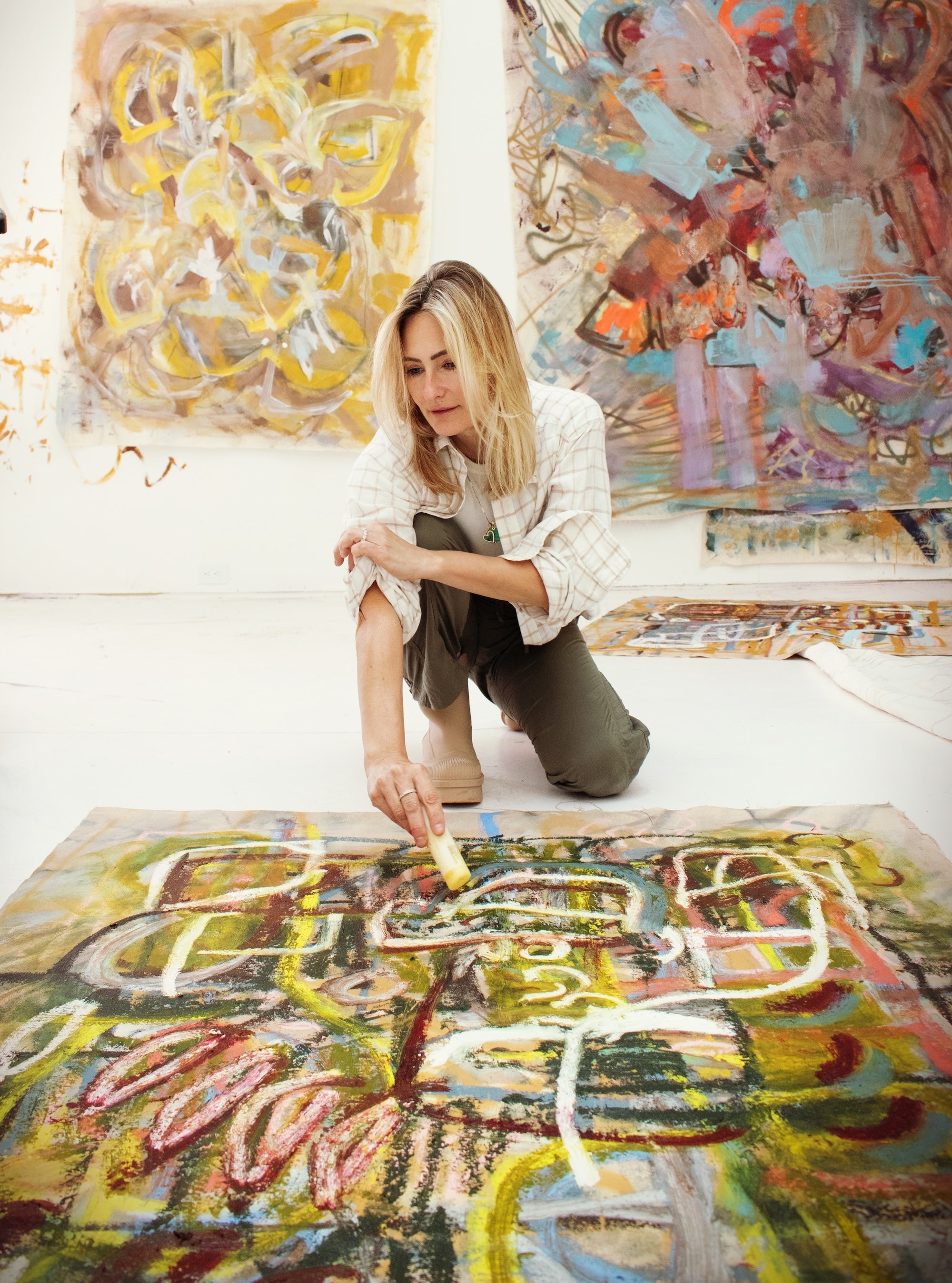
In short: In an AI moment, collectors are naming the artist's physical hand — not the finished image alone — as the actual reason a painting is worth owning. Two young collectors profiled by CULTURED this month say so directly, and a working artist's studio is the most literal place to see it: real paint, real decisions, a real relationship with the person who made the piece, rather than a transaction with a gallery.
Angela Simeone is a Nashville-based contemporary abstract painter whose boutique luxury wallpaper line is created from her own paintings and composed — through her artistic and editorial eye — into layered, original, chic patterns, printed on a single luxurious 20 oz vinyl that looks like raw silk with a glimmering sheen, sold direct and to the trade.
Why does the human hand matter more to collectors right now?
Because everything else got easy to fake. Tae Um, a 35-year-old Seoul-based writer, curator, and founder of the art agency Creative Resource, put it plainly in CULTURED's 2026 Young Collectors profile: "In this A.I. moment, I find myself gravitating toward work that foregrounds the irreplaceable human hand — the physical energy and specificity that comes from a body making decisions in real time." That's not nostalgia. It's a collector who has built bridges between the Korean and American art worlds, naming a specific, current reason to buy — the opposite of what a machine can generate on request.
Mario Zonias, co-founder of Maddox Gallery, sees the same pattern from inside the trade: his 2026 forecast names naïve painting, punk-grunge texture, and other visibly handmade styles as the market's clearest signal, writing that "collectors are gravitating toward art that is unmistakably made — marked by intuition, risk and the imperfections that signal authorship." A painting that couldn't have come from a prompt is, right now, worth more than one that could have.
Does buying directly from the artist change what it feels like to live with the work?
Yes — because you end up with a relationship, not just a transaction. Annie Taylor, a 31-year-old New York patron and Brooklyn Museum advisory board member, told CULTURED about cracking a Ben Cowan painting's frame within two hours of bringing it home. Mortified, she texted the artist to confess. "What started as a careless mistake blossomed into a real friendship," she said. That's not a story a gallery purchase produces. When the person who made the work is the same person you call, an accident becomes a relationship instead of a return.
My own studio works the same way, by design: no gallery rep, multiple pre-ship videos of every piece before it leaves, and a phone number that reaches the person who actually painted it. Walter Benjamin, writing decades before anyone imagined an AI-generated image, described exactly what a reproduction — however perfect — can never carry: it "detaches the reproduced object from the domain of tradition." A print, a scan, a generated image can copy the look of a painting. It can't copy the hand that made the decisions, or the conversation you have with that hand afterward.

Where do you actually see the hand in a finished painting?
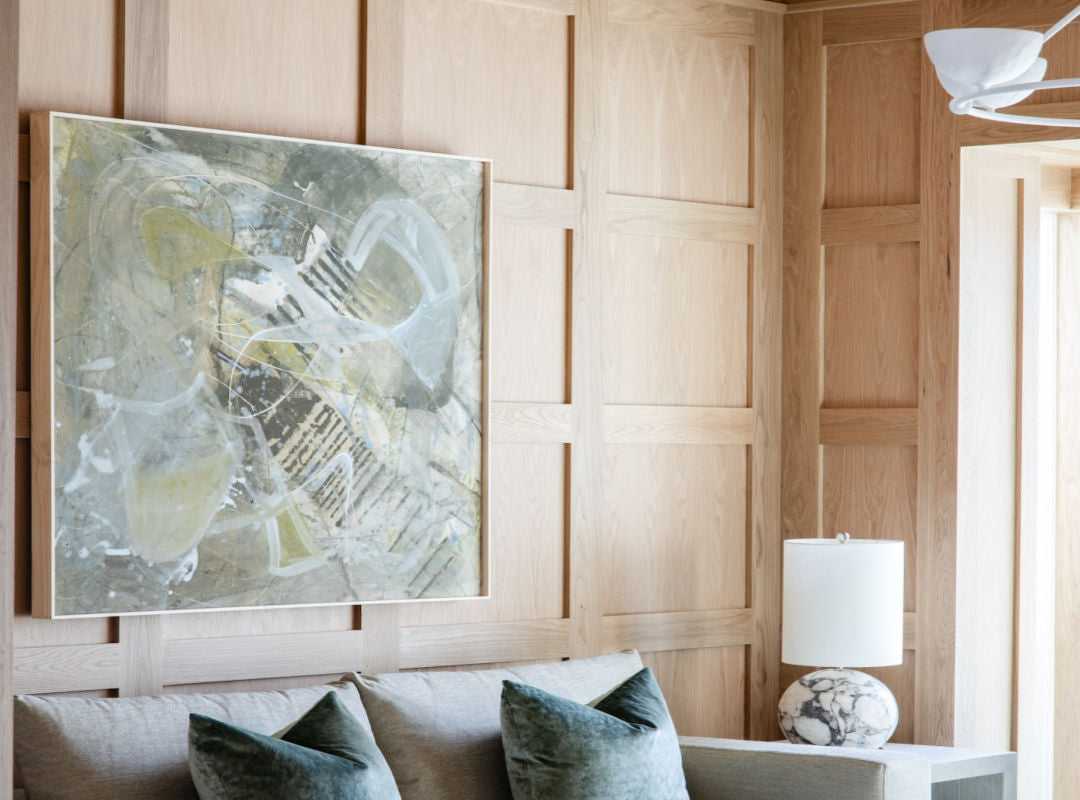
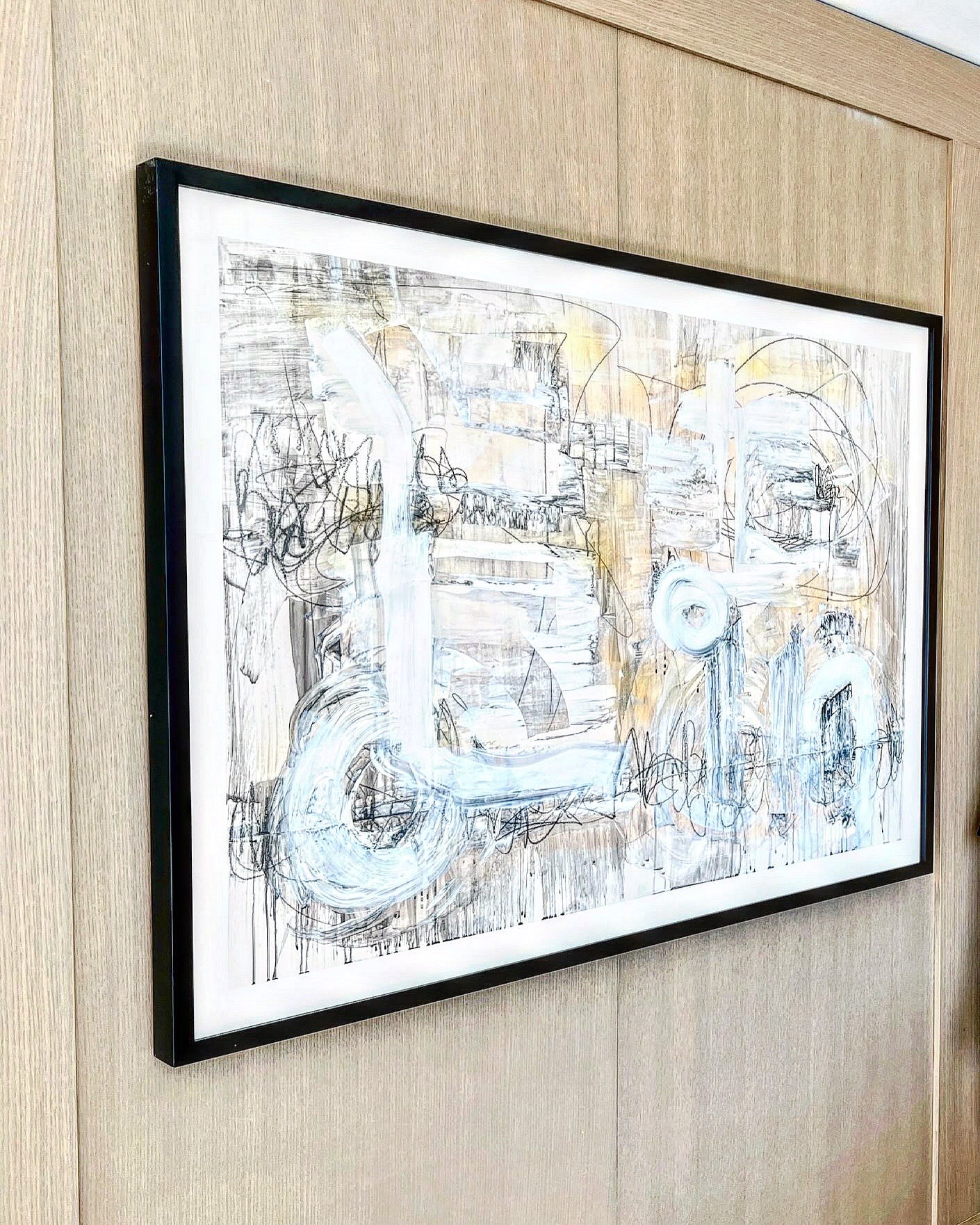
In the marks that weren't planned. My Astral Thicket series — twelve original paintings, each one-of-one, in stock now — was built without a fixed plan for any single canvas: color moving where the paint wanted to move, mark-making left visible rather than smoothed over. John Berger wrote about this same gap between seeing and knowing in "Ways of Seeing": "The relation between what we see and what we know is never settled." You can look at two nearly identical-looking abstract paintings and know, without being told, that one carries a real decision made in real time and the other doesn't — that's the gap a generated image can't close, no matter how convincing the surface.
"Everything we hear is an opinion, not a fact. Everything we see is a perspective, not the truth." — Marcus Aurelius, Meditations

Does this mean every painting has to be a fresh commission?
No — the twelve Astral Thicket paintings shown here are already finished, already in the studio, and each one is one-of-one: it sells exactly once, then it's gone. That scarcity isn't a marketing angle, it's just what "one-of-one" means. For a piece built specifically for your room, the studio also takes commissions, developed the same hands-on way — two full options painted at once, not a single guess shipped cold.
See the full Astral Thicket series and the rest of the current in-stock collection, or start a commission built around your own room. Designers sourcing on a client's behalf can see trade terms on the trade program page.
Frequently Asked Questions
Why are collectors valuing handmade art more in the AI era?
Because AI-generated imagery has made a polished, machine-plausible image common and cheap, collectors increasingly value visible evidence of a real person's decisions — brushwork, imperfection, and process — as the actual mark of authenticity.
What's different about buying a painting directly from the artist?
There's no gallery intermediary — you deal directly with the person who made the work, which often creates an ongoing relationship rather than a one-time purchase.
What is the Astral Thicket series?
A series of twelve original, one-of-one abstract oil paintings by Angela Simeone, each priced at $4,850 and in stock now.
Can I commission a painting instead of buying one that's already finished?
Yes — the studio's commission process includes two full painting options developed simultaneously, a first reveal, and two rounds of revision before the piece ships.
Sources: CULTURED Magazine, "Introducing CULTURED's 2026 Young Collectors List" — profiles of Tae Um and Annie Taylor (July 8, 2026); Maddox Gallery, "2026 Art Trends Forecast" by Mario Zonias; Walter Benjamin, "The Work of Art in the Age of Mechanical Reproduction" (1936); John Berger, "Ways of Seeing" (Penguin, 1972); Marcus Aurelius, "Meditations."
New original work from Angela Simeone's studio ships regularly — see what's in stock now at angelasimeone.com.