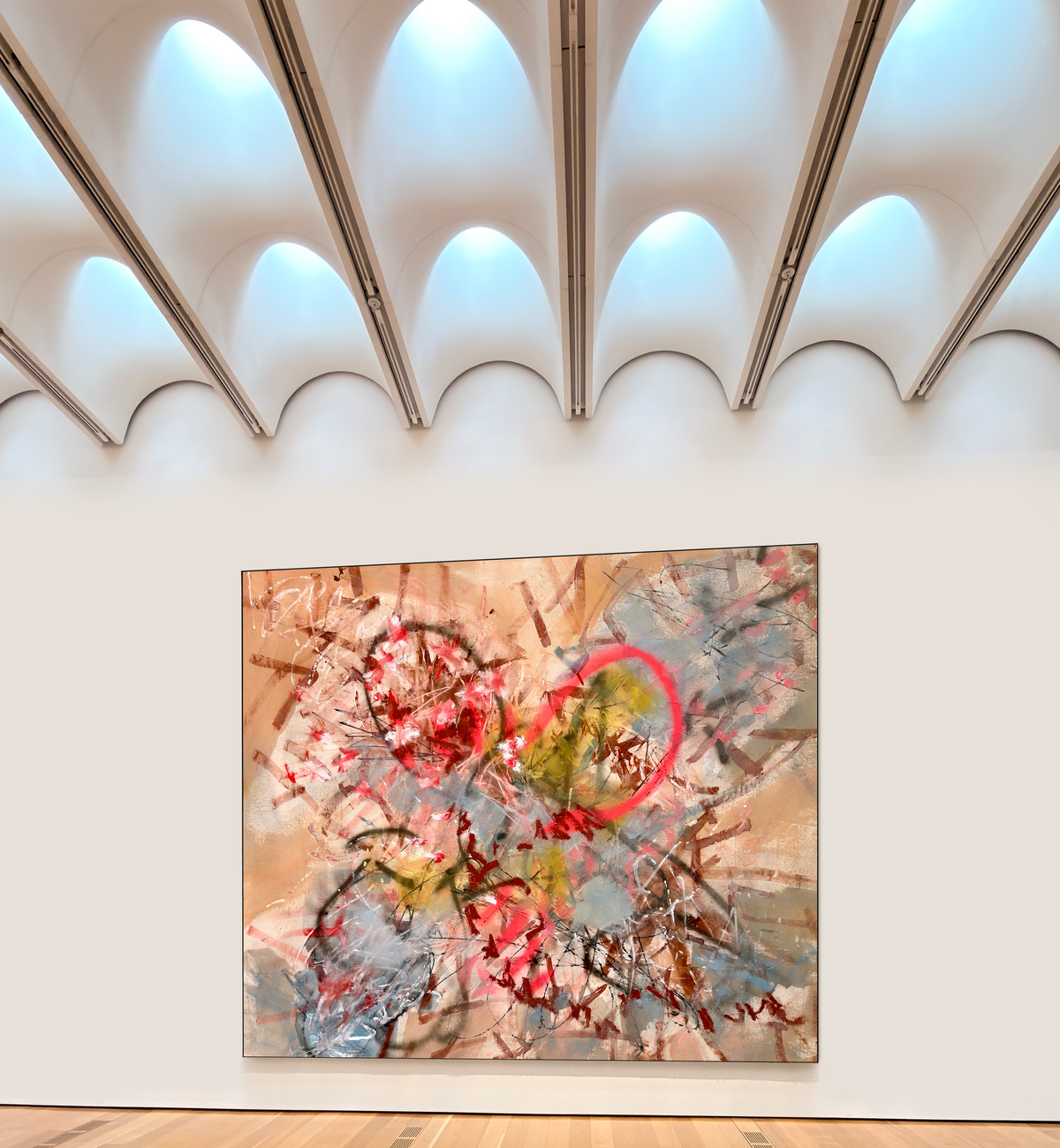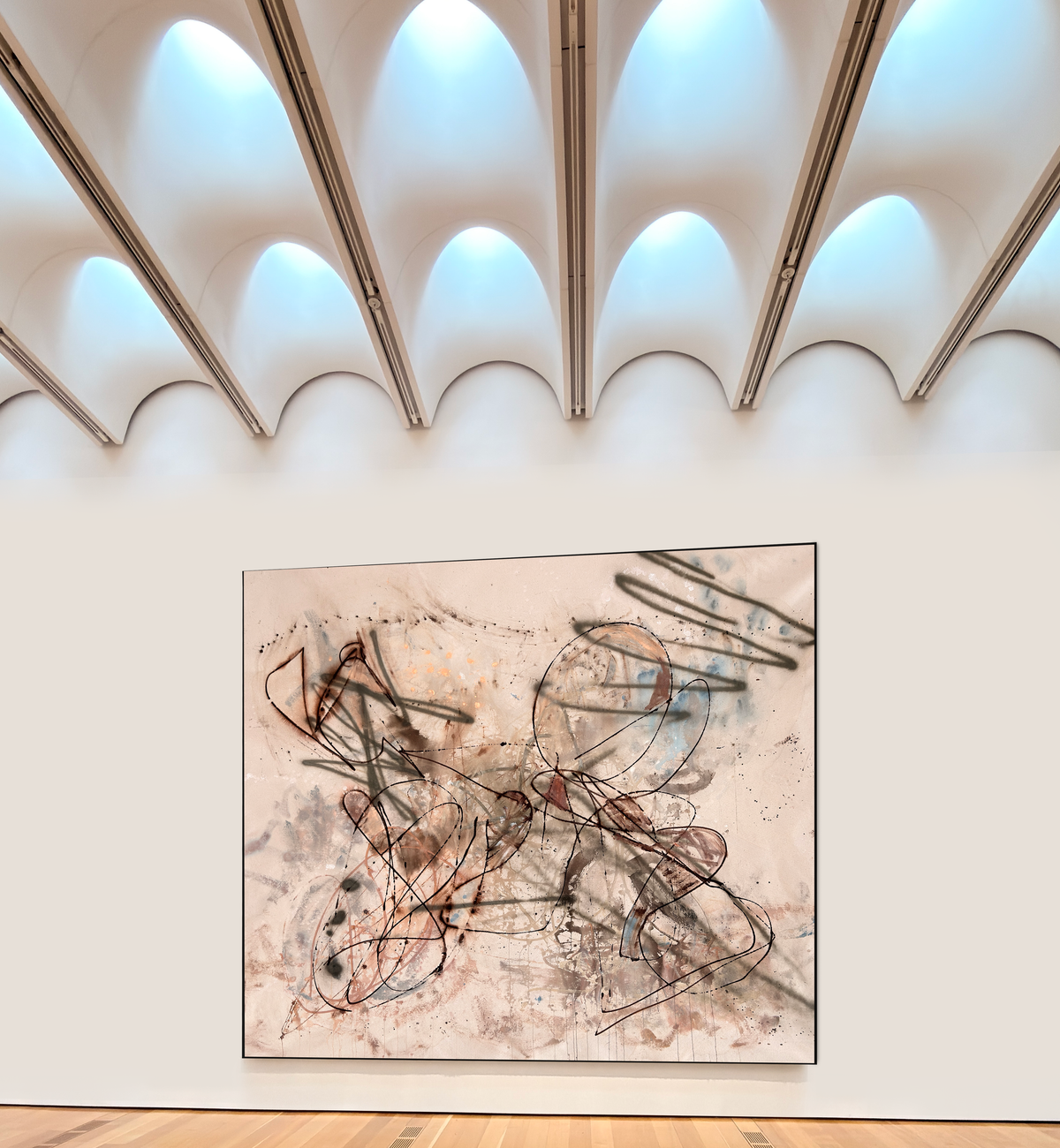
Half a Collection Hanging Is Still a Whole Collection
In short: Owning more original work than you can hang at one time is not a storage problem. It is the ordinary shape of a collection that has been growing longer than the house has. Rotating pieces in and out rests light-sensitive work, gives each painting a fresh reading when it returns, and keeps a room from going invisible. The two things that matter are honest wall math and proper flat, dry, dark storage between hangings.
There is a stage most collectors reach and very little collecting advice addresses. The walls are full. The next piece still arrives. And a painting bought because it stopped someone in a room ends up leaning against a guest-room wall with a sheet over it, quietly generating guilt.
That guilt is misplaced. A collection that outgrows its walls is a collection doing what it is supposed to do.
Is it normal to own more art than you can hang?
It is what happens to anyone who buys on response rather than on a floor plan. Walls are finite and fixed at the moment you move in. A collection is neither — it accumulates on the schedule of your life, your travel, your income, and the artists you happen to meet.
Museums resolved this long ago and never pretended otherwise: the overwhelming majority of what a major institution owns is not on view at any given moment, and nobody reads that as failure. It is called a collection precisely because it is larger than the display.
The private version is the same arithmetic at domestic scale. If the pieces you own exceed the walls you have, the honest conclusion is that you have been buying well, not carelessly.
What does rotation actually do for the work?
Three things, and only one of them is aesthetic.
It rests the fragile. Works on paper, anything with dyed or unstable pigment, photographs, and textiles all accumulate light damage cumulatively and irreversibly. Time off the wall is conservation, not idleness. Oil on canvas is far more robust, but no surface benefits from a decade in direct afternoon sun.
It restores the reading. A painting on a wall you pass forty times a day eventually stops being looked at — not because it got worse, but because the eye files it and moves on. Six months away and it comes back as close to new as a familiar object gets. Collectors describe finding passages in returning work they were certain were not there before. They were there. The looking had gone automatic.
It lets a room change without a purchase. Swapping two pieces between rooms is the cheapest significant change a house can undergo. It costs an afternoon and two picture hooks.
Does a painting in storage still count as owned?
The quilter Mary Lee Bendolph describes where her work starts: "Most of my ideas come from looking at things. I can walk outside in the yard and see ideas all around. Then, sitting down looking at a quilt I get another idea." The looking is not a step that ends when the object is finished. It keeps generating.
That is the part storage does not suspend. A piece you own and cannot currently see is still doing something — it is why the next room gets arranged the way it does, why a colour you would not have chosen five years ago now looks obvious, why the following purchase makes sense. Ownership is not the same as visibility.
The minimalist Charlotte Posenenske built her practice on the same premise and said so plainly in 1968: her works, she wrote, "are components of a space, since they are like building elements, they can always be rearranged into new combinations or positions, thus they alter the space. I leave this alteration to the consumer who thereby again and anew participates in the creation."
She meant it literally about modular sculpture, and it describes domestic rehanging exactly. The person who moves the work is doing something to it. A collection that never moves has one arrangement. A collection that rotates has as many as its owner has moods.
How do you decide what comes down?
Not by ranking. Ranking is how a collector ends up with a permanent top four and a warehouse of regret.
Better questions, in order:
- Which piece has stopped being seen? The one you can no longer describe from memory while standing in another room is the one ready to rest.
- Which room has changed? New rug, new light fixture, a wall repainted, a child moved out. The room is a different argument now; give it a different answer.
- What is the season doing? A cool, high-key painting that carried a room through July can look thin by November. This is not fickleness. It is the same surface in a different atmosphere.
- What is still sealed? Anything acquired and never hung goes to the front of the queue, always.
One discipline worth keeping: rotate on a set interval — quarterly, or twice a year — rather than by impulse. A schedule stops rotation from collapsing into "the ones I forgot about."
What does a growing collection need from the artist?
A working studio you can still reach is worth more here than a name you cannot. The practical parts of rotation — how a piece was built, what the surface will tolerate, whether it can be taken off the stretcher and re-stretched, what it should be wrapped in — are answerable in an email when the painter is alive, working, and yours to ask.
That is also the argument for depth over breadth. Several works from one artist, acquired across years, rotate more coherently than a scattered set of single purchases, because they share a palette logic and a hand. A wall of one artist's studies reads as a body of work. A wall of unrelated acquisitions reads as a wall.
The art adviser Bojana Popovic frames the acquisition side of that in the Spear's 2026 Art Advisers Index: "gone are the days where people are heavily gambling on emerging talent… people are actually stepping back and thinking: what am I actually adding to my collection, and why?" Adding. Not accumulating. The question survives the purchase and keeps being useful every time the walls get rearranged.
How to store original paintings at home, properly
Storage is where good collections get damaged, almost always by improvisation.
- Flat or vertical, never leaning face-to-face. Vertical on padded edges, separated by acid-free board. Stacked flat only if nothing sits on top.
- Interior wall, climate-stable room. Not the attic, not the garage, not against an exterior wall that sweats. Roughly 65–75°F and 40–50% relative humidity is the working target.
- Dark, and breathing. Cotton sheeting or unbleached muslin — not plastic sheeting, which traps moisture against the surface.
- Label the back, photograph the front. A phone photo, the title, dimensions and the year, kept with your invoice and certificate of authenticity. Future-you, and any insurer, will want it.
- Give oil real curing time. A recently finished oil painting wants months of open air before it goes under a wrap.
What to do this weekend
Count the walls. Count the works. If the second number is larger, write down what you own, what is up, and what has never been hung. That list is the collection. The hanging is just the current edit.
Then take one thing down that you stopped seeing, and put up one thing that has been waiting. The room will tell you within a day whether you were right — and either way, nothing was lost, because the collection did not get smaller. It got a second wall.
Angela Simeone's available original paintings are one-of-one works in oil and mixed media, built in layers over weeks. For work made to a specific room, palette or scale, see commissions; designers and art consultants working across multiple client projects should start with the trade program.
Related reading
Frequently asked questions
Is it bad to keep original paintings in storage?
Not if the storage is right. Flat or vertically separated with acid-free board, on an interior wall in a climate-stable room, wrapped in cotton rather than plastic, and kept dark. Rotating work in and out is standard practice for museums and for most long-term collectors, and it actively protects light-sensitive pieces.
How often should I rotate the art in my home?
A set interval beats impulse. Quarterly suits people who enjoy the process; twice a year suits most households. The schedule matters more than the frequency, because it stops rotation from becoming something that only happens to whichever piece you happen to remember.
How many paintings should hang in one room?
Fewer than you own, which is the point. The usable test is whether each piece still has room to be looked at on its own. When two works start competing rather than conversing, one of them is ready to rest.
Does taking a painting down and rehanging it damage it?
Handling is the main risk, not the rehanging. Carry from the sides of the stretcher rather than the top bar, never touch the painted surface, check the hardware each time it goes back up, and give an oil painting months of open air before it is ever wrapped.
Is it better to buy several works by one artist or single pieces by many?
Both build a collection; they behave differently once the walls are full. Multiple works from one artist share a palette logic and a hand, so they rotate and regroup coherently. A set of unrelated single purchases needs more work from you to look like anything together.
See the work
Browse the original paintings currently available, each one of one. Original paintings available now.
Sources
- Souls Grown Deep, Mary Lee Bendolph artist page
- Dia Art Foundation, Charlotte Posenenske retrospective documentation