Pattern Carries the Same History Painting Does
In short
No — and the largest museum survey of American art currently on view is making that argument directly. Western art history spent a century filing carpets, ceramics, architectural painting and folding screens under "merely decorative," a category beneath painting. That hierarchy is now being taken apart by institutions, not just by artists. Pattern carries its own long, complex tradition. Calling a painting decorative describes what it does; it does not describe how much it is worth looking at.
Angela Simeone is a contemporary abstract painter based in Nashville, Tennessee, working in oil and mixed media on canvas.
Where did "merely decorative" come from?
It came from a hierarchy, and hierarchies are always about something other than the objects in them. Nineteenth- and twentieth-century Western art history sorted made things into fine art and decorative art, and the second category collected almost everything that was also useful, patterned, repeated, or produced outside Europe. Modernism inherited the split and hardened it. To call a painting decorative was to say it stopped at the surface.
The trouble is that the objects filed under that heading have traditions as long and as internally argued as painting's own. The Austrian art historian Alois Riegl made this case as early as Stilfragen in 1893: ornament, he argued, has a continuous developmental history of its own, driven by an internal artistic will rather than by accident or by copying from craft. He was writing against exactly the assumption that pattern is what happens when invention runs out.
What is the 2026 Whitney Biennial arguing about it?
The eighty-second Whitney Biennial — 56 artists, duos and collectives, on view through 23 August 2026 — includes the Brooklyn-based painter Kamrooz Aram, whose presentation is a painting, a collage, a vitrine and a folding screen shown together. Aram's practice looks back to histories of abstraction that predate modern art and to forms Western art historians have characterised as merely decorative: ceramics, carpets, architectural painting, screens. His argument, per his gallery's own exhibition notes, is that these carry rich and complex traditions that belong inside the history of painting rather than beside it.
Aram has described the reversal his paintings make possible: they can be read, he has said, not simply as ornamental forms entering the practice of modern painting, but as modern painting being ornamentalised. (⚠ This line comes from 2026 interview coverage read in aggregation this run rather than from a fetched primary transcript; the framing above is deliberately attributed as "has described" rather than set as a hard verbatim.)
What makes this more than an artist's personal position is where it is being said. The Biennial is co-organised by Marcela Guerrero, the Whitney's DeMartini Family Curator, and Drew Sawyer, its Sondra Gilman Curator of Photography, and it draws on more than 300 studio visits. The curators declined to give the exhibition a thematic title at all. As Sawyer put it, they chose to "let our conversations with artists guide us." An institution that refuses a slogan and then platforms an argument about the decorative is doing something more durable than a trend piece.
Does any of this apply to an abstract painting on a living-room wall?
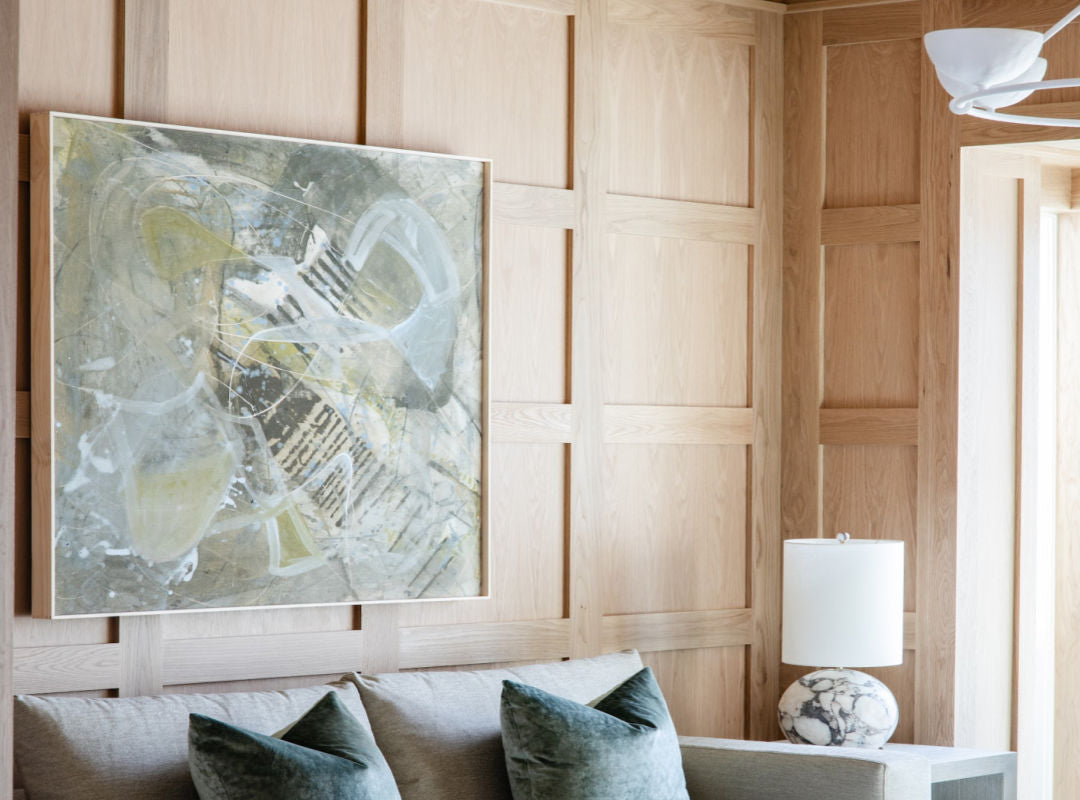
Directly. The question people actually ask about abstraction — is this saying something, or is it just something that looks good over the sofa — is the same hierarchy in domestic clothing. And the answer is the same one Riegl gave: look for the tradition and the decisions inside the object, not for the category it has been filed under.
In my own work that means the thing worth looking for is evidence of choice. A colour mixed toward its neighbour and argued back out of it. A charcoal underdrawing left readable through a later layer because burying it would have cost the painting its record of its own thinking. Oil thinned with medium, a palette knife, a fingertip, weeks of a surface being worked back. None of that is visible in a photograph of a room. All of it is visible standing in front of the canvas, which is why I keep saying the same thing about looking.
The Bauhaus weaving master Gunta Stölzl described her own studio's arc as a movement "from the play with form to a lucid constructive structure" — pattern arrived at by construction, not by decoration applied afterwards. Sheila Hicks, who has spent six decades making pattern carry meaning at architectural scale, puts the same idea in four words: "Thread is my alphabet." Neither of them is describing a lesser activity.
Is "decorative" ever a fair description?
Yes, and pretending otherwise would be dishonest. A pattern can be applied to a surface with nothing behind it. What is not fair is treating the category as the verdict. The Ceylonese-British philosopher of art Ananda Coomaraswamy, who spent his career refusing the split between art and craft, wrote that "the artist is not a special kind of man, but every man is a special kind of artist" — a sentence that only makes sense if useful, made, patterned things are art rather than art's poor relation.
The art historian Meyer Schapiro made the technical version of the same point: the non-mimetic elements of an image — the field, the frame, the ground, the repeat — are not neutral packaging around content. They are load-bearing. And the painter Nicolas de Staël described a painting as needing to be abstract to the degree that it is a flat surface and figurative to the degree that it represents space, which is a working painter's way of saying the surface and the meaning are not separable things.
So the useful question is never "is this decorative." It is "what is holding this together, and can I still find something in it in a year."
Where to go next
Frequently asked questions
Is abstract art just decoration?
No. Decoration describes a function, not a level of quality. Abstract painting carries its own long tradition of construction, colour theory and mark-making, and institutions including the Whitney are currently arguing that so-called decorative forms — carpets, ceramics, architectural painting — belong inside the history of painting rather than below it.
How can I tell if an abstract painting has substance?
Look for evidence of decision rather than effect: colours mixed toward each other rather than straight from a tube, earlier layers left legible on purpose, a surface that changes as you move. A painting worth living with usually has somewhere left to go on the second look.
Why did Western art history rank decorative arts below fine art?
The hierarchy dates to nineteenth- and twentieth-century European art writing, which sorted made objects into fine and decorative categories — the second collecting most work that was useful, patterned, repeated, or made outside Europe. Alois Riegl argued against it as early as 1893.
Where can I see this argument in person in 2026?
The 2026 Whitney Biennial, on view through 23 August 2026, includes Kamrooz Aram's painting, collage, vitrine and folding screen shown as a single argument about exactly this question.
See the work
Every painting is an original, one of one, in oil and mixed media on canvas. View original paintings available now, or start a commission.