Every Layer Of Paint Is A Record Of Time Spent

In short: A worked, built-up painted surface — layers of oil, palette knife, scraped-back passages — isn't decorative texture. It's a physical record of the time and decisions that went into making it, the way an artist actually confronted the canvas. Reading a painting's surface for what it took to make, not just how it looks, is one of the clearest ways to judge an original abstract painting before you buy or commission one.
Angela Simeone is a Nashville-based contemporary abstract painter whose boutique luxury wallpaper line is created from her own paintings and composed — through her artistic and editorial eye — into layered, original, chic patterns, printed on a single luxurious 20 oz vinyl that looks like raw silk with a glimmering sheen, sold direct and to the trade.
Is a built-up, worked-over painted surface actually a record of time — or just texture?
It's a record of time. Tokyo-based painter Yukimasa Ida, whose work has shown with Mariane Ibrahim and Perrotin, put it plainly in a recent interview: paint is a substance that embodies time. "Just as our lives are formed by layers of past experiences, my paintings are formed by piling up layers of paint," Ida said. "I feel that by adding physical mass to the canvas, I am giving weight to invisible memories and time. Sometimes I use collage or thick impasto to leave a 'scar' or a 'trace' of existence that is tactile. The buildup of paint is the physical evidence of the energy and time I spent confronting the subject — a fossil of the 'now' that has passed."
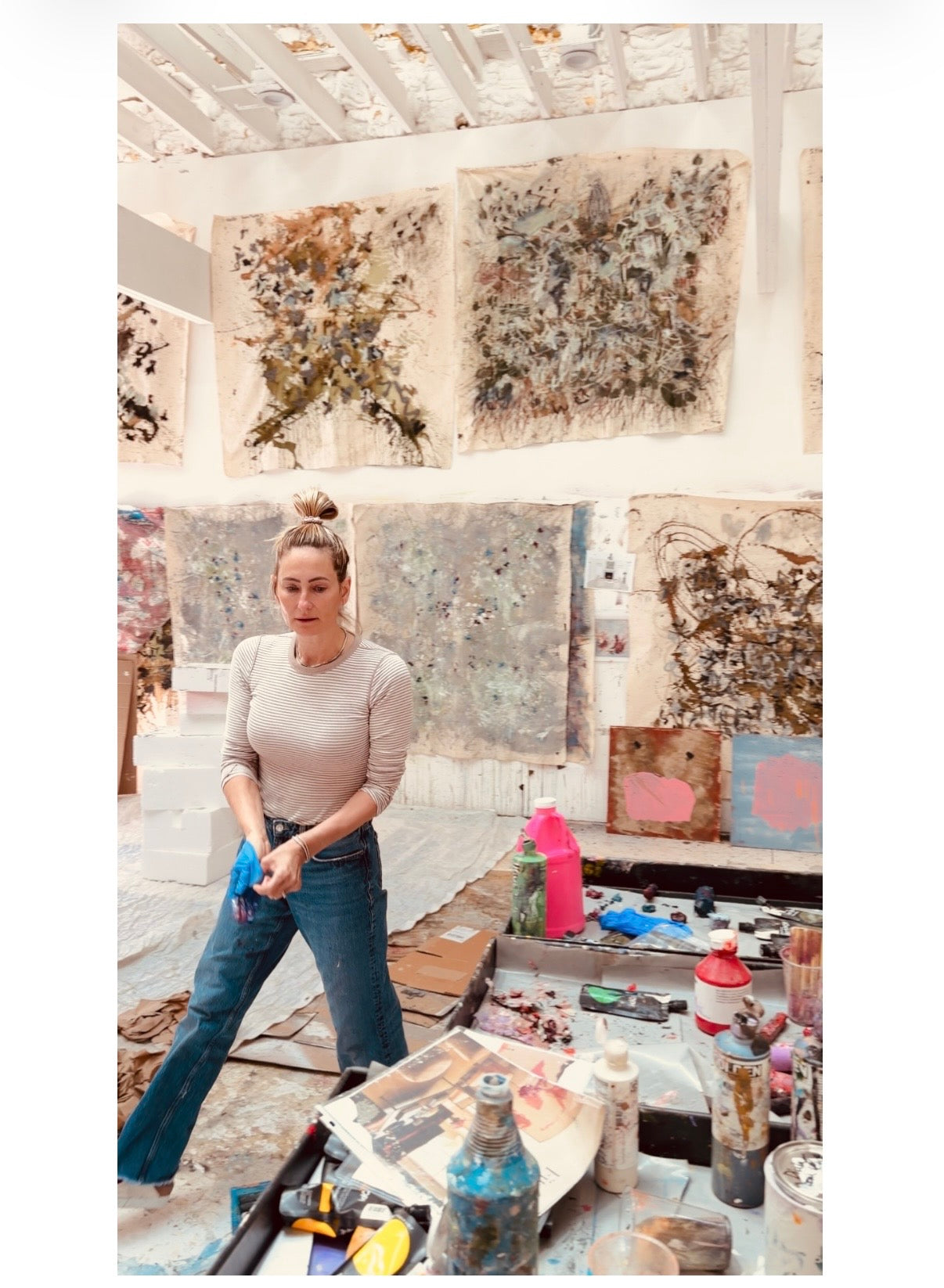
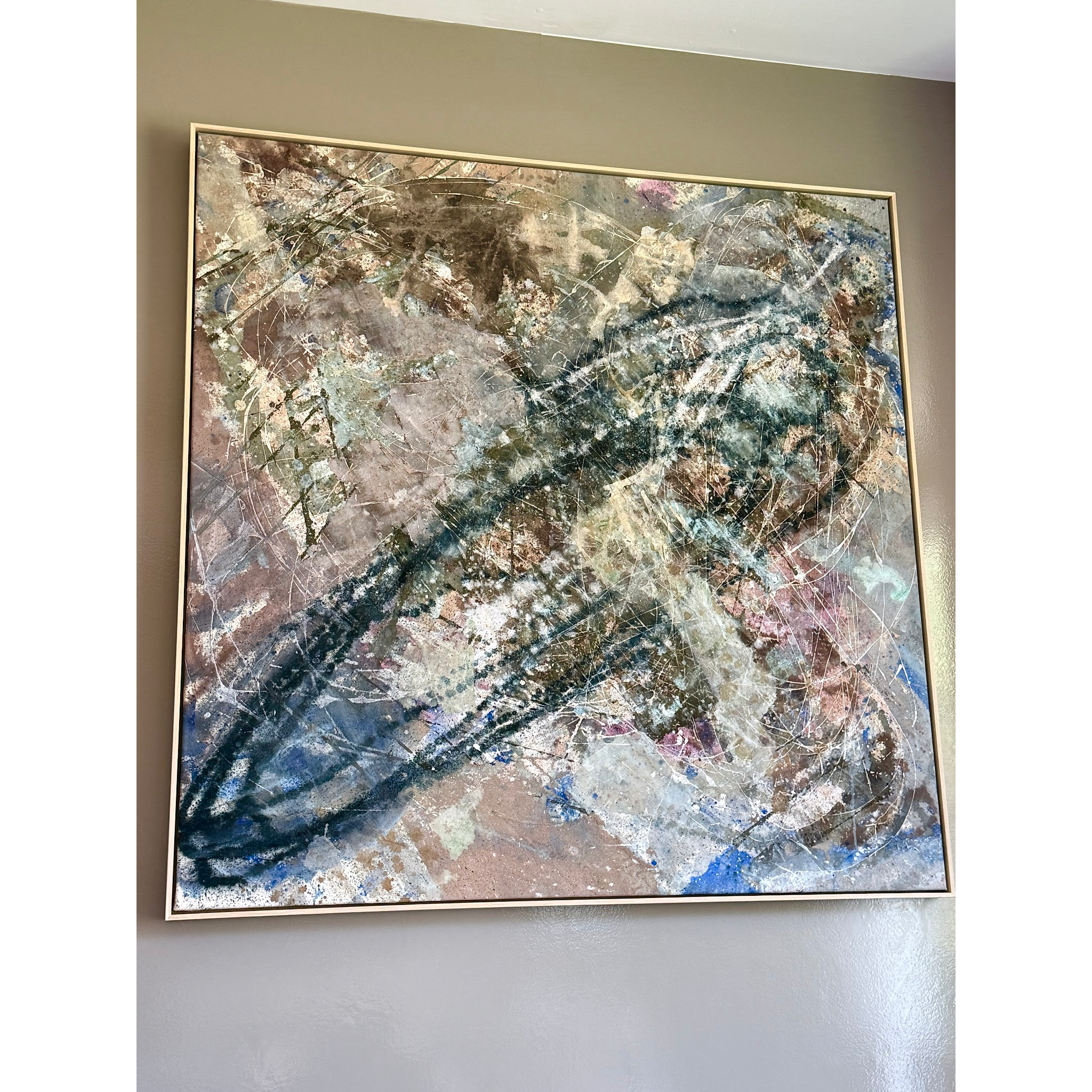
That's the layer of a painting most people never learn to see. A flat print or a photograph of a painting shows you the image. It can't show you the argument — the places where a passage got scraped back and repainted three times before it settled, the ridge where a palette knife dragged wet paint over dry, the pentimento of a color decision that got reversed. In my own studio, a piece stays in continual flux until it doesn't: oil thinned with medium, charcoal underdrawing, palette knife, fingertip, sometimes whole compositions painted over weeks before they settle. What's left on the canvas when it's finished is the residue of every one of those decisions — not a picture of an idea, but the physical trace of the time it took to arrive at one.
How do critics and curators actually talk about a painting's surface as evidence of time?
They read it almost like a geological record. Writing in the Los Angeles Review of Books about Anselm Kiefer's 2023 painting Cosenza, critic Ranbir Sidhu described how "Kiefer applies a fabulous amount of paint to each work, squeezed directly from the tube onto the surface and spread liberally... the paint is applied in seemingly endless thick layers, each occluding or mixing with the one below, the image emerging out of a ragged topography that feels at once intuitive and considered." Sidhu quotes historian Simon Schama's own description of the same body of work: "Kiefer's broken surfaces seem alive even when they represent a field of death... stratified layers of paint nicked and pitted, punctured and penetrated, cracked and torn, beaten and burned, stained and bloodied."
Writer John Vincler had a similar reaction the first time he stood in front of Mark Bradford's paintings at the Wexner Center. In a Paris Review essay on the experience, he wrote that "Bradford's paintings seemed excavated from within some earlier incarnation of themselves" — built up, then scored and sanded back down, the surface reading less like a finished image than like a site that had been dug into. That's the vocabulary worth borrowing when you're standing in front of an original: not "is this pretty," but "what did it take to get here."
Why does this matter when you're choosing a painting for your own collection?
Because it's the difference between decorating a wall and living with something that was actually made. A painting whose surface reads as a record of time holds up to the kind of looking a room invites over years — morning light hits it differently than evening light, and a worked surface has enough real variation to keep giving something back. My Astral Thicket series is built exactly this way: walnuts harvested and boiled from my own yard become the base stain, layered with crushed and ground oil and wax pigments, then lifted by pops of dusty pastel — each piece both a forest disappearing and a night sky twinkling, the layering doing the emotional work a flat image can't.

Julie Mehretu has talked about arriving at a finished painting through the same kind of physical process — building up, then taking away. Describing one turning point in her practice to Art21, she said: "I kept pushing the color into this painting... At one point, I just started to sand away all the color that came into the work. And when I'd finished sanding it, I turned around and looked at it and it was a finished painting... thinking about excavation, erasure, and palimpsest within my own language and my own work." The finished surface isn't the first mark. It's whatever survived every mark that came before it.
What should a collector or designer actually look for in a painting's surface?
Look for evidence of a decision, not just a color. Cy Twombly wrote about this directly: "Each line now is the actual experience with its own innate history. It does not illustrate — it is the sensation of its own realization." Anselm Kiefer has described his own materials in similar terms — "Art is information deposited in a time-space lock. It must not disappear" — treating the physical surface as the archive, not the illustration, of what the artist actually did. And Louise Bourgeois, discussing the years of repair and repetition built into her fabric work, said the physical act "is a recapturing of the past, at the same time it's an attempt at repairing the damage" — the making itself as much a record as the finished object.
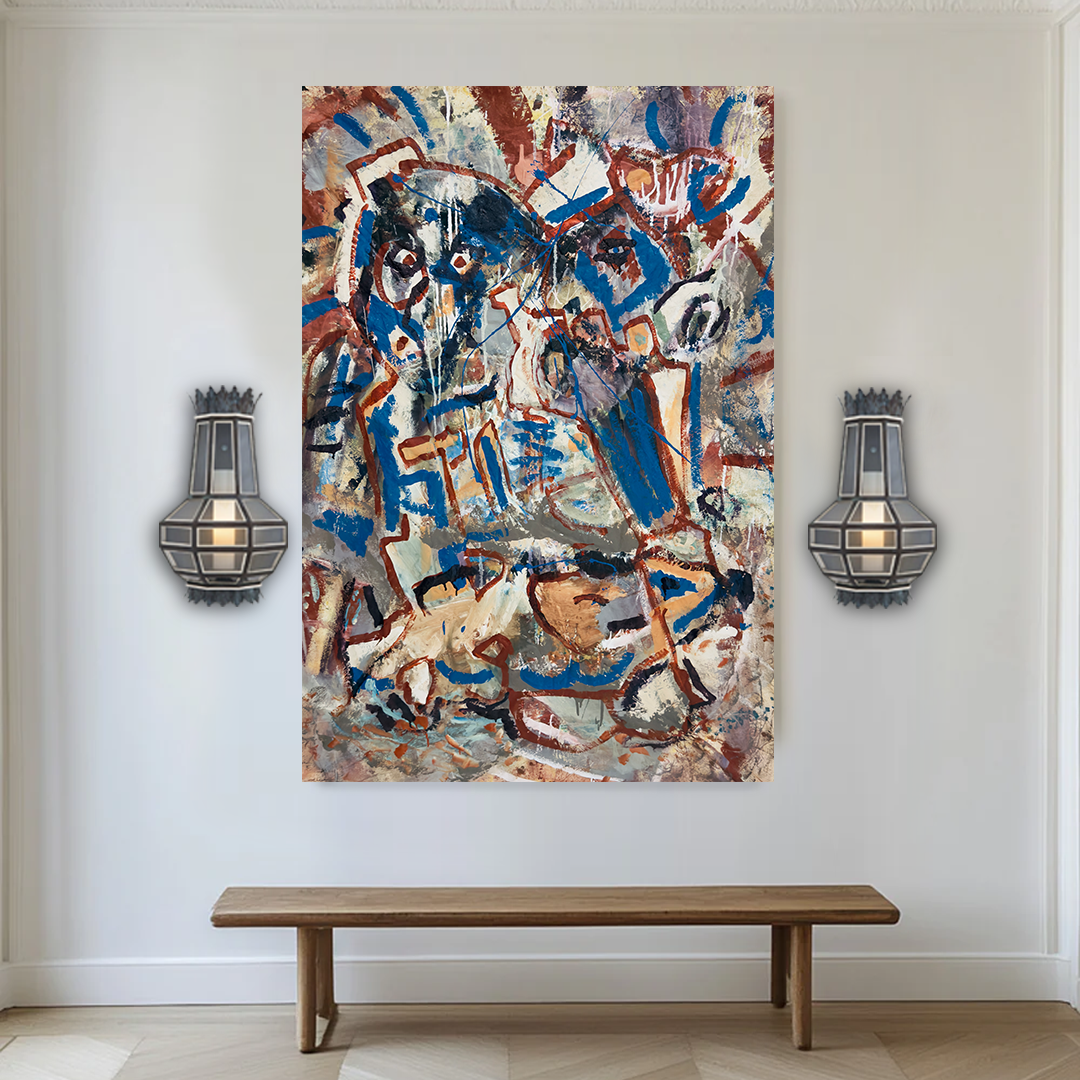
When you're weighing an original against a print, or deciding whether a piece is worth commissioning at a specific scale, this is the real test: does the surface show you time was spent, or does it show you an image was reproduced. My in-stock original paintings are available to view now, and if you're working at a larger scale for a home, office, or hospitality project, I also take on commissions built the same way — in layers, over real time, never planned in advance.
Frequently Asked Questions
Does a heavily textured painting cost more than a flat one?
Not necessarily — price is driven by size, materials, and time in the studio, not texture alone. A heavily worked surface often does mean more studio hours, since layers have to dry and get reworked, but the two aren't a fixed formula.
Can you tell a painting's surface quality from a photo before buying?
Photos flatten texture, so raking light shots (light from the side, showing shadow and ridge) tell you far more than a straight-on product photo. Ask for a raking-light detail shot, or a short video, before committing to an original sight unseen.
Is a scraped-back, reworked surface a sign of an artist changing their mind too much?
No — for many painters, myself included, reworking is the process, not a mistake. A surface that shows evidence of revision is often more considered than one that was resolved on the first pass.
Does this apply to wallpaper patterns derived from paintings, too?
The source painting carries all of that worked, built-up history — but once a pattern designer sets it into repeat and it's digitally printed onto vinyl, the finished wallcovering is a faithful image of that surface, not a hand-built one itself. The time and decision-making live in the original artwork.
Sources: Yukimasa Ida, interviewed by Erica Silverman, Whitewall, June 8, 2026 · Ranbir Sidhu, "Contact High: Anselm Kiefer at 80," Los Angeles Review of Books, December 17, 2025 (quoting Simon Schama) · John Vincler, "On Excavation: The Paintings of Mark Bradford," The Paris Review, July 31, 2019 · Julie Mehretu, interviewed by Susan Sollins, "To Be Felt as Much as Read," Art21, published May 2013 · Cy Twombly, 1957 artist statement, widely documented in Kirk Varnedoe's "Cy Twombly: A Retrospective," MoMA, 1994 · Anselm Kiefer, quoted in Whitehot Magazine, 2026 · Louise Bourgeois, documented artist statement on repair and repetition, MoMA/Tate exhibition texts.