A Visible Influence Is Not A Weakness

In short: Berry Campbell and Sargent's Daughters just opened "Leitmotif," a joint exhibition deliberately pairing artists across generations to trace shared influence. It's a reminder that an artist's stated influences aren't a confession of unoriginality — the trade treats a visible lineage as a real curatorial and selling strategy. If you're evaluating a living painter's work, the question isn't whether she names her influences. It's what she does with them.
Angela Simeone is a Nashville-based contemporary abstract painter whose boutique luxury wallpaper line is created from her own paintings and composed — through her artistic and editorial eye — into layered, original, chic patterns, printed on a single luxurious 20 oz vinyl that looks like raw silk with a glimmering sheen, sold direct and to the trade.
Why Would Two Galleries Deliberately Pair Different Generations?
Berry Campbell and Sargent's Daughters — two respected New York galleries with their own distinct rosters — didn't have to collaborate. They chose to, on purpose, for a show called "Leitmotif," on view now through August 14, 2026 in both Chelsea and Tribeca. In the galleries' own joint exhibition statement, the concept is stated plainly: the show "pairs contemporary artists with those who came before them to illuminate lines of shared influence," tracing "diverse stylistic approaches as they are revisited, reframed, and carried forward by successive generations." That's not a gallery apologizing for influence. That's two galleries selling it as the point of the show.
Does A Painter's Stated Lineage Undercut Her Originality?
It's a fair worry for a first-time buyer: if a living painter names Helen Frankenthaler, Joan Mitchell, and Willem de Kooning as her lineage — as I do — does that mean the work is derivative? Frankenthaler herself answered this from the other side of it, describing what it felt like the first time she saw Jackson Pollock's paintings: "It was as if I suddenly went to a foreign country but didn't know the language, but had read enough and had a passionate interest, and was eager to live there. I wanted to live in this land. I had to live there, and master the language." She didn't imitate Pollock. She learned a language he opened up, then spoke it in her own accent for the rest of her career. De Kooning put the same idea more bluntly: "The past does not influence me; I influence it." A real lineage is something a painter takes and does something with — not something she copies.

What Does T.S. Eliot Have To Do With A Painting?
The clearest version of this argument isn't even about painting. In his 1920 essay on the playwright Philip Massinger, T.S. Eliot wrote: "Immature poets imitate; mature poets steal; bad poets deface what they take, and good poets make it into something better, or at least something different." Wassily Kandinsky made the parallel case for visual art directly: "Every work of art is the child of its age and, in many cases, the mother of our emotions. It follows that each period of culture produces an art of its own which can never be repeated." Even Picasso, working at the furthest edge of invention, was clear that abstraction doesn't start from nothing: "There is no abstract art. You must always start with something and then remove all traces of reality." A painter's stated influences are the "something" she started with — the test is what got removed, and what got left behind, on the way to her own surface.

What This Means Before You Commission Or Collect
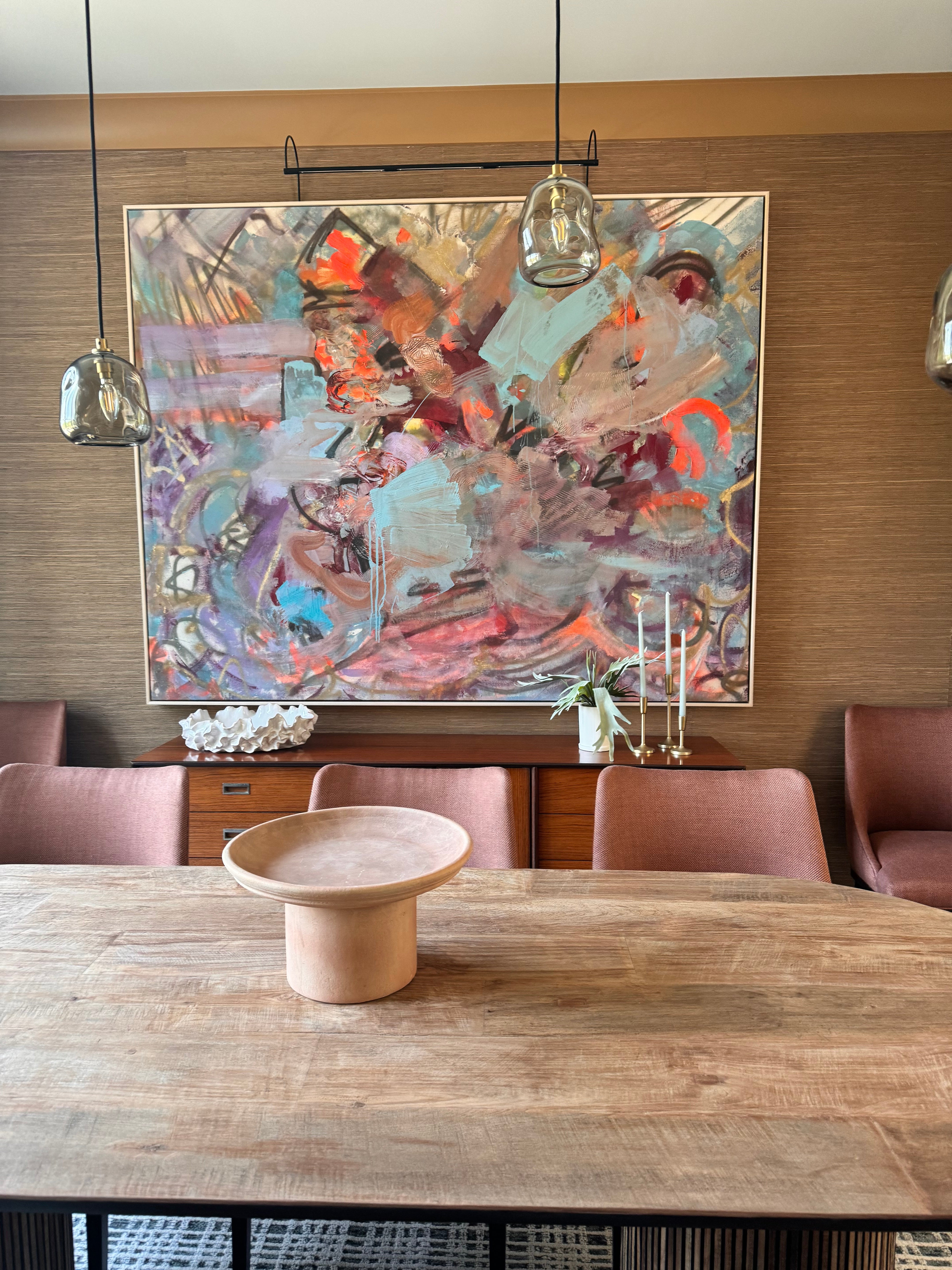
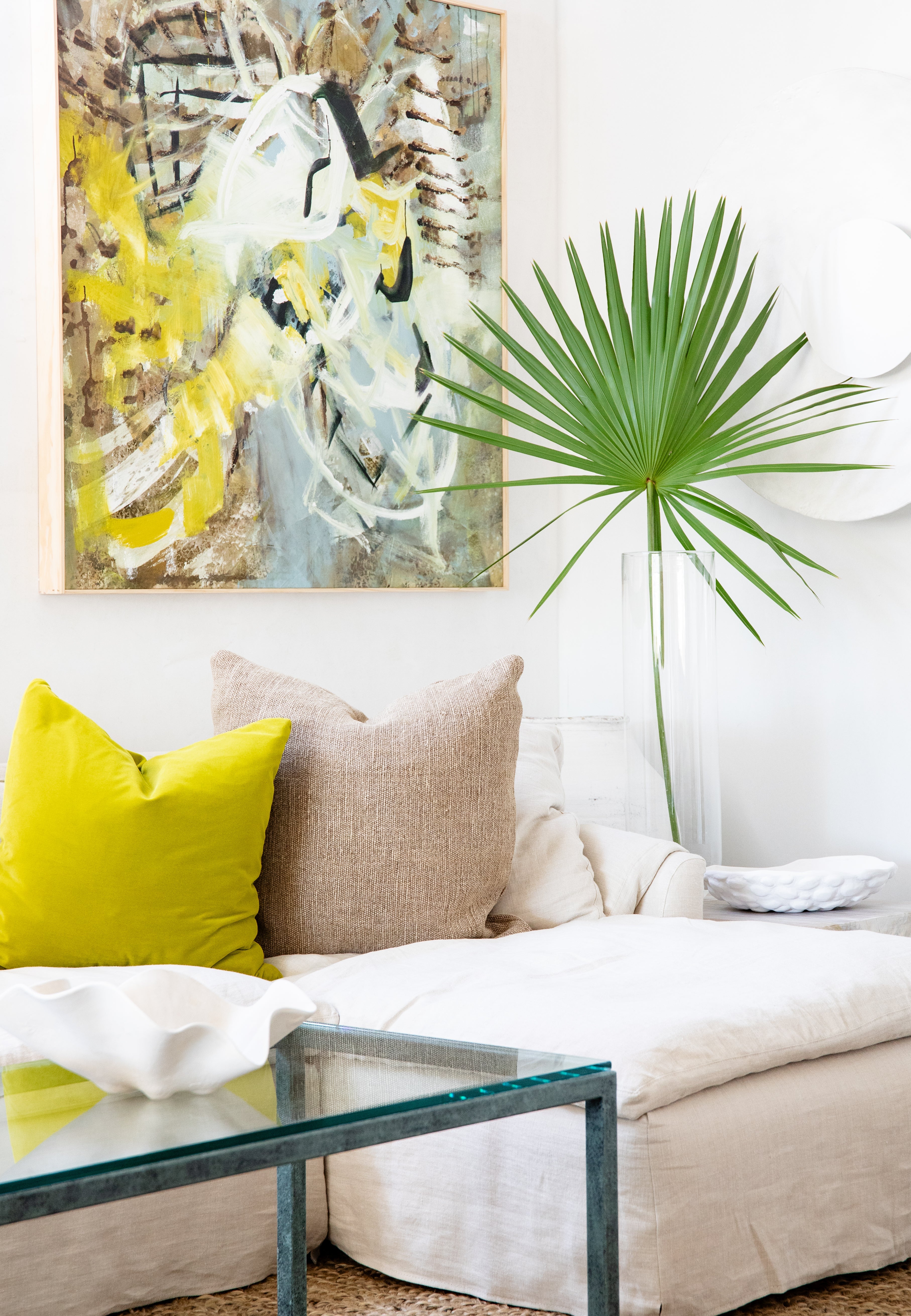
My own paintings work directly from the gestural, color-field, soak-stain lineage of Frankenthaler, Mitchell, and de Kooning — walnut stain boiled from my own yard, oil and wax pigments layered and scraped back, built up over twenty years into a body of work that's been placed at the Conrad Nashville, Peabody Union, Blackberry Mountain, the Frist Clinic, and Sarah Cannon Cancer Center. I don't hide the lineage. Naming it is more honest than pretending a gestural abstract painter today invented color-field painting from scratch. What you're actually buying isn't the absence of influence — it's what a painter does with it across a real, documented, twenty-year practice.
Browse the current paintings available now, or start a conversation about a commission built around your own room from the ground up.
Frequently Asked Questions
Does a visible influence make a painting less original?
Not on its own. What matters is what the painter does with that influence over a real body of work — whether she's speaking her own visual language or simply repeating someone else's.
How do I tell if an artist is working seriously within a lineage, or just copying it?
Look at the body of work across years, not one painting. A serious practice shows the influence transformed — different materials, a different hand, a different resolution — not a repeated formula.
Why do galleries pair artists from different generations in the same show?
Because a visible throughline between generations is genuinely interesting to collectors and adds context, not because it hides a lack of originality. Berry Campbell and Sargent's Daughters built an entire 2026 exhibition, "Leitmotif," on exactly this premise.
What should I ask about an artist's stated influences before I buy?
Ask what the artist changed — the materials, the scale, the process — not just what she was looking at. A twenty-year practice with visible, repeated decisions is the real credential.
Sources: Berry Campbell and Sargent's Daughters, joint exhibition statement, "Leitmotif," 2026 (sargentsdaughters.com/leitmotif); Helen Frankenthaler, widely documented 1965 interview statement on first encountering Jackson Pollock's work; Willem de Kooning, widely documented artist statement; T.S. Eliot, "Philip Massinger," in The Sacred Wood, 1920 (tseliot.com/prose/phillip-massinger); Wassily Kandinsky, Concerning the Spiritual in Art, 1910; Pablo Picasso, widely documented artist statement, in Dore Ashton, Picasso on Art: A Selection of Views. NOTE — tastemaker quote bank ran 1/5 this post (Leitmotif exhibition statement only); no additional named living gallerist/curator/advisor quote specifically on the "visible influence" theme was found within this run's search budget. Flagged rather than padded.