Wallpaper Now Belongs In Small, Considered Doses

In short: The more sophisticated move with wallpaper right now isn't wrapping a whole room — it's using one considered pattern in a single, deliberate spot: a ceiling, a powder room, a niche, the inside of a built-in. This season's designers are naming that restraint directly, and it changes how a pattern like Angela Simeone's painting-derived Flourish should be chosen: not as wall-to-wall coverage, but as a single, placed decision, the way you'd hang one painting.
Angela Simeone is a Nashville-based contemporary abstract painter whose boutique luxury wallpaper line is created from her own paintings and composed — through her artistic and editorial eye — into layered, original, chic patterns, printed on a single luxurious 20 oz vinyl that looks like raw silk with a glimmering sheen, sold direct and to the trade.
Is it actually better to use wallpaper in small doses now, instead of a whole room?
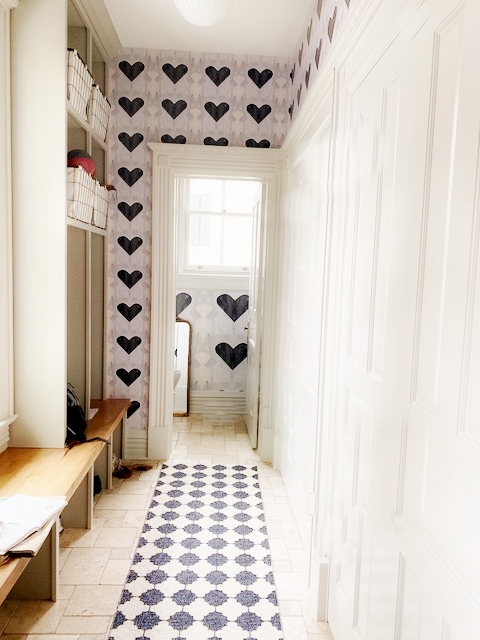
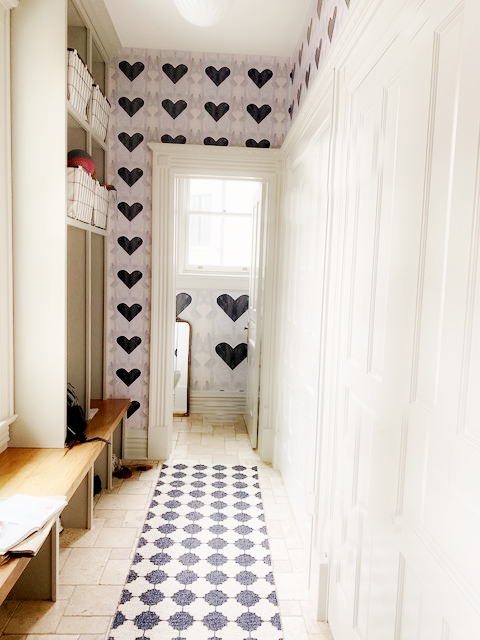
According to this season's designers, yes. Meghan Jay of Meghan Jay Design told Good Housekeeping directly that thinking in small doses makes just as much impact: "Today, it's used more selectively: on ceilings, lining bookshelves, or wrapping niches." For one powder room, she framed the paper within the existing paneling so the finished effect "feels intentional and tailored," reading "more like decorative millwork or a piece of art than traditional wallcovering" rather than a blanket treatment. That's the shift — wallpaper chosen and placed the way you'd place a single painting, not applied the way you'd paint a whole wall one color.
Where else are designers applying that same restraint?
On the ceiling and inside built-ins — both places that contain the pattern to one considered surface instead of the whole room. New York-based designer Kelsey Matyas of Kelsey Deirdre Designs uses the ceiling for exactly this kind of placed intensity: "Wallpapering overhead is about embracing every surface in a room, ensuring no detail is missed, and every angle feels considered." Yena Jung of By Yena Designs takes the same logic inside a living room built-in, choosing a floral pattern for the paneling because "it's the perfect way to add a pop of color or pattern and create texture on a wall" — without covering the room in it. And Lauren Williams of MV Architects treats the powder room itself as the contained opportunity: a compact space built for exactly the kind of bold, self-contained statement a full room can't pull off as cleanly.

Why does restraint actually make a pattern feel more considered, not less?
Because a single, contained decision reads as intentional, while blanket coverage reads as default. The modernist architect Ludwig Mies van der Rohe made the case for exactly this kind of editing a century ago with two words that still hold: "Less is more." The Japanese novelist Junichiro Tanizaki made a more specific version of the same argument, writing that beauty lives "not in the thing itself but in the patterns of shadows, the light and the darkness that one thing against another creates" — a room gains more from what it contains carefully than from what it covers completely.
Henri Matisse, writing about his own decorative work, described the effect he wanted a considered surface to have on a room: "an art of balance, of purity and serenity devoid of troubling or depressing subject matter... a mental balm." And Georgia O'Keeffe, describing how she arrived at the essential form of anything she painted, put the same principle in plainer terms: "it is by selection, by elimination, by emphasis, that we get at the real meaning of things." A single wallpapered niche or ceiling, chosen deliberately, does more work than four walls of the same pattern asked to do everything at once.
"Nothing is more simple than greatness; indeed, to be simple is to be great." — Ralph Waldo Emerson

How does this apply to a wallpaper pattern that started as a real painting?
It applies more, not less — because a pattern with real painterly depth rewards being seen up close, in one place, the way you'd look at an actual painting. William Morris, the founding figure of hand-drawn wallpaper design, made this case in an 1880 lecture, arguing that "simplicity of life, even the barest, is not a misery, but the very foundation of refinement." Every pattern in the Flourish and Lavish collections starts as one of my own paintings before it's composed into a repeat — which is exactly why a single wallpapered powder room or niche, done in one of these patterns, functions less like coverage and more like hanging a piece of art with real depth to it.
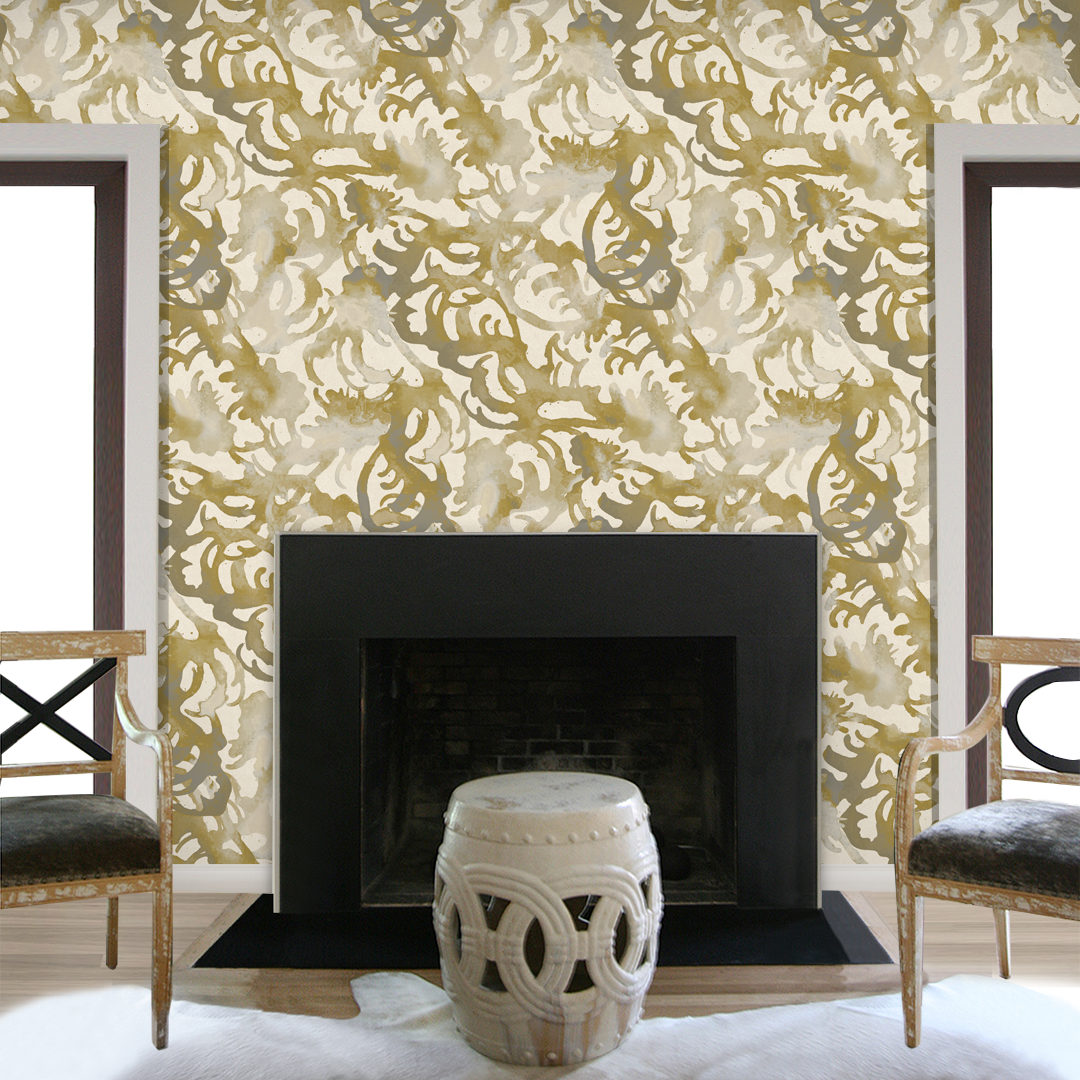
See the full wallpaper collection, including Flourish Marigold and Grey and Lavish Blue Grey shown here, and browse the original paintings these patterns are drawn from.
Frequently Asked Questions
Should wallpaper cover an entire room or just one area?
This season's designers increasingly recommend using wallpaper selectively — on a ceiling, inside a niche or built-in, or in a contained space like a powder room — rather than wrapping every wall.
Where does "small dose" wallpaper work best?
Powder rooms, ceilings ("the fifth wall"), bookshelf backs, and the interiors of built-in cabinetry are the spots designers are naming most often for a single, considered application.
What makes Angela Simeone's wallpaper different from a standard printed pattern?
Every pattern starts as one of Angela Simeone's own paintings before it's composed into a repeat, so the finished wallpaper carries real painterly depth rather than a flat, engineered print.
Is this wallpaper printed to order?
It's printed on a single luxurious 20 oz vinyl with a raw-silk, glimmering sheen, sold direct and to the trade.
Sources: Good Housekeeping, "These Wallpaper Trends Will Be Everywhere in 2026, According to Designers" (Meghan Jay, Kelsey Matyas, Yena Jung, Lauren Williams; Feb. 2026); Ludwig Mies van der Rohe, widely documented modernist maxim; Junichiro Tanizaki, "In Praise of Shadows" (1933); Henri Matisse, "Notes of a Painter" (1908); Georgia O'Keeffe, 1922 statement; Ralph Waldo Emerson, essays; William Morris, "The Beauty of Life" (1880 lecture).
See the full wallpaper collection at angelasimeone.com.