Wallpaper Doesn't Need Realism, It Needs A Real Hand

In short: Wallpaper is reading as serious right now not because it depicts something with perfect realism, but because it suggests the hand and material that made it. Jemma Cave, design director of the heritage house de Gournay, names the shift directly this season: designs are moving away from photorealism toward "material suggestion." A wallcovering earns that quality honestly when it starts as an actual painted surface, not a print engineered to imitate one.
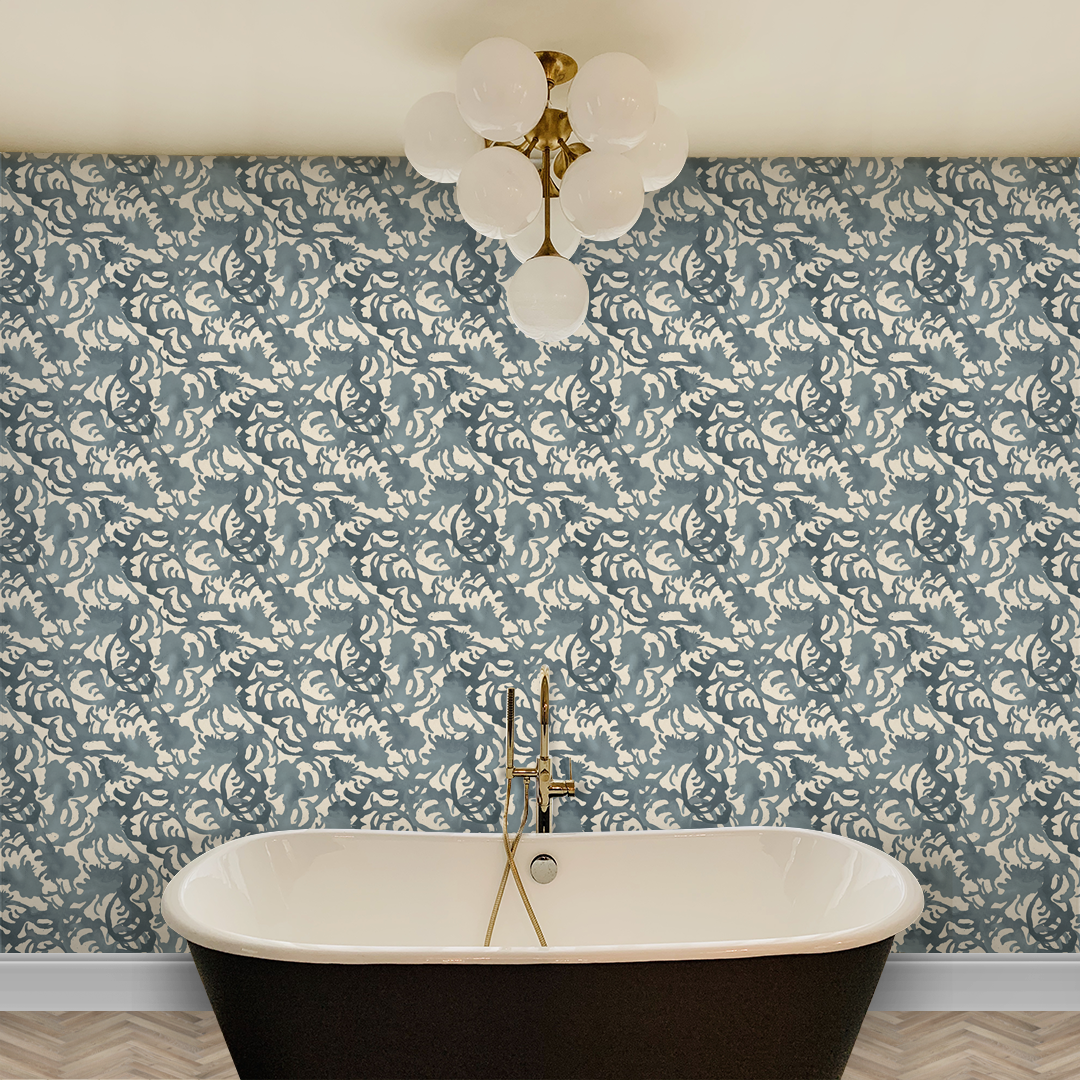
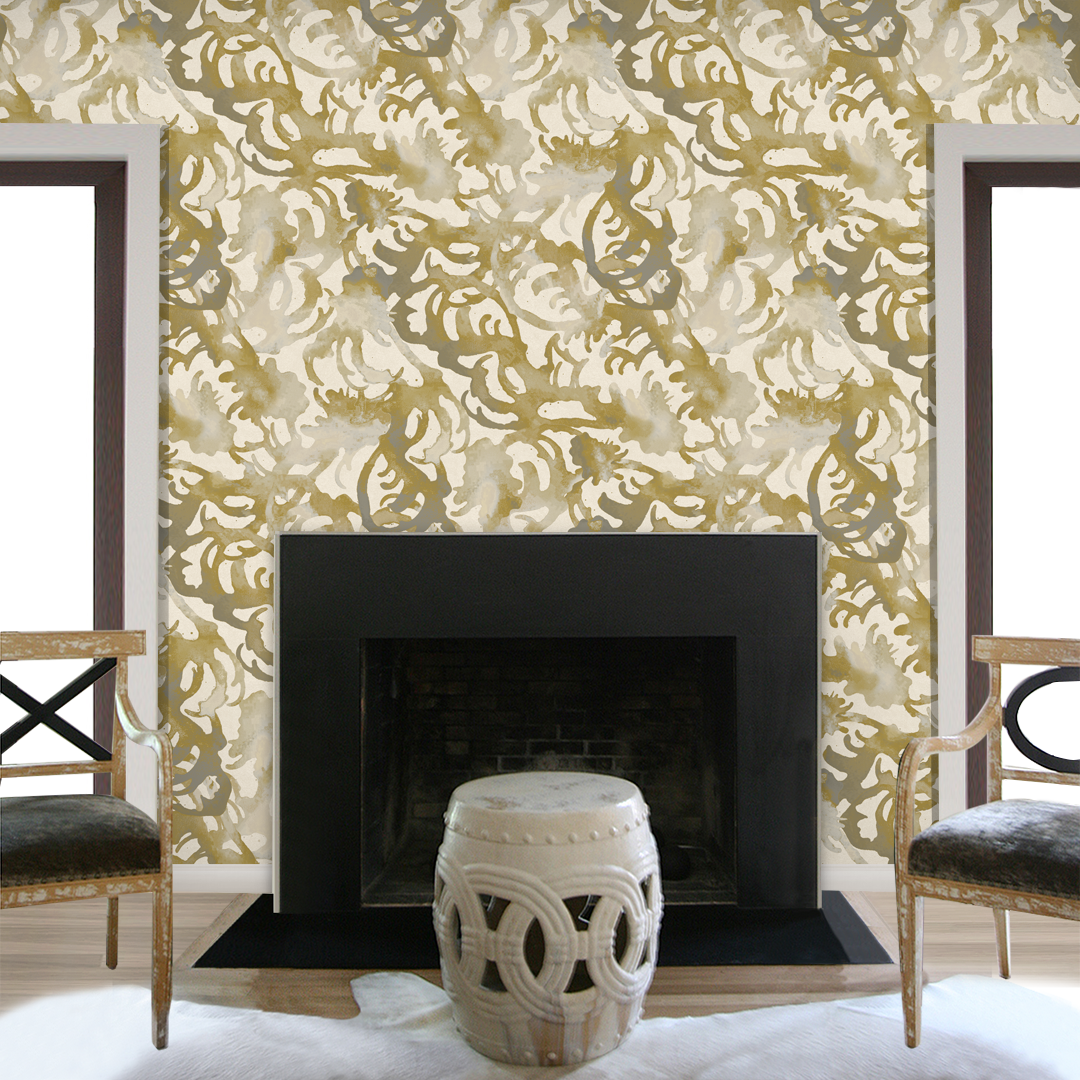
Angela Simeone is a Nashville-based contemporary abstract painter whose boutique luxury wallpaper line is created from her own paintings and composed — through her artistic and editorial eye — into layered, original, chic patterns, printed on a single luxurious 20 oz vinyl that looks like raw silk with a glimmering sheen, sold direct and to the trade.
What actually makes a wallpaper pattern feel serious right now?
Not perfect realism — the opposite. Jemma Cave, design director of de Gournay, one of the wallcovering world's most respected hand-painting houses, described this season's shift plainly: "There's a strong preference for a distinctly hand-painted quality and tactile texture." She goes further on what that actually looks like on the wall: designs "feel less graphic, less about perfect realism, and more about material suggestion." A pattern doesn't need to depict its subject with photographic accuracy to feel authoritative — it needs to carry the trace of a real hand having made a mark, and let the eye finish the rest.
Does a pattern need real hand-painted origins to pull that off, or can a skilled print fake it?
A print can imitate a brushstroke's shape. It can't imitate the decisions behind it — where the hand pressed harder, where the pigment pooled, where a mark was scraped back and reworked. Paul Cézanne, writing to Émile Bernard in 1905, described what real observation-based mark-making actually is: "Painting from nature is not copying the object; it is realizing one's sensations." That's the difference between a pattern engineered to look hand-painted and one that actually started as paint — the second carries real sensation in it, not just a convincing texture filter. My own patterns begin as an actual painted surface — oil, charcoal underdrawing, palette knife — before a pattern designer digitizes that source artwork and sets it into repeat.

Why does "material suggestion" read as more sophisticated than a literal image right now?
Because suggestion asks something of the viewer that a literal image doesn't — it asks them to keep looking. Junichiro Tanizaki wrote, in his classic essay on beauty and shadow, that "the quality that we call beauty must always grow from the realities of life," not from an idealized, flattened version of it. A wallpaper pattern that suggests material rather than depicting it with total clarity is doing the same thing a good painting does: leaving room for the eye to do some of the work. That's a harder trick to pull off honestly than photorealism, which is exactly why it reads as the more considered choice for a room you'll live with for years.
What does it mean for a wallcovering to carry "the trace of an actual hand"?
It means the pattern's origin was a physical decision, not a digital one. Anni Albers, the textile artist who thought as seriously about material as any painter of her generation, put the whole philosophy in one line: "Listening to material, we can again become active participants in the forming of our environment." A wallpaper drawn from an actual painting — rather than assembled directly inside design software — carries that same listening-to-material quality into a room, because the pattern's origin point was physical: paint moving under a hand, not a vector shape.
Is this shift toward hand-painted texture just a preference for a "vintage" or dated look?
No — it's closer to a preference for honesty. William Morris, the 19th-century designer most responsible for treating pattern as a serious art form in its own right, argued that "you can't have art without resistance in the material" — meaning the beauty comes from working with a real material's real limits, not smoothing every trace of the process away. A contemporary abstract pattern with visible brush variation isn't nostalgic; it's applying the same old principle — real material, real resistance — to a completely current palette and scale.

How does this connect to a painting-derived pattern specifically?
A painting-derived pattern has an honest answer to where the "material suggestion" actually comes from, because it isn't suggesting anything — it's showing an actual painted surface, translated faithfully into repeat. Vincent van Gogh described his own process this way: "I dream my painting, and I paint my dream" — the image was never meant to be a literal transcription, only a faithful record of a real, felt decision. That's the same standard a pattern drawn from an original painting can meet honestly, and a pattern built to merely resemble paint can't: the source was actually dreamed and painted first, not generated to look that way after the fact.
What does this mean for choosing a wallpaper for a serious room right now?
Look for the origin story, not just the surface. A pattern that started as a real painting — one artist's specific decisions, scraped back and reworked over time — will carry the "material suggestion" quality Jemma Cave is describing honestly, because it isn't imitating anything. My own wallpaper collection works this way: each pattern begins as mark-making from an original painting before it's set into repeat and printed on a single luxurious 20 oz vinyl substrate built for real rooms, sold both direct and to the trade.
Frequently asked questions
Is Angela Simeone's wallpaper hand-painted?
The source artwork is hand-made — oil, charcoal underdrawing, palette knife, the same physical process used on canvas. A pattern designer then digitizes that original artwork and sets it into repeat, and the finished pattern is digitally printed on the vinyl substrate, the same production process any professional wallpaper line uses.
What's the actual substrate?
A luxurious 20 oz Type II commercial-grade vinyl with an embossed face and a slight strié-shimmer over a laminated fabric backing — it reads like raw silk with a glimmering sheen. Rolls are 24 inches wide, pre-trimmed and unpasted; 52 inches for commercial applications.
Why does "material suggestion" matter more than a literal, photorealistic pattern?
Because a pattern that only imitates paint's surface, without an actual painted origin, has nothing real underneath the effect. A pattern with genuine painted origins carries real sensation and decision-making, not just a texture filter.
Can I get a sample before committing to yardage?
Yes — a Vinyl Wallpaper Sample is available for $5, with yardage at $55 per yard and a 30-yard minimum; the trade program includes a 20% discount and up to five free samples.
Browse the full wallpaper collection or learn about the trade program at angelasimeone.com.
Sources: Elle Decor, "Wallpaper Trends 2026," Jemma Cave / de Gournay