Hotel Art Is Architecture Now, Not An Afterthought

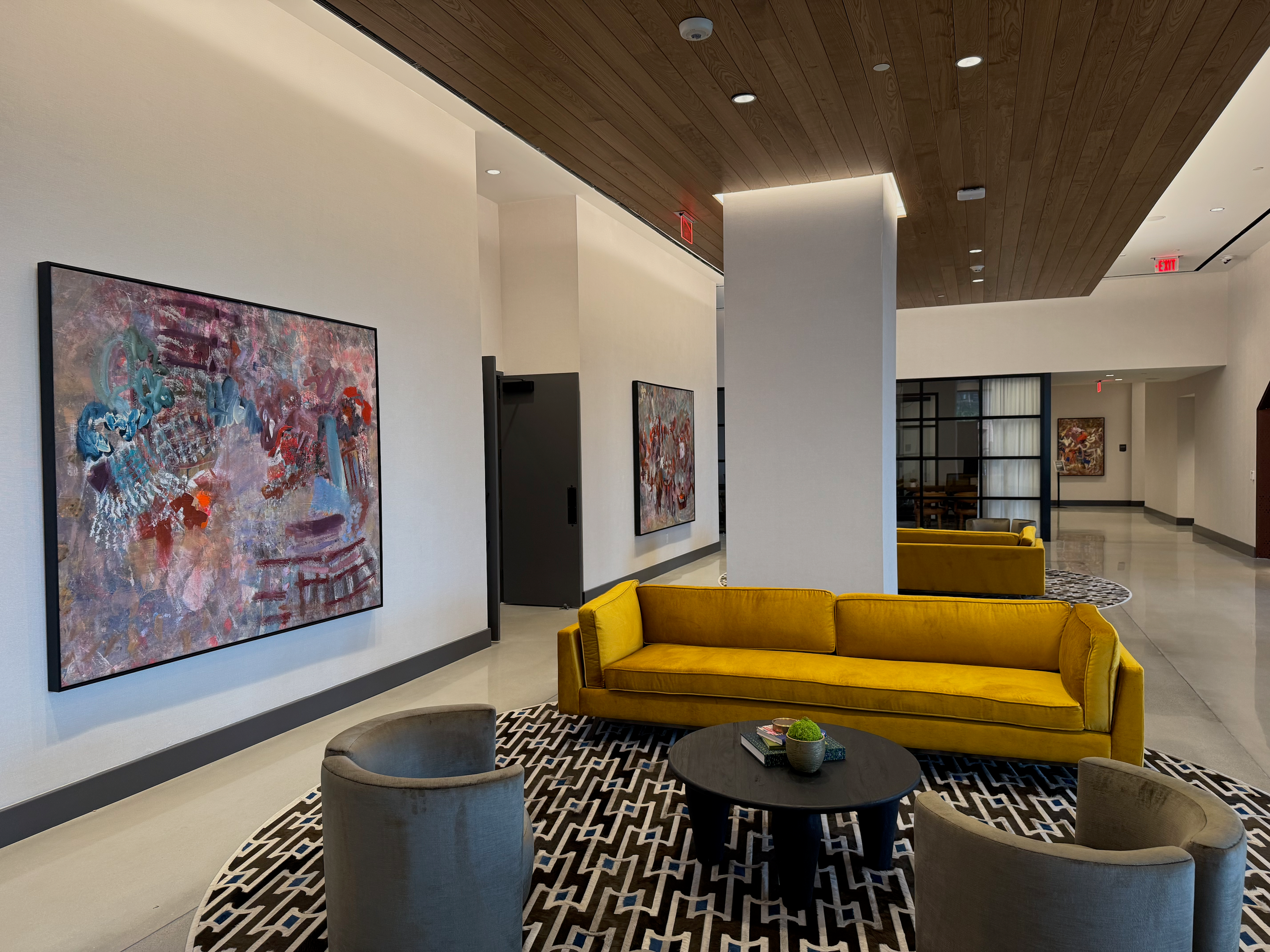
An Angela Simeone original in the lobby at Peabody Union, Nashville — Simeone is the most-placed artist in the building, with 5 originals.
In short: 2026's hospitality design trend isn't hanging more art — it's embedding art into a project from the architecture up, so it reads as part of the building rather than a decorative afterthought. Wimberly Interiors' 2026 forecast names this shift directly. Angela Simeone's placements at the Conrad Nashville (33 originals, Champalimaud interiors) and Peabody Union (5 originals, most-placed artist) were built this way from the start — commissioned into the design, not added after the room was finished.
Angela Simeone is a Nashville-based contemporary abstract painter whose boutique luxury wallpaper line is created from her own paintings and composed — through her artistic and editorial eye — into layered, original, chic patterns, printed on a single luxurious 20 oz vinyl that looks like raw silk with a glimmering sheen, sold direct and to the trade.
Hotel Art Is Architecture Now, Not An Afterthought
For years, art in hospitality projects arrived last — after the architecture, the finishes, the furniture plan, once someone remembered the walls were still bare. Wimberly Interiors' 2026 hospitality forecast names the shift away from that habit directly: art is moving "from something hung to something embedded," where sculptural walls, dimensional surfaces, and site-specific commissions turn corridors, lobbies, and stairwells into part of the story a building tells, not decoration applied to it afterward.
Hussain Kamal, Managing Principal at Wimberly Interiors, puts the standard plainly: "Art should not be an afterthought, it should be a line of poetry you walk through to get to your room." (Wimberly Interiors, "Interior Design Trends 2026: Authenticity, Resonance, and Resilience," December 2025.) That's the difference between a lobby with art in it and a lobby built around the art.
What Does "Embedded" Actually Look Like In A Real Project?
It means the art is part of the brief from the start, not a punch-list item. Damien Follone, an Associate Principal at Wimberly Interiors, frames the deeper goal behind the trend: "Authenticity is not a theme; it's a conversation with the people, the land, and the memory of a place." Art commissioned into a project's architecture is one of the clearest ways a hotel or restaurant has that conversation — a piece made for that specific wall, at that scale, rather than sourced to fill it.

An original by Angela Simeone in a private suite at the Conrad Nashville — interiors by Champalimaud Design.
Does "Local" Have To Mean Regional, Or Can It Mean The Working Artist Down The Street?
Both, and the working artist is often the more direct answer. Deepu Mahboobani, a Principal at Wimberly Interiors, describes what this looks like when it's done well: "We craft narratives, infusing the local culture, craftsmanship, indigenous materials and patterns to echo the identity of a destination…we introduced local wood species, Balinese batik or ikat patterns as accents and collaborated with local artists to create an authentic experience rooted in tradition and culture. Such authentic experiences support local community, reinforces sustainability goals and helps guests build an emotional connection." A Nashville painter's originals inside a Nashville hotel is the same idea in its plainest form — no import, no marketing gesture standing in for the real thing.
Erin Nichols Walker, another Associate Principal at the firm, points at the quality that separates a commissioned original from a piece sourced to match a color scheme: "What moves me is when a detail is flawless on paper but still carries the warmth of the hand in reality." A painting built up in oil over weeks, scraped back and reworked until it settles, carries exactly that — a surface a generated image or a mass-produced print can't fake.
What Should Go Into The Art Brief For A Hotel Or Restaurant?
The brief works best when it treats art as part of the architecture, not a finishing touch: the scale and sightlines of the specific wall, the guest experience the space is trying to create, and enough lead time for an original to be made rather than sourced off a shelf. Liana Hawes Young, an Associate Principal at Wimberly Interiors, makes the case for pieces that carry real history into a space rather than filling it with something generic: "Some of the most powerful design moves are the gentle ones — giving a beautiful object a second life and letting it shift the entire mood of a space." A commissioned original does that from day one, and keeps doing it for as long as the building stands.
How Does This Show Up At The Conrad Nashville?
At full scale. The Conrad Nashville carries 33 originals across its private suites, public and gallery areas, and both dining rooms — Blue Aster and Thistle & Rye — making Angela Simeone the most-placed artist in the building, planned into Champalimaud Design's interiors rather than added once the rooms were finished. Peabody Union follows the same model at a smaller scale: 5 originals, again the most-placed artist in the building. Large-scale and multi-panel work is built with no upper size limit — canvas tiles that reassemble seamlessly on site for lobbies and atriums — so the anchor piece a project needs doesn't have to be sourced from what already exists; it can be made for the wall it's going on.
Paintings That Show The Range
Two ready-to-ship originals at the scale hospitality projects tend to reach for, alongside the commission process used for site-specific work:
Aubergine Darkest Green Plum White Canvas Painting · original oil on canvas, 61" × 48" · $5,850 — moody, layered, built for a room at its best after dark.
Navy Grey Yellow Glow Painting · original oil on canvas, 47" × 77" · $5,800 — a large dark field with light breaking through, built to run a room.
→ Browse all available paintings
→ Start a commission for a specific space
FAQ
What does "embedded" art mean in hotel design?
Art planned into a project from the architecture and interior design phase, made or chosen for a specific wall and scale, rather than sourced and hung after the space is finished.
How early should a hotel or restaurant commission art in a project?
At the concept stage, alongside the architecture and interiors, so scale and lead time can be planned rather than rushed at the end. Angela Simeone's commission process runs roughly four weeks deposit to delivery, with longer lead times for large-scale or multi-panel work.
Can one artist supply both the lobby anchor piece and the secondary works?
Yes — the Conrad Nashville and Peabody Union placements both work this way, with one artist's originals across public spaces, private suites, and dining rooms, which keeps the visual story consistent throughout the building.
Does a hospitality commission cost more than sourcing ready-made art?
Architectural and multi-panel commissions are priced by quote, scaled to the project. Ready-to-ship originals ($1,850–$9,850) are also available where a project needs work sooner than a commission timeline allows.
Sources
- Hussain Kamal, Deepu Mahboobani, Damien Follone, Liana Hawes Young, and Erin Nichols Walker, in "Interior Design Trends 2026: Authenticity, Resonance, and Resilience," Wimberly Interiors / WATG, December 11, 2025 (updated January 8, 2026).